


Locate the problem before making the style tighter: a collar collision, pulling at the front and a slipping covering need different checks.
Start with what you will actually wear and which details you want visible. A useful result is a hairstyle you can sit, turn and travel in comfortably. The Gulf style hub connects the plan with clothing, jewellery and makeup so the same area is not designed three separate times.
Identify the interaction before adding hold
| Observation | What to check separately | First action | Useful check |
|---|---|---|---|
| Bun pushes against a high collar | Gathering position versus garment height | Compare less bulk or another comfortable position | Turn and sit without contact |
| Front feels pulled before covering | Band, pins and gathering tension | Loosen and rebuild without pulling the hairline | Comfortable before any extra layer |
| Pressure appears only after a layer | Cap edge, drape or collar contact | Add layers one at a time in a private trial | Which addition recreates pressure? |
| Sheila slips after gathering changes | Cap fit, shape and drape | Compare one fit adjustment without tightening roots | Does coverage hold during normal movement? |
These are observations, not proof of why a headache occurs. “Low” alone does not guarantee comfort.
Map the neckline and visible space
Put on the garment or bring a photograph that shows the actual front, side and back of its collar. Note where embroidery, buttons, a necklace or the scarf's edge sits. These details determine the space available to hair more accurately than a label such as formal or modest.
Choose the area you want to show. A detailed collar may remain clearer with hair away from it; a simple collar may leave space for loose lengths. These are options to compare, not rules for a particular body shape.
| Outfit feature | Two arrangements to compare | What to check |
|---|---|---|
| High collar | Low gathering and hair clear behind shoulders | Does hair press or catch at the collar? |
| Detailed neckline | Gathered hair and one-sided loose placement | Which leaves your chosen detail visible? |
| Plain neckline | Loose lengths and a low bun | Which balance do you enjoy with jewellery? |
| Covered hair | Lower-volume loose gathering and another comfortable position | Where does the covering rest without pressure? |
Use Gulf wedding guest outfit planning to settle arrival and indoor arrangements first. A reference image cannot answer whether you intend to uncover hair in a particular space.
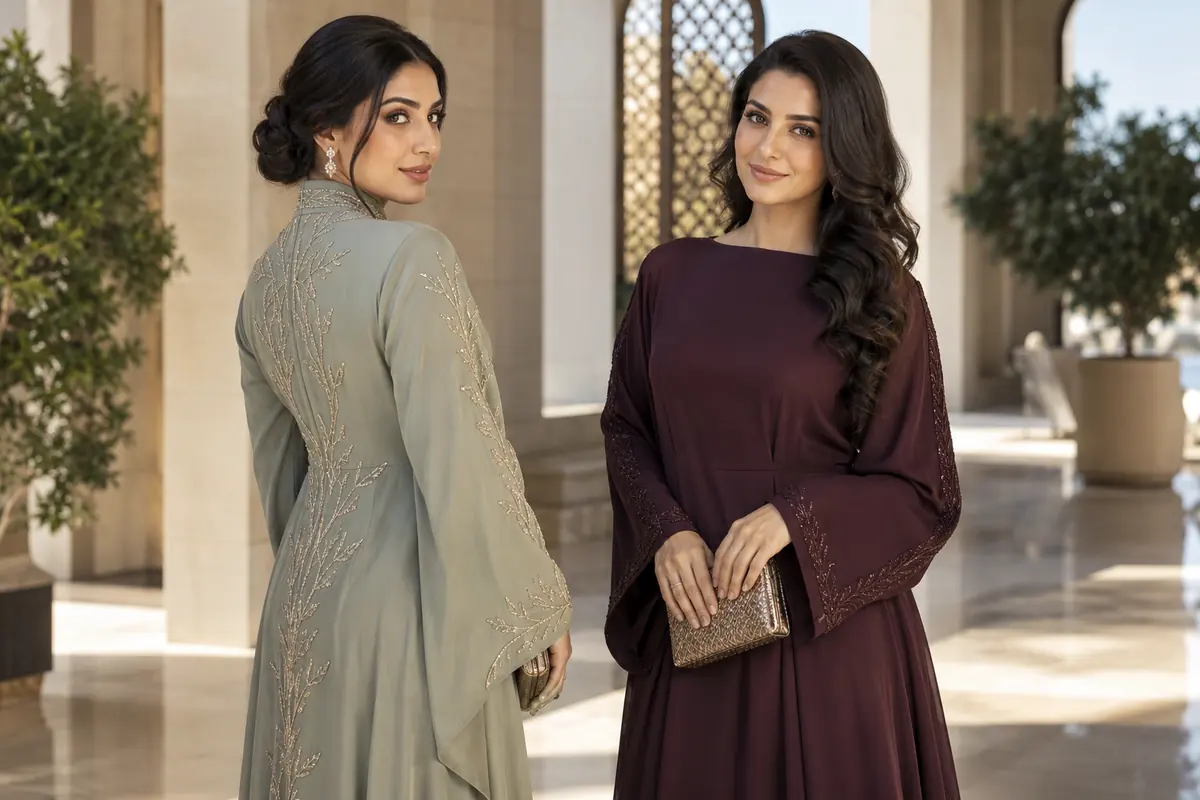
Try a low gathering without forcing a sleek hairline
Begin with a familiar, comfortable parting. Gather hair loosely at a position that does not collide with the collar. Ask the stylist to support the shape without pulling the front tight. The location can be low without sitting directly on the neck or garment fastening.
Check from the side. A bun that looks good from the front may press against the chair back or catch a high collar when you turn. Sit for several minutes and move normally before deciding. If pins or a band press, adjust their position rather than accepting discomfort as the price of an occasion style.
With short hair, discuss a smaller gathered effect, a clip or another arrangement achievable with your own length. You do not need a large bun simply because the illustration shows one. How to talk to your stylist helps turn a preference into a practical brief.

Compare side placement with loose lengths
If you want loose hair, test where it sits beside the garment. Place it on one side, then behind both shoulders. Keep the same parting and clothing for the comparison. Notice whether the neckline, earring or brooch you want to show remains visible.
Turn your head and sit. Does the hair return to a comfortable position, or need adjusting after every gesture? A lightly secured side may be more useful than a loose arrangement that keeps catching a necklace. Check the fastening without increasing tension to hold the entire shape rigid.
For curls or waves, plan around the texture you actually have and how it behaves in your trial. A polished illustration does not establish that your hair will hold that shape for a whole evening. Summer humidity hair planning covers preparation when your real route includes warm or humid conditions.

Plan covered hair with the real sheila or scarf
Bring the exact covering and any underlayer you normally use. Test where a loose gathering fits without pressure from the collar or fabric. Consider low volume before adding padding, hairpieces or an unnecessarily large shape.
AAD's guidance on pulling hairstyles links repeated tension with hair loss and recommends loose gathering beneath coverings. Loosen a style that hurts or pulls. Persistent hairline changes need healthcare advice, not a tighter arrangement.
Wear the complete setup for several minutes while sitting and turning. Check the pressure points yourself; appearance cannot prove comfort. If hair stays covered throughout the event, you may prefer a simple practical arrangement rather than an elaborate hidden style. If coverage changes, ask about private arrangements and prepare a realistic adjustment.
Use hairstyles under hijab for daily planning and sheila draping with necklines for the visible fabric. Keep coverage preferences personal; a venue description does not decide them for you.

If loosening makes it slip: test the layers separately
Begin with the comfortable base
In a private trial, check hair gathered without the cap or sheila, then add the cap, then the sheila, then the real collar and outer layer. This sequence locates an interaction; it does not diagnose pain. If the gathering already pulls, changing fabric cannot resolve that pull by itself.
If discomfort appears with one added layer, stop and adjust its placement or fit rather than tightening every layer together. Keep the preferred coverage while considering another comfortable arrangement. There is no need to add volume solely to reproduce an illustration.
Distinguish staying covered from staying rigid
Test sitting, looking sideways and putting on the outer layer. A little natural movement is not automatically failure. If coverage slips beyond what you want, compare one drape or cap-fit change. Do not use more hairline tension as the automatic answer.
A collar collision is a separate geometry problem: move the gathering slightly or reduce bulk, then repeat with jewellery. Do not tolerate pain for a photograph or claim that a particular fabric cures headaches. If pain continues after adjustment or you notice persistent hairline changes, seek appropriate healthcare advice.
Keep the technique proportionate to the occasion
Ask what can be achieved with your own hair before adding extensions or a new treatment. A style's complexity is not a measure of how respectfully you are dressed. A comfortable low gathering can be as intentional as a detailed updo.
If heat is used, follow tool directions and avoid unnecessary repeated passes. AAD's hair-damage advice favors lower heat and less frequent use. A stronger setting is not a guarantee of a better evening result.
If you are dealing with breakage, begin with hair breakage versus shedding and tell the stylist about the concern. Do not combine a cosmetic trial with unplanned chemical changes just to chase the exact colour or volume of a picture.
Write a brief the stylist can use
Include the event setting, the real collar, whether hair is covered in each space, your preferred parting, expected time and any comfort constraint. A useful example is: “Low loose gathering, no pulling at the front, detailed collar visible, sheila during arrival, earrings must not catch.”
Bring two references for placement rather than a gallery of unrelated finished looks. Explain what you like in each: the low location, visible wave or open space around the neckline. Explain what you do not want, such as added height or heavy extensions.
Use a bridal hair trial guide for a longer appointment structure when appropriate; a guest's needs may be much simpler. Ask what to bring and how your hair should be prepared according to the booked service.
Test the style through an ordinary mini-rehearsal
Reserve around fifteen quiet minutes after choosing the arrangement. Put on the real collar and coverage, sit, turn, stand and reach for your bag. Take front and side photos for your own reference. Note any point needing adjustment before the final appointment.
Ask how to make one small correction, and how to remove the pins or accessories later without pulling. Do not assume you can safely dismantle an unfamiliar structure by tugging it loose at night. Agree a simple method with the stylist.
Plan event makeup touch-ups so touching the face does not constantly disturb hair or fabric. A useful evening routine contains only the adjustments you expect to need.
A hypothetical example: the collar changed the bun position
Imagine Dana selects a low bun from a reference. At the trial, her high embroidered collar presses on the gathering when she turns. The stylist changes the placement slightly, reduces bulk and checks the actual sheila over it.
Dana sits comfortably, tests her earrings and chooses no added hairpiece. This is an illustrative scenario, not a real client's result. The lesson is to test the relationship between garment and hair rather than treating the photograph as a complete plan.
Her final brief records the placement, parting, fastening and coverage sequence. The hairstyle succeeds because it works with her evening, including arrival and departure.
Frequently asked
What if a low bun presses against a high collar?
Test sitting and turning with the actual collar. Compare slightly different gathering placement or less bulk, then repeat with the covering and jewellery. Low placement alone does not guarantee clearance or comfort.
Should I tolerate a pulling style because it holds better?
Loosen an uncomfortable style rather than accepting pain for the occasion. Test the gathering and layers separately. Persistent discomfort or hairline changes need appropriate healthcare advice, not a tighter remake.
Why does the sheila slip after I lower the bun?
Changing the gathering can change the shape beneath the covering. Check cap fit, drape and collar contact separately; appearance cannot establish one cause. Compare a comfortable arrangement rather than compensating with more root tension.
Can I keep preferred coverage without a large hairstyle underneath?
Yes. Test a practical low-volume arrangement with the actual covering and underlayer. The illustration's volume is not a requirement, and a fully covered event does not demand an elaborate hidden hairstyle.
Do I need extensions to make the style work?
Not automatically. Compare what is achievable with your own hair. Added weight, installation and removal bring practical questions; they do not solve every collar or fit problem.