

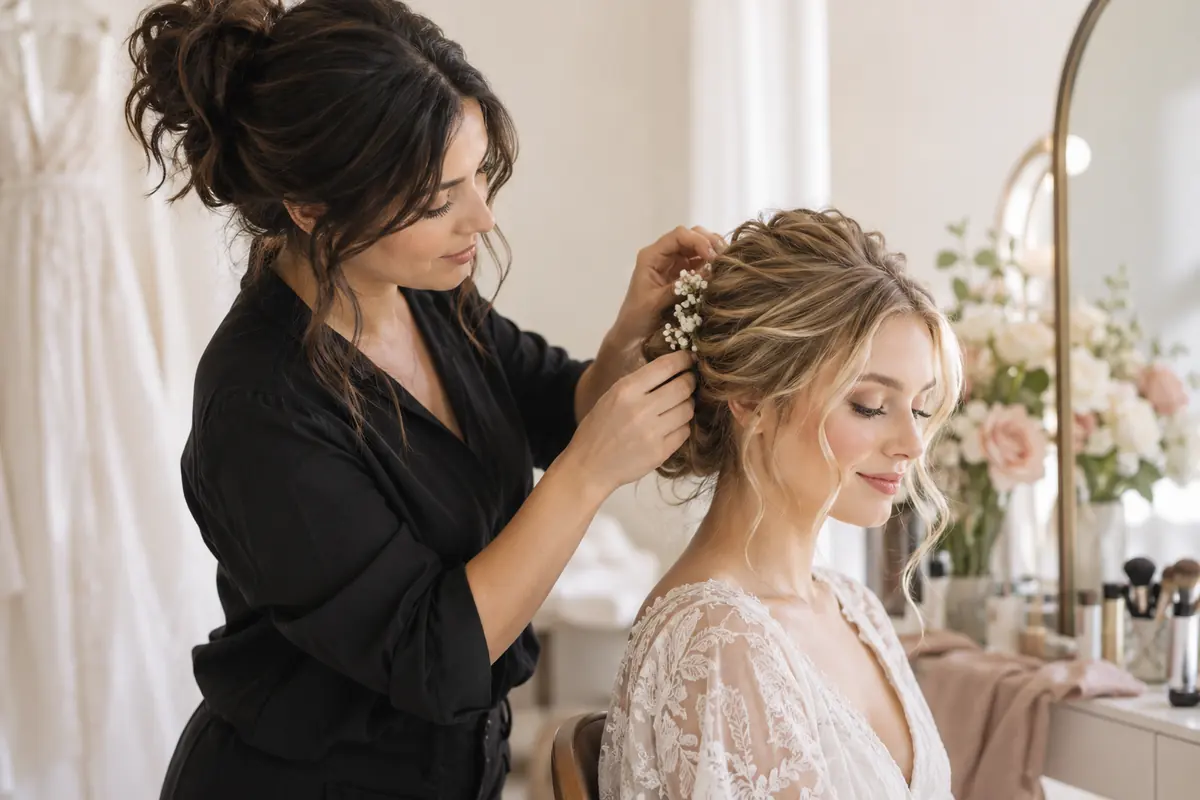
A bridal hair trial is two to three hours of a senior stylist's time, booked two to three months before the wedding, and you should expect to pay for it. What you should not expect, although nearly every guide on the subject quietly assumes it, is to spend that paid time guessing.
The standard advice treats the trial as round one: walk in with a Pinterest board, try a few directions, see what sticks, book a second trial if the first one misses. That framing made sense when the only way to see a style on your own face was to sit in a chair while someone built it. It does not make sense anymore. The render on your own selfie is round zero. The paid trial is round two, confirmation, not exploration. This guide covers the logistics every bride asks about, timing, cost, the checklist, what actually happens in the chair, and the one step that changes the economics of all of it.
The quick answer
Book the trial two to three months out. Block two to three hours. Expect to pay, typically $75–250 for hair alone, $150–400 with makeup. Arrive with clean, dry, product-free hair, a white top, your dress photos, your veil, and a shortlist you have already tested on your own face.
| Question | Short answer |
|---|---|
| When to book | 2–3 months before the wedding; earlier in post-Eid and Sept–Nov Gulf peaks |
| How long it takes | 2–3 hours for hair alone; half a day with makeup |
| What it costs | $75–250 hair only; $150–400 hair and makeup combined |
| Free or paid | Paid, sometimes credited toward the wedding-day booking |
| Hair on arrival | Clean, completely dry, product-free (confirm, some stylists prefer day-old) |
| What to bring | 3 photos you love, 2–3 you don't, dress and veil photos, a white top, your renders |
| How many trials | One, if you arrive decided; 2–3 if you arrive guessing |
The rest of this piece unpacks each row. The full month-by-month countdown, colour at six months, trial at two to three, cut at three weeks, gloss in the final week, lives in the wedding hair planner; this is the deep version of the trial stage.
Two to three months out, and the season makes it stricter
Book the trial two to three months before the wedding. Closer than that and a bad surprise has no calm exit; further out and your hair will not match itself, length, colour, even how your face reads, by the time the day arrives.
Two to three months is the window where both halves of the problem are solved. Your hair is close enough to its wedding-day state that the trial is an honest preview. And there is still enough calendar left to change direction, rebook, or, worst case, find a different stylist without the decision being made under panic.
The MENA wedding calendar makes the rule stricter, not looser. The post-Eid season is running right now, and the Gulf peak from September to November is the heaviest stretch of the salon year. Senior stylists' wedding diaries close from the back of the calendar forward: the wedding-day bookings land first, and trials get squeezed into weekday mornings or pushed to junior colleagues. If your date sits inside a peak, treat two to three months as the minimum and book the moment your dress direction is settled.
One sequencing rule the thin guides skip: colour comes before the trial, not after. A trial styled on hair that is about to change shade is a preview of a head you will not have. If the plan involves colour, a move toward butter blonde, a deepening gloss, a root plan, settle it on the bride's colour timeline first, so the trial happens on the hair you will actually wear.
What it costs, and whether you pay full price
Expect $75–250 for a hair-only trial and $150–400 for combined hair and makeup, and expect to pay it. The trial is not a sales meeting; it is the actual service, performed completely, by the person whose time is the product.
The range is wide because the inputs are wide: a junior stylist in a neighbourhood salon and the senior artist at a bridal-specialist house are not selling the same hour. In MENA capitals the pricing often arrives shaped differently, folded into a bridal package, quoted per look rather than per hour (relevant when the henna night and the hall are separate styles), or carrying an on-location surcharge if the team comes to you on the day.
Three questions to ask when you book, before money moves:
- Is the trial fee credited toward the wedding-day booking? Many salons apply some or all of it. Some don't. Both are fine; surprise is not.
- Will the person doing my trial be the person doing my wedding day? A trial with one stylist and a wedding morning with another quietly deletes most of the trial's value.
- What does the day-of quote include? Travel, an assistant, touch-up presence through the evening, veil removal mid-event, each is sometimes included and sometimes a line item.
A genuinely free trial deserves mild suspicion rather than gratitude. It usually means the trial is brief, junior-staffed, or priced into the package somewhere you cannot see it.
The checklist: what to bring
Bring three photos of styles you love, two or three you don't, your dress and veil, a white top, and the render of the style on your own face. Arrive with clean, dry, product-free hair. That is the whole list; here is why each item earns its place.
- Three photos you love. Not thirty. Three forces you to decide before the chair, and the stylist can read a direction from three coherent references far faster than from a scroll session.
- Two or three photos you don't love, ideally near-misses. "This, but I hate the height" teaches a stylist more than another photo you like.
- The render on your own face. The reference photos show the style; the render shows the style on you. It is the single highest-information object in the bag.
- Dress photos, front and back, neckline visible. The neckline decides more about the right style than the Pinterest board does.
- The veil or headpiece, the real one if it exists, a photo plus its weight and attachment type if not. A style that ignores the veil is half a trial.
- Extensions and accessories, if they are part of the plan. They change the physics of the style and need to be in the room.
- A white or cream top, close to the tone of the dress, so the mirror test reads true, the full logic is in what to wear to your hair appointment, which covers bridal trials specifically.
- Honest hair. Washed the night before, fully dry, no oils or leave-ins, unless your stylist asks for day-old hair, which some prefer for updos. Ask when you book.
What happens in the chair, hour by hour
Consultation first, the full style second, adjustments third, documentation last. Knowing the sequence keeps you from spending the consultation minutes on small talk and the final minutes rushing the photos.
The first 20–30 minutes are conversation and assessment. The stylist reads your hair, texture, density, length, condition, what it will and won't hold, against your references and the dress. This is where the render and the "don't love" photos earn their keep.
The next hour is the build: the style executed completely, not sketched. Pins, products, the veil placed, the headpiece seated. If the salon offers to "rough in" the shape to save time, decline politely; an approximate trial approves an approximate wedding day.
Then the adjustment pass. Softer at the front, lower at the nape, more or less around the face. Say the small things now, the trial is the only rehearsal where changes cost nothing.
The last twenty minutes are documentation, and they matter most. Photograph the finished style from the front, both sides, and the back, on your own phone, in daylight near a window and again in the salon's warm light. Then run the movement test: shake your head, lean forward, mimic a long hug. A bridal style is worn for eight hours of greetings and dancing, not for one mirror moment. Ask the stylist to note the products, the pin count, and the timing, that note is what makes the wedding morning repeatable.
The free trial you can run tonight
Before you pay for the salon trial, run the shortlist on your own selfie. This is the round-zero step: take a head-on photo in daylight, render the candidate styles on your own face in Mademoiselle's Hair Studio, and let the misses eliminate themselves for free.
The 2026 shortlist is friendlier to this method than any year in memory, because the season's direction, It-girl simplicity, the sleek low bun, glossy Hollywood waves, the bridal bob conversation, and the Gulf's broader shift toward khaleeji soft glam, is built on clean, legible shapes that render honestly. Build the shortlist itself with the face shape and neckline framework, then test it; the AI bridal hair try-on guide covers the mechanics in detail.
Studio prompt:
"Glossy Hollywood waves on my hair, deep side part, polished brushed-out S-waves with mirror shine, bridal finish, even daylight."
Studio prompt:
"Sleek low bun at the nape on my hair, centre part, smooth and polished with no flyaways, minimal and modern, soft daylight."
Two honest caveats, because the render is a decision tool, not a magic one. First, the render decides direction, not physics, it will not tell you whether the bun survives four hours of dancing in August humidity. That is exactly what the paid trial is for, which is the point: let the salon test endurance and execution, not direction. Second, bridal selfies are about as personal as a photo gets. The renders happen on your own image and stay yours, private by design explains precisely what that means and why it is non-negotiable for this use case in particular.
How many trials do you really need
One, if you walk in decided. Two or three is common, and most of the second and third are the price of arriving with a mood board instead of a decision.
Run the arithmetic. At $75–250 per round, an exploratory first trial plus a "narrowing it down" second is real money spent doing what a free render does in an evening. The render-first method does not make the trial unnecessary; it makes the second and third trials unnecessary, which is where the waste lives.
A second trial is still legitimate in a few cases: your hair changes significantly after the first (a big cut, a colour correction), you change stylists, or you are styling two genuinely different events, the henna night and the hall, with different teams. Those are new decisions, not re-guesses.
Questions to ask your stylist at the trial
Ask about endurance, logistics, and the morning itself, the style is already decided; the trial is where you interrogate everything around it.
- How will this hold through an outdoor evening, humidity, and dancing, and what is the touch-up plan?
- Will it be you on the wedding day, or a colleague, and if a colleague, can they see these photos and notes?
- How long will the style take on the morning, and what time does that mean you arrive?
- What should I do with my hair the night before, wash, sleep style, products?
- Which pins and products are you using, in case something needs an emergency fix mid-event?
- Where exactly does the veil attach, and who removes it during the evening without dismantling the style?
- What changes if I move the parting, add the headpiece, or drop the extensions?
- If the weather turns, what is the fallback version of this style?
Write the answers down before you leave the chair. The post-trial note is the difference between a rehearsal and a nice afternoon.
Walk in with a photo of you
The strongest brief at a bridal trial is a render of the style on your own face. Stock photos and saved reels show a style on someone else's bones, someone else's hairline, someone else's density; the stylist has to translate. The render removes the translation step, the conversation starts at adjust, not imagine.
The general grammar of briefing a stylist is covered in how to talk to your stylist; the bridal version adds one sentence worth saying as you sit down:
"This render is the direction, the softness around my face matters more to me than the exact height of the bun, so adjust the structure however my hair needs."
That sentence does two jobs. It tells the stylist what is fixed and what is negotiable, and it hands them the authority over physics while you keep the authority over direction. That division of labour is the whole philosophy of the render-first trial.
The trial was never meant to be round one. Render tonight, decide this week, book the chair for two to three months out, and walk in carrying a photograph of the bride you have already met.
Frequently asked
How long does a bridal hair trial take?
Plan for two to three hours for hair alone, and half a day if you combine hair and makeup. The first half hour is consultation, the style itself takes about an hour, and the rest is adjustments, photographs from every angle, and notes. Book a morning slot and keep the rest of the day light.
When should I schedule my bridal hair trial?
Two to three months before the wedding. That is close enough that your hair length, colour, and face are what they will be on the day, and far enough out to change direction calmly if the trial surprises you. In MENA peak seasons, the post-Eid rush and September to November in the Gulf, book the slot earlier, because senior stylists' wedding diaries close first.
What should I bring to my hair trial?
Bring three photos of styles you love, two or three you don't, photos of your dress from the front and back, the veil or headpiece, and any extensions or accessories you plan to wear. Wear a white or cream top, arrive with clean, dry, product-free hair, and bring the render of the style on your own face, it is the most useful reference in the bag.
How much does a wedding hair trial cost?
Typically $75–250 for a hair-only trial and $150–400 for hair and makeup combined, depending on the stylist's seniority and the city. In MENA capitals, trials are often quoted inside a bridal package rather than as a separate line, so ask whether the trial fee is credited toward the wedding-day booking before you commit.
Do you pay full price for a hair and makeup trial?
Usually, yes. A trial is two to three hours of a senior stylist's chair time, and most salons price it accordingly. Some credit part or all of the trial fee toward the wedding-day package, and some discount it when you book the day with them, but treat a free trial with mild suspicion. The trial is the work.
How many hair trials should a bride have?
One is enough if you arrive with a decided shortlist. Brides commonly book two or three, but the extra rounds are usually paid exploration, narrowing options that could have been narrowed at home. Render the candidates on your own selfie first, eliminate the misses for free, and the single paid trial becomes confirmation rather than guessing.
Should I wash my hair before a hair trial?
Ask when you book, then follow your stylist's answer. The default is clean, completely dry, product-free hair washed the night before. Some stylists prefer day-old hair for updos because it grips pins and holds curl better. Either way, skip oils, leave-in creams, and heat styling on the day, the stylist needs to see your hair's honest texture.