

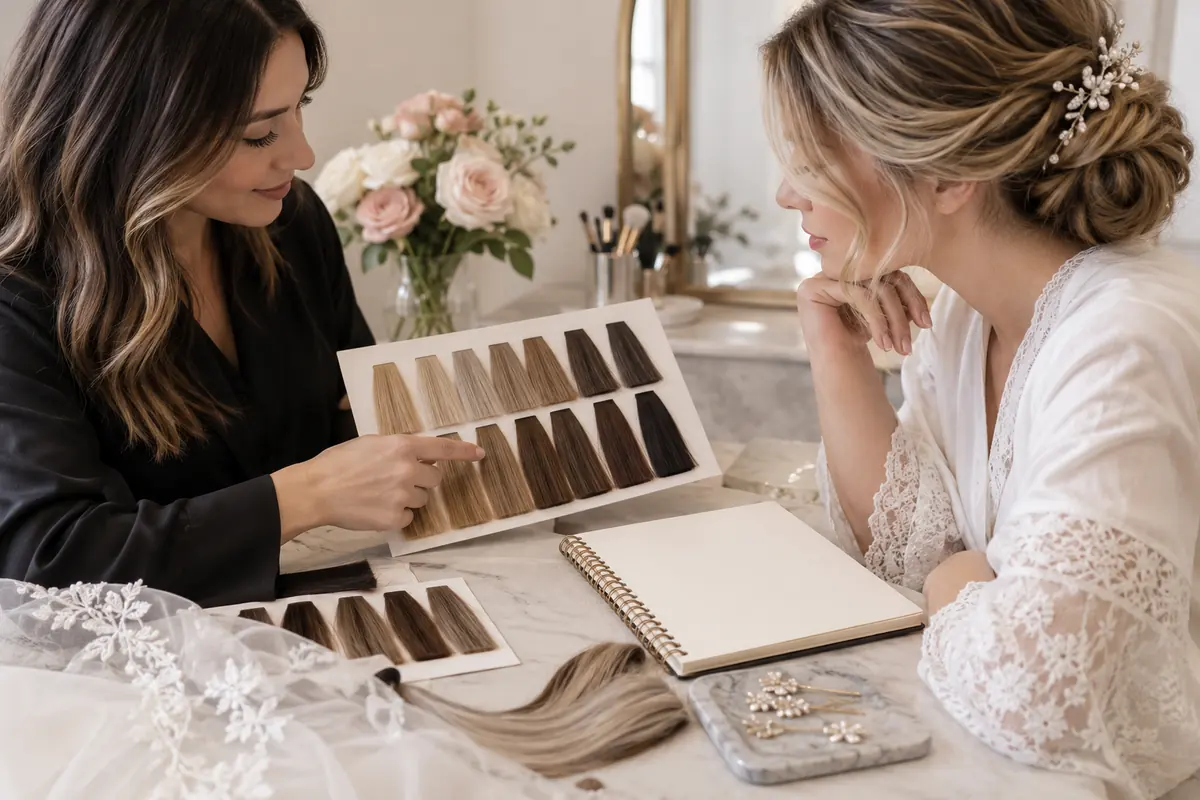
Start with one appointment: a colour consultation where you share the wedding date, your current hair and its treatment history. Ask which service, if any, will achieve the change you want, and when should it happen? A root line, unwanted warmth and a wish for brighter pieces are different briefs. They do not automatically require the same calendar.
Use this colour chapter alongside the wedding hair planner. The aim is to coordinate salon availability, the styling trial and time to review your choices. No number of weeks can promise that a colour service is suitable for every bride.
The quick answer: which service, which week
The table is an illustrative planning calendar, not a treatment schedule. Your colourist may move, combine or omit appointments after discussing your hair, the products and their instructions. A bride keeping her current colour may need no colour appointment.
| Planning checkpoint | Conversation or possible appointment | What to decide |
|---|---|---|
| About 6 months before | Consultation for a substantial change | Feasible options, possible stages, budget and an alternative look |
| About 3 months before | Review the chosen look and styling trial | Whether colour placement works with the hairstyle and maintenance fits your plans |
| 2–3 weeks before | An established colour refresh, if recommended | The agreed service and when to review the result |
| Around 2 weeks before | A root appointment, if needed and agreed | Which new growth to address and the expected finish |
| Final week | Review the existing plan | Whether any proposed gloss is justified or the colour can stay as it is |
| Final 48 hours | Styling and practical preparation | Confirm the stylist's preparation instructions and avoid improvised changes |
Do not book every row by default. Leave room for any product-specific preparation or testing before confirming a service date.
Six months out: discuss a substantial change early
If you are considering a different colour family, first-time lightening or a change over previous dye, an early consultation gives you more choices. Six months is a convenient planning example, not a minimum that makes a process safe. The colourist may suggest several appointments, a smaller change or waiting until after the wedding.
Bring two references: the colour you like and a current photograph of your own hair. Separate the features you want: lighter overall, warmer or cooler in tone, brighter around the face, or less contrast at the roots. That is more useful than asking for a trend name without agreeing what it means on your starting colour.
Before paying for a series, ask what the first appointment is intended to achieve, what remains uncertain and what would make the colourist change the plan. Agree on an alternative you would be happy to wear if the original target is unsuitable.
Three months out: agree the look and its upkeep
Use this checkpoint to connect colour with the bridal hair trial. Show the colourist whether you expect a low bun, waves, a braid or a visible parting. Ask the styling professional to show you the front, back and areas beneath the veil so you can discuss the colour that will actually be visible.
Set a maintenance budget in money and appointments. Ask which changes are essential, which are optional, and how to care for the chosen product between visits. Mention travel or other appointments that could affect the plan. Avoid assuming every copper, blonde or brunette needs the same refresh interval.
Keep a written record of the agreed shade direction, services and review dates. If another salon will do the final appointment, ask what information to pass on rather than relying on a photograph alone.
Two to three weeks out: review highlights and balayage
For a bride refreshing familiar colour, two to three weeks can be a useful appointment window to discuss. Its benefit is practical: there may be time for a follow-up conversation before the event. It does not mean toner must take a week to become its true colour, or that a correction will always be possible.
Show the colourist three observations in ordinary light:
- New growth: is the contrast at the parting or hairline what you want to change?
- Placement: do you want brighter pieces in a particular area of the planned hairstyle?
- Tone: are the existing lengths warmer, cooler or darker than you prefer?
The balayage and highlights comparison explains the vocabulary. Let the consultation establish the technique; a photograph cannot determine the formula or the condition of the hair beneath its surface.
Around two weeks out: a root appointment, if needed
A possible root appointment belongs in the plan only if you want to cover or blend new growth and your colourist recommends it. Around two weeks is an example to discuss, not a promise of invisible regrowth or a fully recovered scalp on the wedding day.
Ask what finish to expect at your parting and hairline. If you also dislike the tone of the lengths, say so separately. The root touch-up and gloss comparison can help you name the question, but it cannot establish that you need both services or that they must happen in separate weeks.
The final week: decide whether anything needs changing
Do not add a gloss simply because it appears on a bridal checklist. “Gloss” does not guarantee one formula, no developer, grey coverage or a particular result. Ask for the product name, its purpose and the change your colourist expects on your hair. A gloss is not automatically risk-free.
If the colour is already acceptable, keeping it and confirming the styling plan is a valid decision. If you dislike a late result, contact the salon with photographs and explain the wedding deadline. Do not improvise a chemical correction at home. Ask what can realistically be done, including whether styling is the better option.
Bring your treatment history, including henna
Write down home and salon colour, lightening, henna or other plant dyes, straightening and perms on the hair you still have. Include approximate dates, product names, previous reactions and areas with different histories. Bring labels or photographs if you have them; say when a product is unknown. Do not use an arbitrary two-year cut-off for disclosure.
Ask which product instructions and salon tests apply. A strand test concerns a sample of hair; it does not replace a skin allergy test.
The FDA's hair-dye guidance advises following product directions and skin testing before every use; a negative test cannot guarantee no reaction. Do not dye an irritated or damaged scalp. Disclose previous reactions, including to “black henna” tattoos.
Grey blending is a choice, including for mothers of the bride
Ask each person whether she wants to keep her silver, soften the contrast or seek coverage. None is a compulsory bridal-family look. Take the same treatment-history note to her appointment and let her colourist plan around her preferences and existing hair.
If a salon proposes a gloss for grey blending, ask what that specific product can deliver on her starting colour. “Blend” and “cover” can describe different expectations; agree the expected finish before booking.
Use a preview to explain a preference
An AI image can illustrate a direction, but it may shift skin tone, lighting or hair detail. It cannot measure hair condition, model previous treatments or guarantee what a salon will produce. Compare it with an unfiltered daylight photograph and point out the parts you want the colourist to discuss.
Mademoizelle is in early access. You can prepare this brief now with ordinary photos and a written note; a generated preview is optional. The AI hair colour try-on guide explains how to read a preview's limits.
Copy this into your appointment note:
My wedding is on ____. My hairstyle will be ____. I want to change ____ and keep ____. My hair has had ____. Which service do you recommend, what preparation does its product require, and when should we review it?
Use the stylist communication guide to refine the brief. Leave the consultation with named services, agreed dates and a clear alternative if your preferred change cannot be achieved.
Frequently asked
How far before my wedding should I colour my hair?
Agree the date with your colourist using your hair history, chosen service and product instructions. In an example calendar, an established colour refresh might be discussed two to three weeks before the wedding and a needed root appointment around two weeks before. These are planning checkpoints, not safety or result guarantees.
Should I book highlights before my wedding?
Book a consultation if you want to change the placement or brightness, and bring a photo of your planned hairstyle. If you already wear highlights, ask whether a refresh is needed at all. The colourist should decide what is realistic and leave room to review the result.
Do I need a root touch-up and a gloss?
Not necessarily. A root service addresses new growth; a gloss is a salon term for products used to adjust tone or shine, with results that depend on the formula. Describe the problem you see and ask which service addresses it. There is no compulsory two-appointment bridal sequence.
Is a gloss a safe last-week colour appointment?
A gloss is not automatically risk-free, and the name does not identify its ingredients or instructions. Before a late appointment, confirm the exact product and proposed result with your colourist. Keeping the existing colour and concentrating on styling is also an option.
How far back should I mention henna or other hair treatments?
Give your colourist the history of treatments on the hair you still have, including henna or plant dyes, home colour, bleach, straightening and perms. Bring names, labels and approximate dates where possible. A fixed two-year cut-off cannot establish whether a service is suitable.
Can an AI colour preview show my exact wedding result?
No. It can help explain a preference, but it may alter skin tone or lighting and cannot assess hair condition, predict a chemical result or guarantee salon accuracy. Bring an ordinary daylight photo alongside any preview and ask the colourist what can be achieved.