

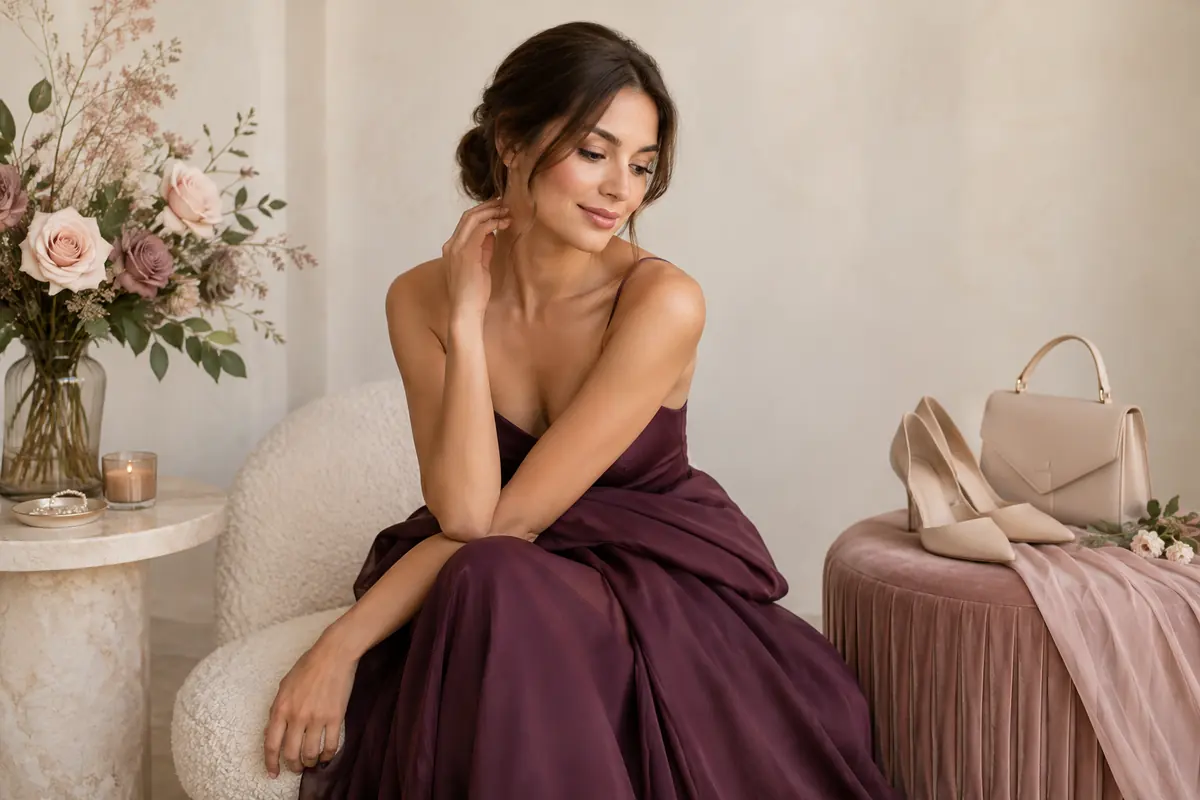
The wedding guest panic has a schedule. The invitation arrives a month out and feels manageable. Then suddenly it is Tuesday, the wedding is Friday, and you are refreshing delivery estimates on a dress you have never touched, in a size you are guessing at, for an event where everyone has a camera.
Here is the part the retailer SERPs will never tell you: the outfit is almost certainly already in your closet. What is missing is not a dress. It is a decode of what kind of wedding this actually is, an honest pass over what you own, and a way to see the candidates on your own body before Friday, not draped over the bedroom chair, and not in your imagination.
This is that method. It pairs with the hair half of the same evening, covered in the wedding guest hair guide, and slots into the full wedding hair planner if you are anywhere closer to the wedding than the guest list.
The quick answer: three outfits, zero shopping
Pull three candidate outfits from clothes you already own, a proven dress, a colour outfit, and a modest-glam layer, then let the ceremony type pick the winner. That is the entire method. Everything below is the detail.
| Outfit slot | What it is | Where it wins |
|---|---|---|
| The proven dress | The occasion piece you have already worn well, right length, right neckline, no surprises | Mixed weddings, ballroom receptions, any time you are unsure |
| The colour outfit | A jewel tone or butter yellow piece, or separates, lifted by your best accessories | Women-only halls, evening receptions, photos |
| The modest-glam layer | A festive abaya or structured kaftan with tonal embroidery or a clean architectural cut | Gulf halls, family-heavy weddings, multi-event invitations |
Three is the working number. One option leaves no room for a venue surprise; ten reopens the decision every evening until the wedding. Three candidates, one decode, one decision, made days out, not the night before.
Read the invitation before you open the wardrobe
The ceremony type decides the dress code, not the mood board. "Wedding guest outfit" is not one question, a Gulf women-only hall, a mixed reception, an Egyptian farah, and a multi-day Maghrebi wedding are four different briefs, and the most common guest mistake is dressing for a generic wedding instead of the actual one on the card.
| The invitation suggests | What it usually means | What to pull |
|---|---|---|
| Women-only hall (Gulf) | Full glam happens inside; you arrive covered and reveal at the door | Your boldest dress, plus the abaya or wrap for arrival and exit |
| Mixed wedding | Modesty stays on all night; photos circulate widely | Sleeves or a shawl that genuinely stays on, midi-to-floor hem |
| Katb ktab / aqd | Intimate, often daytime, family-forward | Polished daytime modest, softer colour, less shine, less skin |
| Egyptian farah | Loud, long, dance-heavy, ends late | Comfort and movement: secure straps, breathable fabric, shoes you trust |
| Henna night | Its own festive register, often traditional dress welcome | A kaftan, a jellabiya, or your most colourful piece |
| Multi-day Maghrebi wedding | Several events, several outfits, escalating formality | One outfit per event, planned together, repeats restyled, not rewearied |
Two of these deserve a word more. The women-only hall changes the entire calculus: the outfit underneath can be far bolder than anything you would wear to a mixed event, but the arrival layer is part of the look, not an afterthought. And the henna night runs on rules of its own, festive, traditional, built around the bride's outfit changes, which is why it has its own hair-and-look guide rather than a paragraph here.
If the invitation does not say, ask. One message to a cousin or a fellow guest, "is it mixed?" "is there a theme?", replaces an hour of guessing and most of the panic.
The colour rules: what guests can and cannot wear
Black is generally fine, white never is, and anything that could be mistaken for bridal is out, that is the whole rulebook, with regional footnotes. The footnotes matter, so here they are.
Black. In the Gulf and much of the region, black is unremarkable as evening formal wear, black occasionwear and festive abayas are the default language of elegance, not of mourning. Where to hesitate: daytime ceremonies, garden weddings, and families or communities where black still reads sombre. If you are unsure, keep the black base and lift it, coloured heels, a strong bag, gold rather than silver.
White and its cousins. White, ivory, cream, champagne, and very pale blush all belong to the bride. So does heavy crystal embellishment on a long pale gown, full-length white lace, and big tulle volume, even in a non-white colour, a gown that is shaped like a wedding dress reads like one in photos.
Everything else is a pairing problem, not a permission problem. A jewel-tone dress with the wrong shoe metal, or a strong colour fighting a strong bag, fails more often than any forbidden shade does. The pairing logic lives in the outfit colour combinations guide, worth ten minutes before you commit accessories.
2026's guest colours are probably hanging in your closet already
This year's guest palette, butter yellow, jewel tones, and the soft off-white called Cloud Dancer, is closer to what you already own than to anything on the new-in rail. That is the quiet joke of trend coverage: it sends you shopping for colours that have been sitting in your wardrobe for three seasons.
Butter yellow is the breakout guest colour of 2026, soft, warm, daylight-friendly, and flattering against the olive and golden undertones common across the region. If you own anything in that register, a pale yellow midi, a soft gold kaftan, even a yellow-cream blazer over wide trousers, it is suddenly the most current thing you can wear to a daytime or early-evening wedding.
Jewel tones, emerald, sapphire, deep burgundy, amethyst, are the evening workhorses. They photograph richly in dim halls, they flatter nearly everyone, and they are the single most likely category to already exist in your closet, because jewel tones are what occasionwear has been made of for a decade. If you built a wardrobe along the lines of the capsule wardrobe guide, you almost certainly have at least one.
Cloud Dancer, the season's soft off-white, comes with the warning from the section above. Wear it as separates, as a layer over colour, or in a texture that reads clearly non-bridal. A full-length fluid off-white gown is technically on-trend and socially a misfire.
None of this requires a purchase. It requires looking at what you own through this year's lens, which is a sorting problem, and sorting problems are what the next two sections solve.
Modest-glam: the abaya and kaftan as occasionwear
A festive abaya or a structured kaftan is a complete wedding-guest answer, not a compromise. The modest-glam register has been one of the most interesting corners of occasionwear for several years now, architectural cuts, tonal embroidery, jewel-tone crepes, sleeves treated as the design feature rather than the constraint, and it solves three problems at once: the mixed-hall modesty calculus, the multi-hour comfort question, and the am-I-overdressed anxiety.
What separates the festive abaya from the daily one is intention: a deeper colour, a fabric with weight and drape, embroidery that is tonal rather than loud, a cut with one architectural idea, a sculpted sleeve, a clean column, an asymmetric closure. One idea, executed well. The same logic carries the kaftan, which has the added advantage of being exactly right for a henna night and most multi-day celebrations.
If your closet holds one of these and you have been mentally filing it under "religious occasions only", refile it. At a Gulf wedding it is not the safe choice. Worn with finished hair and one good piece of jewellery, it is frequently the best-dressed table.
The photograph-well checks: will it survive the night
An outfit that looks right standing still in a 6pm mirror has passed one test out of six. A wedding is five hours of sitting, dancing, hugging, flash photography, and temperature swings, run the candidates through the night before the night does.
- The sit test. Sit down in it. Does the hem behave, does the waist dig, does the slit become a problem on a banquet chair?
- The arms-up test. Raise both arms, greeting, dancing, the dabke moment. If the neckline or the zip protests now, it will protest worse at 11pm.
- The flash test. Photograph it with flash. Sheen turns shiny, sheer turns transparent, and pale turns bridal, better to learn this on Tuesday.
- The crease test. Sit in it for ten minutes, stand, look at the lap. Linen and some crepes arrive at the venue pre-wrinkled by the car ride.
- The climate test. Gulf halls are air-conditioned to a chill while the car park is at 43 degrees; an outdoor summer wedding inverts the problem. A wrap is not an accessory, it is equipment.
- The strap test. One evening of pinning a sliding strap costs more attention than any outfit is worth. If it needs tape, decide that now and pack the tape.
Any candidate that fails two of these is out, regardless of how good the mirror said it looked.
Try it on your body before the day, not on the bedroom floor
The bedroom-floor pile is the old method: everything you own, tried in a rush, judged in a mirror, abandoned in a heap that makes you feel like you own nothing. The Smart Closet pass replaces it. Photograph the candidate pieces once, and Mademoiselle lets you assemble them into outfits and try each one on a photo of your own body, your proportions, your skin tone, your actual self, before you commit an evening to steaming the wrong dress.
What the render settles is the elimination round: which colour actually works against your skin in photo light, whether the kaftan reads elegant or engulfing on your frame, whether the jewel-tone dress wants gold or silver, whether two separates you have never physically combined belong together. The full mechanics, what virtual try-on does well, where it stops, are in the AI outfit try-on guide, and the event-specific workflow is in Smart Closet for events.
What the render does not settle is fit. It will not tell you the zip strains or the fabric stopped stretching two summers ago. So the honest sequence is: render everything, shortlist two, physically try the two. That is one evening of work instead of four, and no pile.
One more thing, because wedding-adjacent photos are personal: the photos you take for this stay yours. No gallery, no feed, no training set, the architecture is laid out in private by design. For an event where half your family is in the background of every test shot, that is not a footnote.
Finish the look: hair that belongs to the same outfit
Decide the hair after the outfit, and make them one decision instead of two. A high neckline or sculpted collar wants the hair up and away, this is the sleek low bun's natural habitat, and the bun's polish is doing half the outfit's work. A simple column dress or clean abaya line can carry glossy Hollywood waves without the whole look tipping into costume. The 2026 guest mood is It-girl simplicity: one strong element, everything else quiet, which means if the outfit is the statement, the hair should be the frame.
Both looks are worth seeing on your own face before you book a chair or heat an iron, the same way the outfit earned its render.
Studio prompt:
"Sleek low bun on my hair, centre part, polished and smooth, no flyaways, soft around the hairline, evening hall light."
Studio prompt:
"Glossy Hollywood waves on my hair, deep side part, brushed-out S-waves, high shine, even golden-hour light."
The venue logic, the texture-by-texture options, the hijab-friendly styles, and the salon-or-DIY call all live in the wedding guest hair guide, it is the other half of this post.
One week out, you are done
The whole method, on a calendar: decode the ceremony the day the invitation arrives; pull the three candidates and run the Smart Closet renders that same week; physically try the two finalists at least three days out; steam, hang, and pack the wrap and the tape the night before. By the time the panic-shopping window opens for everyone else, you are choosing earrings.
The dress you already own and have already worn well will beat the dress that arrives Thursday in the wrong size, not occasionally, almost always. The closet was never the problem. The method was.
Frequently asked
How do I use a smart closet for an event?
Photograph the candidate pieces once, then build them into complete outfits and try each one on a photo of your own body. For a wedding, shortlist three outfits, a proven dress, a colour option, a modest-glam layer, render all three, and judge them against the ceremony type and venue. Decide at least three days out, then physically try the winner to confirm fit.
Can AI outfit try-on replace trying clothes on?
No, it replaces the elimination round, not the final fitting. A render on your own body shows colour against your skin, proportion, and how pieces work together, which is enough to cut ten maybes down to two. It cannot confirm physical fit, fabric stretch, or comfort across a five-hour night. Render to shortlist, then put the finalists on before the day.
How many outfit options should I save?
Three. One proven dress you have already worn well, one colour outfit built around a jewel tone or butter yellow, and one modest-glam option such as a festive abaya or kaftan. Three covers nearly every ceremony type without reopening the decision every evening. Saving ten renders feels productive, but it recreates the panic-shopping problem inside your own closet.
Can wedding guests wear black in the Middle East?
Generally yes. Black is a normal, even elegant, guest choice at evening weddings across the Gulf and much of the region, where black occasionwear and festive abayas are everyday formal language. Be more careful at daytime ceremonies, garden weddings, and with families who read black as mourning, if you are unsure, lift it with colour in the shoes, bag, or wrap.
Is it ok to wear white to a wedding?
No, unless the couple has explicitly asked for an all-white dress code. White, ivory, cream, and very pale off-whites, including 2026's Cloud Dancer, can all read bridal in hall lighting and in photos. The test is simple: if a stranger scrolling the wedding album could mistake you for the bride for half a second, choose another colour.
What to wear to a summer wedding in 2026?
A jewel tone or butter yellow in a fabric that survives the venue. For an air-conditioned hall, structured fabric and a wrap for the cold; for an outdoor summer wedding, breathable natural fibres, a secure silhouette you can dance in, and nothing that creases on the drive. The 2026 guest mood is polished simplicity, one strong colour, finished hair, minimal fuss.