

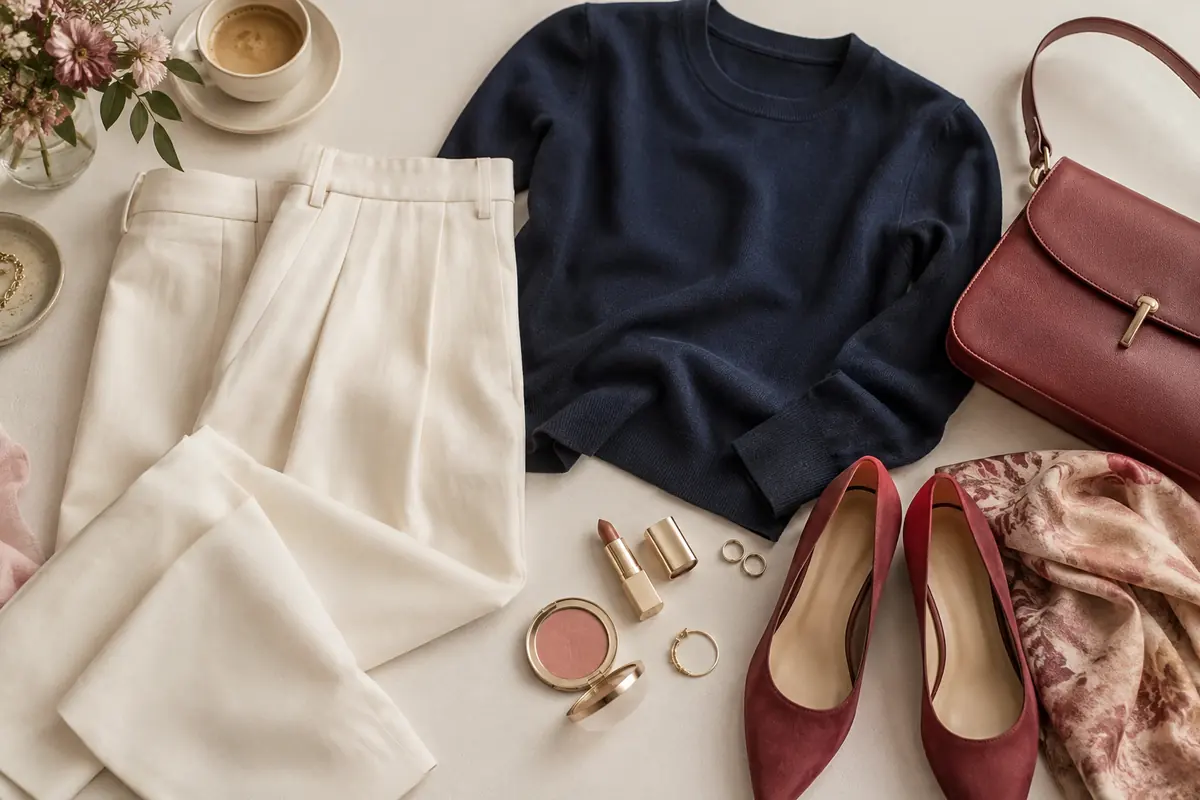
Colour advice usually starts in the wrong place. It starts with a wheel, a season, or a list of shades someone insists are "timeless." Useful, sometimes. But outfits are not built from theory. They are built from the clothes already hanging in your closet.
The best colour combination is not the most creative one. It is the one your closet can repeat without making you feel dressed as an idea.
This is the closet-first method.
Start with the anchor
Every outfit needs an anchor colour. The anchor is the piece with the most visual weight: trousers, abaya, dress, blazer, coat, skirt, or denim.
Ask: what is the largest colour block?
If the anchor is black, the outfit will read around black. If the anchor is cream, the outfit will read lighter and softer. If the anchor is olive, chocolate, navy, burgundy, or denim, the rest of the outfit has to respond to that temperature.
Do not start with the accessory. Start with the largest piece.
Choose one of three colour strategies
1. Tonal
Tonal dressing uses shades from the same family: cream, beige, camel, chocolate; or navy, denim, pale blue; or black, charcoal, soft grey.
It works because the eye reads harmony before detail.
Best for:
- elegant daytime outfits
- work events
- travel
- modest dressing with long layers
- looking polished without looking loud
Risk: if every piece is the same flat shade, the outfit can look dull. Add texture: silk with wool, matte with shine, smooth leather with cotton.
2. Contrast
Contrast dressing uses clear difference: black and ivory, navy and white, chocolate and pale blue, olive and cream, burgundy and blush.
It works because the eye understands the decision immediately.
Best for:
- photos
- dinners
- events
- strong tailoring
- simple outfits that need presence
Risk: too much contrast can cut the body into pieces. Use one repeated element, such as black shoe plus black bag, or gold jewellery plus warm bag.
3. Neutral plus accent
This is the safest way to wear colour. Build the outfit in neutrals, then add one colour: red bag, green shoe, blue scarf, coral lip, burgundy belt.
Best for:
- people who own mostly neutrals
- first experiments with colour
- work wardrobes
- event outfits where the dress code is unclear
Risk: the accent should look intentional, not accidental. Repeat it once if possible.
Undertone matters more than colour name
Beige can be pink, yellow, grey, or green. White can be optic, ivory, cream, or bone. Brown can be red, yellow, cool, or almost black.
The names do not matter. The temperature does.
Warm pieces tend to like:
- cream
- camel
- chocolate
- olive
- rust
- gold
- warm denim
Cool pieces tend to like:
- optic white
- charcoal
- navy
- black
- blue-red
- silver
- cool denim
Neutral pieces can usually go either way, which is why they become favourites.
If an outfit feels wrong but the colours "should" work, check undertone. A yellow cream blouse beside a cool grey trouser can look slightly off even though cream and grey are both neutrals.
The MENA neutrals that work hard
For wardrobes built around abayas, modest layers, tailoring, and warm weather, a few colours earn their space repeatedly:
- black
- ivory
- chocolate
- espresso
- olive
- sand
- navy
- deep burgundy
- warm denim
- soft gold
This is not a rule. It is an observation from the way clothes are actually worn: heat, indoor light, family events, work polish, travel, and pieces that need to move between private and public contexts.
Use your Smart Closet as evidence
Open your closet inventory and sort by colour. The answer may surprise you.
You may think you wear colour, then discover your closet is 70% black and denim. You may think you need more neutrals, then discover you own six cream tops and no shoe that works with them. You may think red does not suit you, then find the burgundy bag that makes half your wardrobe better.
Tag items by:
- colour
- undertone
- formality
- season
- event use
- works with black
- works with cream
- needs matching shoe
- photographs well
The useful closet is not the prettiest inventory. It is the one that answers a question quickly.
AI outfit try-on prompts for colour
Use AI try-on to compare harmony, not exact shade.
Tonal outfit:
"Try this tonal cream and camel outfit on my body, realistic fabric colours, full-length view, daylight, show shoe and bag balance."
Contrast outfit:
"Try this black and ivory outfit on my body, clear contrast, full-length view, realistic proportions, indoor evening light."
Neutral plus accent:
"Try this neutral outfit with a burgundy bag accent, full-length view, realistic colour harmony, daylight, no body reshaping."
After rendering, ask:
- Does the face look brighter or duller?
- Does the outfit feel intentional?
- Is one colour shouting?
- Do the shoes belong?
- Would I repeat this combination?
Repeatability is the hidden test. A colour combination you can repeat becomes style. A colour combination you can only wear once becomes costume.
The quiet rule
Start with the anchor. Pick tonal, contrast, or neutral plus accent. Match undertone. Use accessories to finish the temperature.
Your closet already has a colour system. The work is to notice it, name it, and stop shopping against it.
Frequently asked
How do I choose outfit colours that work together?
Start with one anchor colour, then choose either a tonal combination, a contrast combination, or a neutral-plus-accent combination. Keep the undertone consistent unless contrast is the point. Shoes, bag, and jewellery should support the temperature rather than fight it.
What are the easiest outfit colour combinations?
The easiest combinations are tonal neutrals, black with ivory, navy with white, chocolate with cream, denim with white, olive with black, and one neutral base plus one accent colour. They work because the contrast is clear and repeatable.
How can a smart closet help with colour?
A smart closet can show which colours you actually own, not which colours you imagine you own. Once items are tagged by colour and undertone, it becomes easier to build outfits from real anchors and see gaps before shopping.
Can AI outfit try-on judge colour accurately?
It can judge harmony and contrast direction, but not exact fabric colour. Use AI try-on to compare combinations, then check the real garments in daylight because screens can shift undertones.