
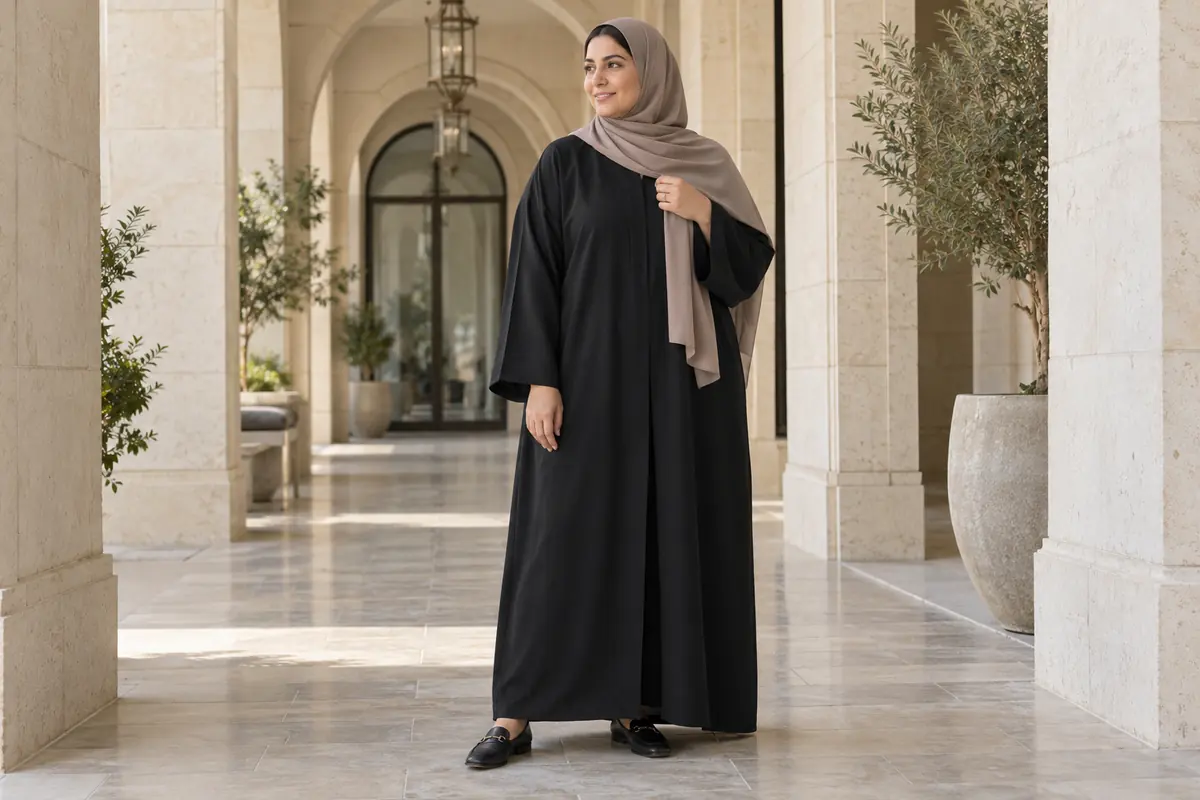
Choosing an abaya size? Read the seller's chart, then test the garment in motion. Put on the shoes and underlayer you expect to wear, sit down, reach forward and walk several steps. An abaya can look composed in a still photograph and become awkward at a desk, on stairs or while carrying a bag. Your body does not need correcting; the garment needs to suit its job.
Women across Gulf countries choose different silhouettes, coverage and occasion dress. An abaya is not every woman's daily uniform, and a relaxed cut is not the only valid preference. This guide helps you test a garment against your own choices without declaring one regional look correct.
Check the hem with the actual shoes
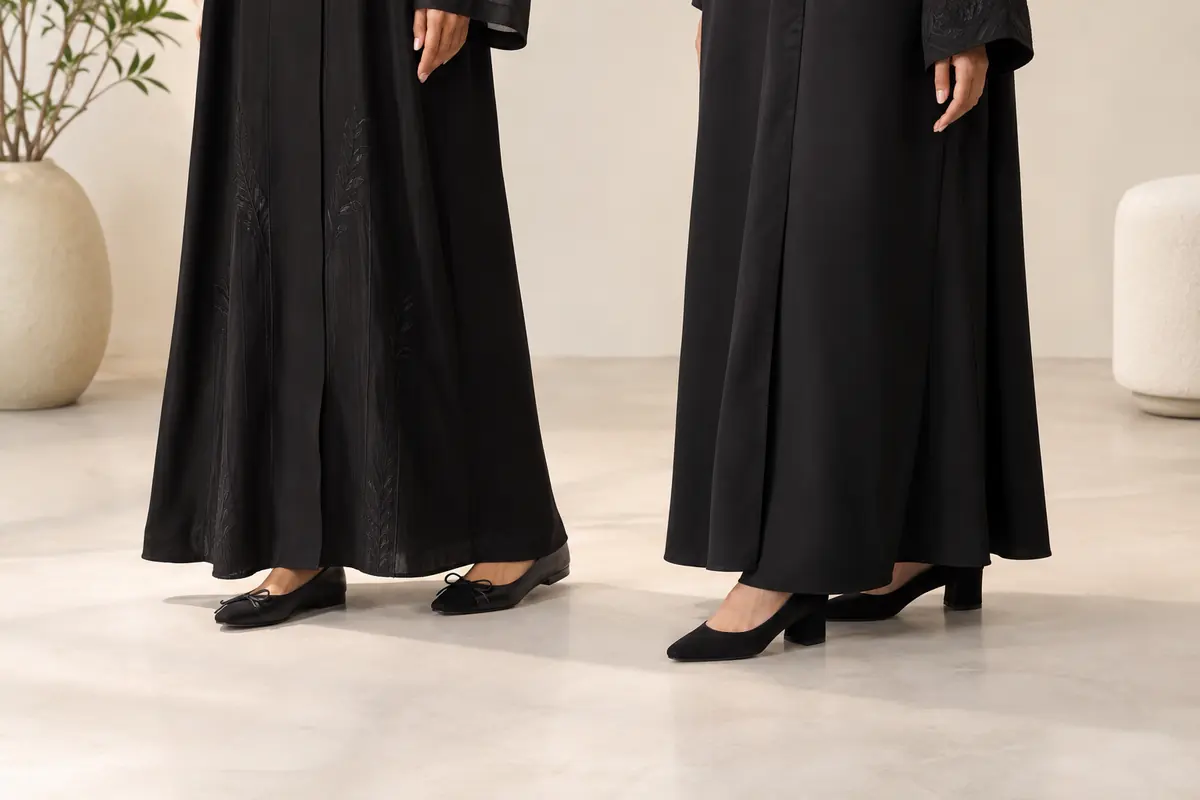
A hem measured with heels can drag when you switch to flats. Bring the shoe you use most, then test any second shoe you plan to wear. Walk forward, turn and step onto a low stable step if available. Keep the fitting area clear and use support when needed.
Check both front and back; a mirror view of the front alone misses a dragging back panel. Sit down and stand again without pulling the garment into place for the photograph. Notice whether you need to hold the hem every time you move.
There is no universal floor clearance that suits every cut and journey. Ask for a practical fitting on the body with the intended footwear. If the same abaya must work with very different shoe heights, choose a compromise that stays usable, or reserve it for one height rather than expecting one hem to do everything.
Abaya too long at the back, but fine at the front
Try: empty the pockets, settle the shoulders, fasten the front as intended and stand in the planned shoes. Ask a helper to look at front, sides and back without holding the fabric up. A garment with a deliberately longer back should not be treated as an accidental uneven hem.
Check: is the back consistently lower, or does it drop only after sitting or when the bag pulls a shoulder? If changing the bag position removes the problem, test that arrangement before altering the hem. If it persists, photograph the floor relationship at each view.
Next step: show the tailor the longer-back observation and your preferred front coverage. Ask whether the cut is intentionally asymmetric and have the proposed line checked on you. Cutting an equal-width strip all around can preserve the original difference rather than fix it. Heat tape is not a universal substitute: fabric, lining and care restrictions still need assessment.
A useful fitting note lists the shoe pair, underlayer, front/side/back observation and desired outcome. Keep centimetres and inches clearly labeled; seller body measurements, flat-garment measurements and floor clearance describe different things.
Check shoulder and sleeve movement
Review the upper garment with the same care as the hem. For a set-in sleeve, check whether the shoulder seam sits where the design intends and whether the sleeve turns comfortably with your arm. A dropped shoulder deliberately sits farther down; do not judge it as a tailoring error simply because it differs from a fitted shirt.
Reach forward as if holding a steering wheel, typing or greeting someone. Then gently raise your arms to a comfortable height. Note where tension begins: across the back, under the arm, around the upper sleeve or at a fastener. Remove a restrictive underlayer and repeat once if appropriate. That separates an abaya issue from an underneath issue.
Tell the tailor what happened: “The back pulls when I reach toward a keyboard” is useful. “Make it more flattering” does not identify the movement you need.
It pulls only when you reach: compare one layer first
Repeat the same comfortable reaching motion in the underlayer alone, then with the abaya. If the underlayer also restricts it, change that layer before narrowing or enlarging the outer garment. If only the abaya pulls, note whether the first tension appears at the upper sleeve, armhole, back or fastening.
Record the task rather than assigning yourself a “wrong” shoulder shape. A still shoulder measurement cannot prove that a sleeve will work at a keyboard. Ask the tailor to preserve comfortable width and test the proposed change while reaching; tightening the whole sleeve to control an oversized cuff can create a new restriction.

Test the fabric and underlayer while seated
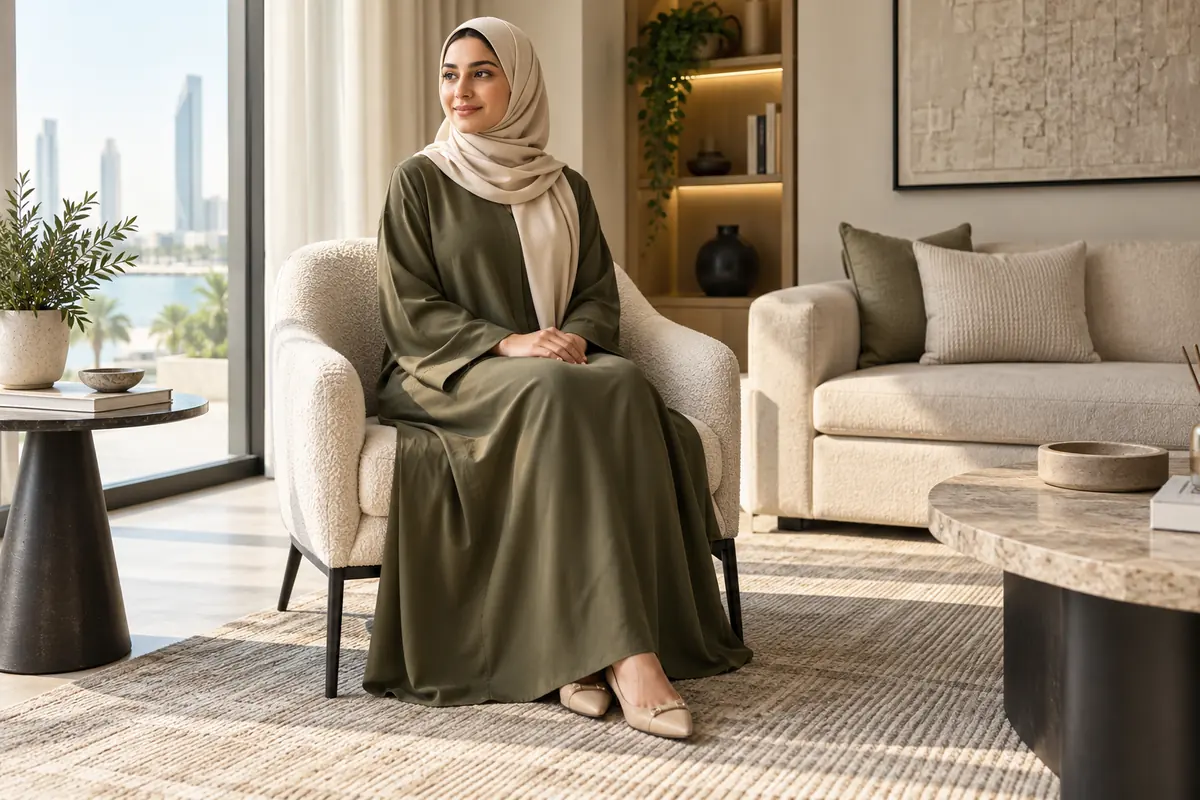
A wide cut can still feel restrictive if the underlayer catches or the outer fabric hangs heavily at the shoulder. Try the whole outfit. Check how the fabric falls after you sit and whether it clings to the layer beneath. Do not conclude from “crepe,” “linen blend” or a marketing adjective that every garment will behave alike.
Physical fabric behavior matters even in digital garment design, as CottonWorks explains. A styled image cannot replace touching and moving in the finished piece.
For your own fitting, hold the fabric loosely, release it and watch the folds settle. Check visibility over your intended underlayer near a window and in room light. This is an ordinary visual check, not a certification of opacity in every setting.
Check the front and shoulder arrangement
Once the front is arranged, inspect both shoulder lines from the side and back. If one side is displaced, check whether a bag strap or uneven scarf layer is pulling it before requesting a seam change. Show the tailor the garment in its normal arrangement, not held up by your hands.
A closed front, an open front and an abaya with optional fasteners offer different arrangements. Check a closed style while seated: are fasteners straining, panels twisting or fabric pulling across your lap? A gap you do not want is information about the garment's fit, not a reason to tolerate discomfort.
With an open design, the underlayer provides much of the outfit's coverage. Walk and turn while observing the opening. If you want a more stable front, ask whether an appropriate fastener can be added without distorting the design. Do not pin a closure through yourself while wearing the garment.
Check the neckline with the sheila if you use one. The fabric at the neck, front fastening and scarf layers should work together. Adding one more tight layer is not a universal solution to an unstable drape.
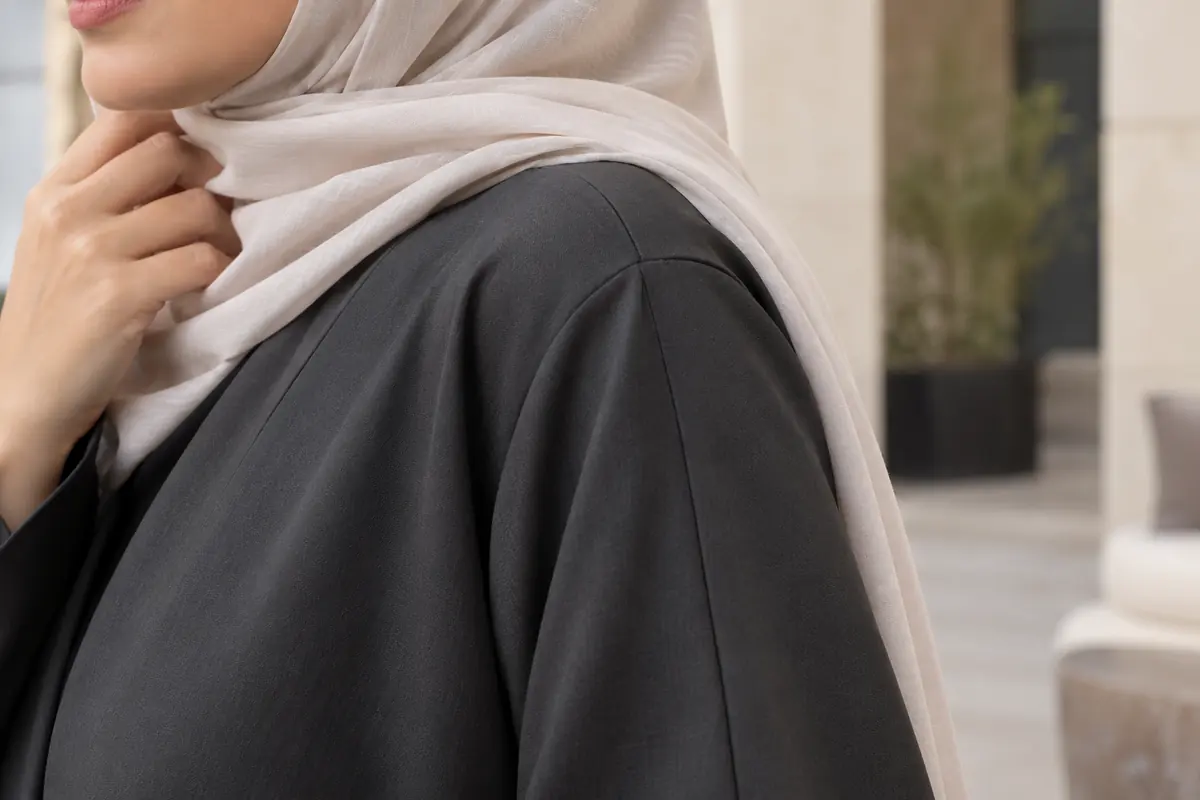
Read the abaya size chart before choosing 52, 54 or 56
Ask what the size number describes. Aaliya's size guide uses inches of garment length for its numbered abayas and distinguishes regular and slim widths. A length code alone cannot establish your chest or hip fit, and the same number need not describe the same cut at another shop.
This is an inch-to-centimetre conversion only, rounded to one decimal place. Use it only when the seller confirms that its number means garment length in inches; it is not a height recommendation or a universal abaya size chart.
| Confirmed garment length in inches | Length in centimetres |
|---|---|
| 50 | 127.0 |
| 52 | 132.1 |
| 54 | 137.2 |
| 56 | 142.2 |
| 58 | 147.3 |
| 60 | 152.4 |
Read the chart heading before using the tape. Anaya's guide identifies its size measurements as body measurements and gives abaya length separately. Boksha's abaya chart identifies garment measurements and specifies sleeves measured from the neck in inches. A sleeve measured from a shoulder seam has a different starting point.
Take measurements you can actually compare
Use a flexible tape and record the unit beside every number. For a garment chart, start with an abaya that already works when you sit and reach. Lay it flat, close it as intended and smooth it without stretching. Follow the seller's diagram rather than imposing another shop's method.
| Chart asks for | What to measure | Common mismatch to avoid |
|---|---|---|
| Body bust, waist or hips | Follow the body guide; keep the tape level and comfortably touching, without squeezing | Entering a flat garment width as a body circumference |
| Flat garment chest width | Measure between the seller's stated underarm points on the fastened garment | Comparing one flat width directly with your full bust circumference |
| Garment length | Use the stated top point, such as shoulder or neck, down to the hem | Treating body height as the garment's shoulder-to-hem length |
| Sleeve length | Follow the stated neck-to-cuff or shoulder-to-cuff route | Comparing sleeves measured from different starting points |
If the seller explicitly defines a flat chest width as half the finished circumference, 60 cm flat would mean approximately 120 cm around the garment. This is a hypothetical measurement example, not a recommended size or a 120 cm body fit. Open fronts, overlap, pleats and the cut can make a simple doubling misleading. The extra room between body and garment is ease; there is no single allowance that guarantees every fabric, layer and movement will work.
Ask before ordering or cutting
Send one specific message: “For this model, does size 54 change length only, or width too? Are chest values body circumference or garment width? Where do length and sleeve measurements start, and are they in inches or centimetres?” If the chart is unclear, request the actual finished garment measurements and the shop's stated measurement tolerance before ordering.
If your preferred length and width fall in different options, ask about a separate width choice or an alteration. Compare the front while seated as well as standing; adding length does not necessarily add useful width. Check the return conditions before ordering a customised or shortened piece. At the tailor, show the task that fails and have the proposed hem or cuff pinned and tested before any cutting.
Match a fit problem to a useful conversation
| What you notice | Check before changing size | Useful request |
|---|---|---|
| Upper back pulls when reaching | Sleeve and underlayer movement | Show the reaching motion to the tailor |
| Sleeves cover your hands at a desk | Cuff design and intended sleeve length | Test a shorter or more controlled cuff |
| Hem drags only in flats | Actual shoe height and back hem | Fit the hem for the shoes you use |
| Front twists after sitting | Fastener placement and underlayer bulk | Review the closure with the garment seated |
| Bag pulls the shoulder out of place | Strap weight and contact point | Test your real bag before alterations |
A larger size is one possible answer, but not a diagnosis. It can add useful room while making cuffs longer or moving a seam. Compare the movement in two sizes if possible and choose from that evidence.
Build three outfits around the same fit
For a walking day, try a movement-tested abaya, an underlayer that stays comfortable seated, secure everyday shoes and a bag that leaves a hand free. Keep any long scarf end where it will not catch in the bag or door.
For desk work, try a sleeve arrangement that clears your hands, a simple underlayer and a bag that holds the actual work kit. Test the neckline on a video call if that is part of your day; the screen does not show the whole outfit.
For an occasion, use the intended shoes, a deliberately selected underlayer and one detail you want to feature. A striking cuff, textured fabric or a scarf can carry the look without making every component elaborate.
Use the alteration appointment well
Photograph the garment front, side and back in a neutral standing position, then add one image of the troublesome movement. Obtain permission before photographing anyone else. Write down the task, shoe height and intended underlayer; bring them when possible.
Ask the tailor which changes are feasible before deciding. Shortening a sleeve, relocating a fastening and changing an armhole are different jobs. A cut does not become suitable merely because several seams can be tightened.
Read the garment's care label before treatment: GINETEX care guidance. Keep the label and any supplied spare fasteners.
A hypothetical fitting, with one clear change
Hypothetical example: Noura likes the fall of her abaya when standing, but the sleeves slide over her hands while she types. The shoulders move comfortably and the hem clears her flats. She first tests a controlled cuff with a tailor, keeping the comfortable body width. Buying a smaller garment would change areas that already work.
After the change, she repeats typing, reaching and sitting. Success means the sleeve works for her day and she likes the result; it is not a body-shape score.
Choose the next guide for the remaining question
Use black abaya textures for finish, sheila and neckline draping for the upper arrangement, and abaya colour palettes for combinations. Build a repeatable day with Gulf workwear formulas, compare modest outfit ideas or review summer outfits. The Gulf style hub brings the decisions together.
Frequently asked
What does size 52 mean in an abaya?
Some sellers use 52 for a garment length of 52 inches, about 132.1 cm. Confirm this on the exact product chart. The number alone does not tell you the bust fit, sleeve length or whether width changes between sizes.
Should I compare my bust with the chart's flat chest width?
First confirm whether the chart lists body circumference or finished garment width. A flat underarm-to-underarm width is not a body bust measurement. Compare like with like using the seller's measurement points.
Can height or weight alone tell me my abaya size?
Height may help shortlist a length in a seller's chart, but it does not establish chest, hip, sleeve or seated fit. Weight alone cannot provide those measurements. Check the actual model with your underlayer and shoes.
How long should an abaya be?
Choose a length that clears the floor during your actual walking and seated movements with the intended shoes. There is no universal centimeter rule; a tailor can check front and back hems on the garment.
Should I size up for movement?
A larger size may help some restrictions but can also lengthen sleeves or move the shoulder seam. Identify where the garment catches before choosing a size or alteration.
Why does the front pull when I lift my arms?
The restriction may involve the sleeve, armhole, upper back, underlayer or closure. Repeat the movement slowly and show the exact pulling point to a tailor rather than guessing from a size number.
Can an open abaya work for everyday wear?
Yes, when the underlayer and front arrangement give the coverage and practicality you want. Check walking, wind and sitting; an open front is a design choice, not automatic coverage.
What if my abaya is longer at the back than the front?
First check whether the cut is intentionally asymmetric. Settle the shoulders, wear the planned shoes and compare front, sides and back before and after sitting. Show a tailor the persistent floor relationship and the front coverage you want to keep; do not assume cutting the same amount all around fixes the difference.