

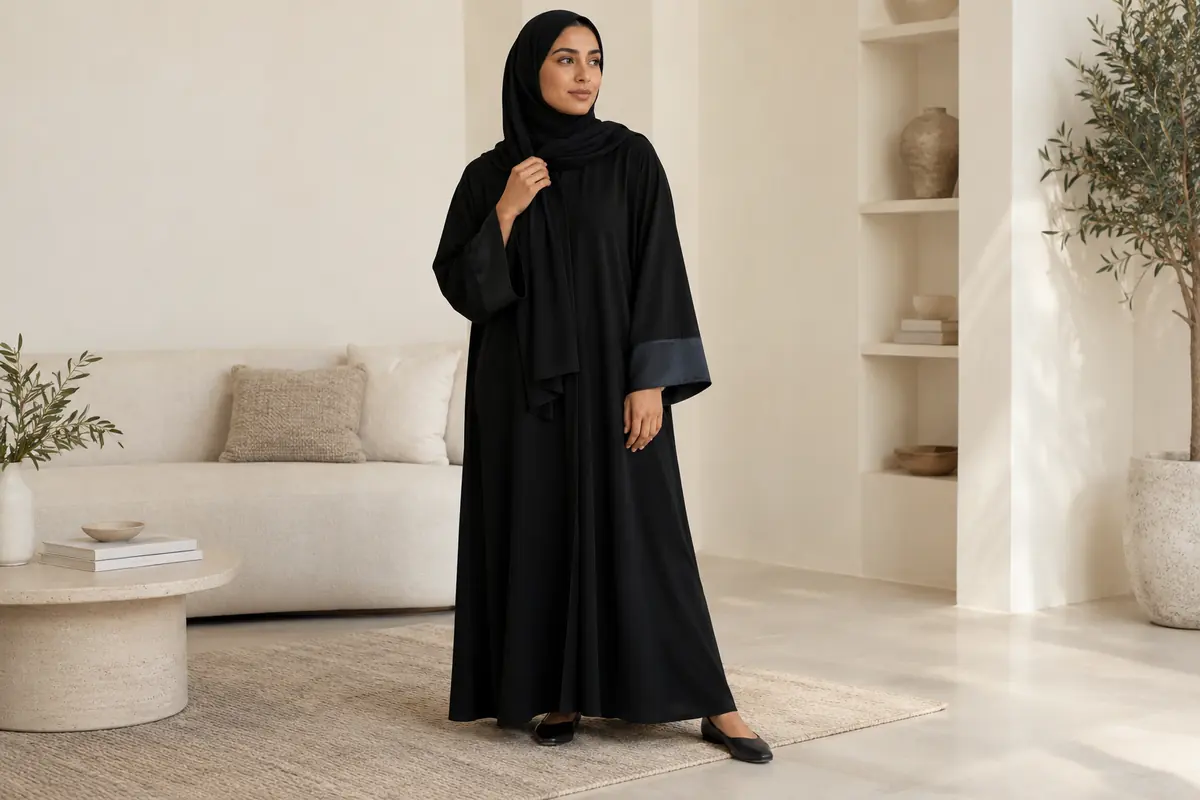
Choose one surface or detail to lead the outfit. Lay your black abaya beside its underlayer, scarf and bag. If every piece has a strong shine, texture or decoration, remove one and look again. This is an editing exercise, not a rule that an outfit must be minimal to be stylish.
A black abaya can express many preferences: crisp, soft, decorative, understated or deliberately mixed. Gulf women do not share one required way to wear it. Begin with your actual occasion, chosen coverage and comfortable movement, then build the visual arrangement you enjoy.
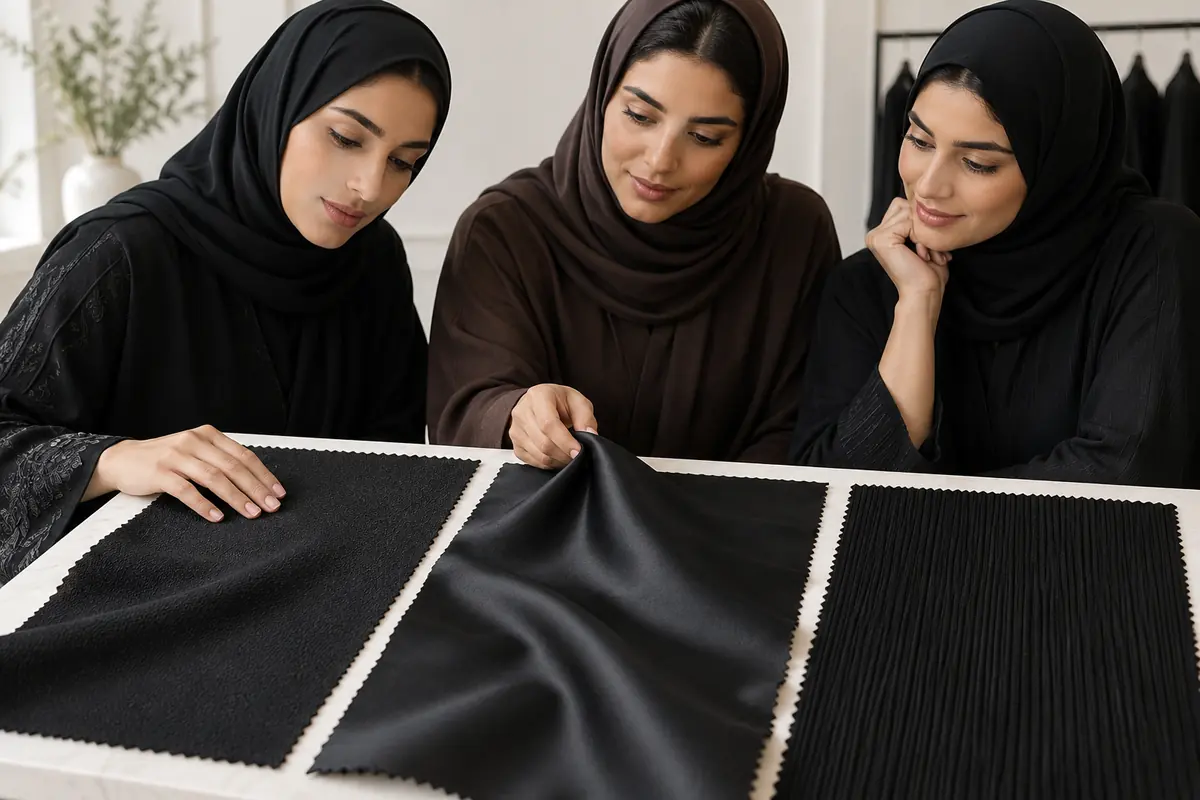
Compare surfaces instead of calling every black fabric identical
Hold three pieces side by side if available: a matte surface, a smoother lustrous surface and a visibly textured surface. Use garments already in your closet; you do not need a specialist swatch kit. Tilt them gently to observe how the surface changes without stretching the fabric.
| Surface you observe | An outfit idea to test | Practical check |
|---|---|---|
| Mostly matte | Let a small glossy bag detail stand out | Check lint and marks in normal light |
| Smooth and lustrous | Pair with a quieter scarf or underlayer | Check snags where jewelry touches |
| Ribbed or raised texture | Keep adjacent details simpler | Check bulk at closures and cuffs |
| Decorative or embroidered | Repeat one visible color in a small item | Check contact with bag straps |
CottonWorks describes satin weave's sheen and potential snagging: woven fabric guide. That does not tell you the fiber content or durability of every retail garment. Inspect its label and finish.
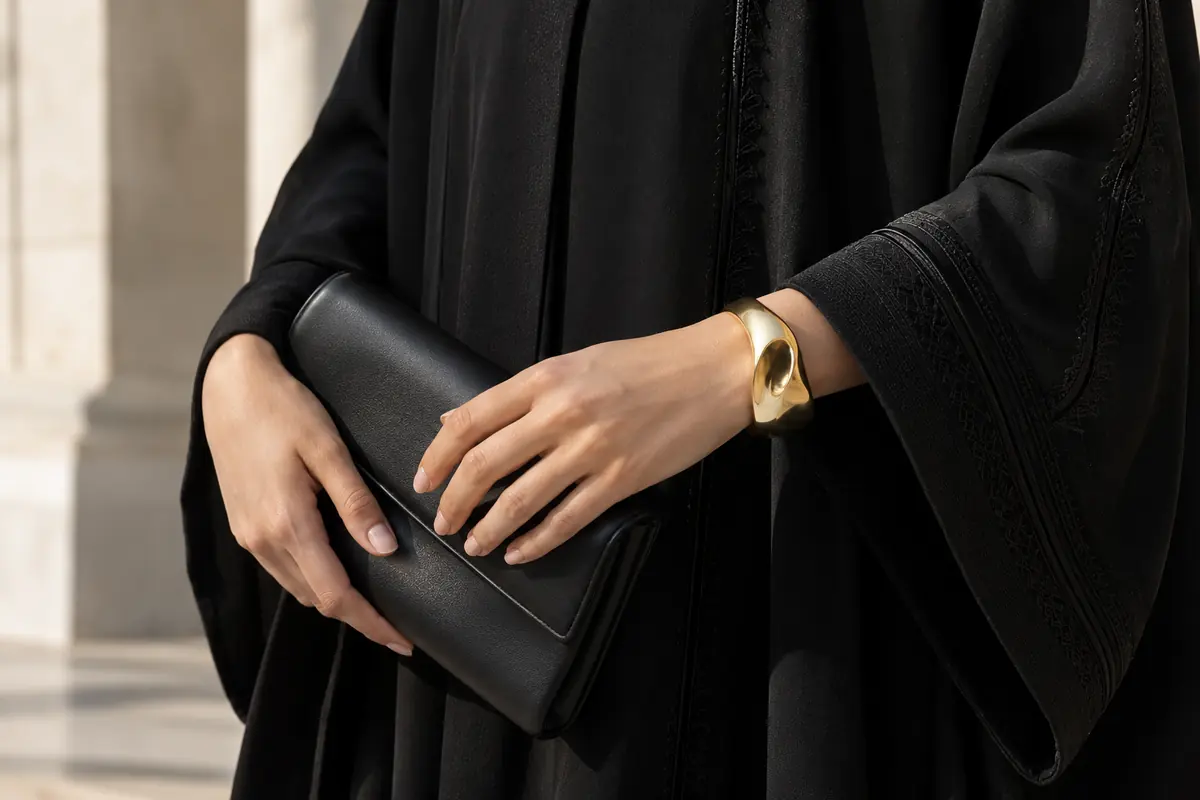
Put a metallic accent where it can work
Choose one area first: a bag fitting, earring if worn, cuff detail or scarf edge. The aim is a detail you can see and use comfortably. You can repeat the tone in a second small element if you like the connection, but there is no need to match every fastening.
Try lifting the bag, turning your head and resting your hands on a table. Does a bracelet catch a sleeve? Does a scarf end get caught under the bag fitting? If so, move or remove the detail before concluding the entire outfit is wrong.
Metal tones need not be assigned by a skin-tone label. Choose the combination you like beside the actual fabrics. An accent may be warm copper, silver tone, dark metal or no metal at all; neither “expensive” nor “Gulf” is a useful physical description of a fastening.
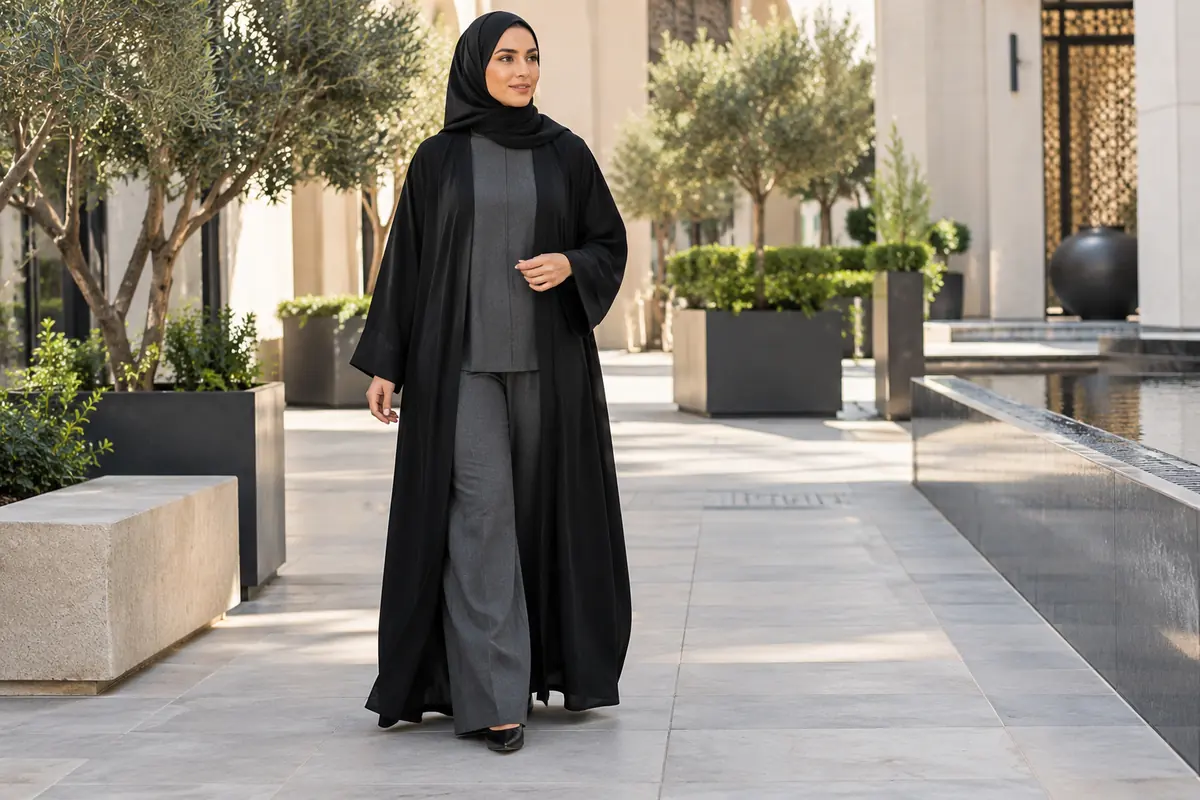
Check an open outer layer over an opaque base
An open abaya and its underlayer form one outfit. If you want a reliably covered base, begin by examining that garment rather than assuming a dark outer color makes everything opaque. Check the neckline, sleeves and lower garment in the positions you use.
Near a window, look at the underlayer beneath the open front and any thin outer sections. Repeat in room light. Sit, reach and walk so the opening changes naturally. Do not use deliberate stretching or a harsh spotlight as if it were an official fabric test.
Choose the layers by their job. A simple base can let an outer texture remain clear. A strongly textured base under another textured piece can also work, but first check whether the overlap feels bulky, catches or shifts.
Build day and evening flatlays with one base
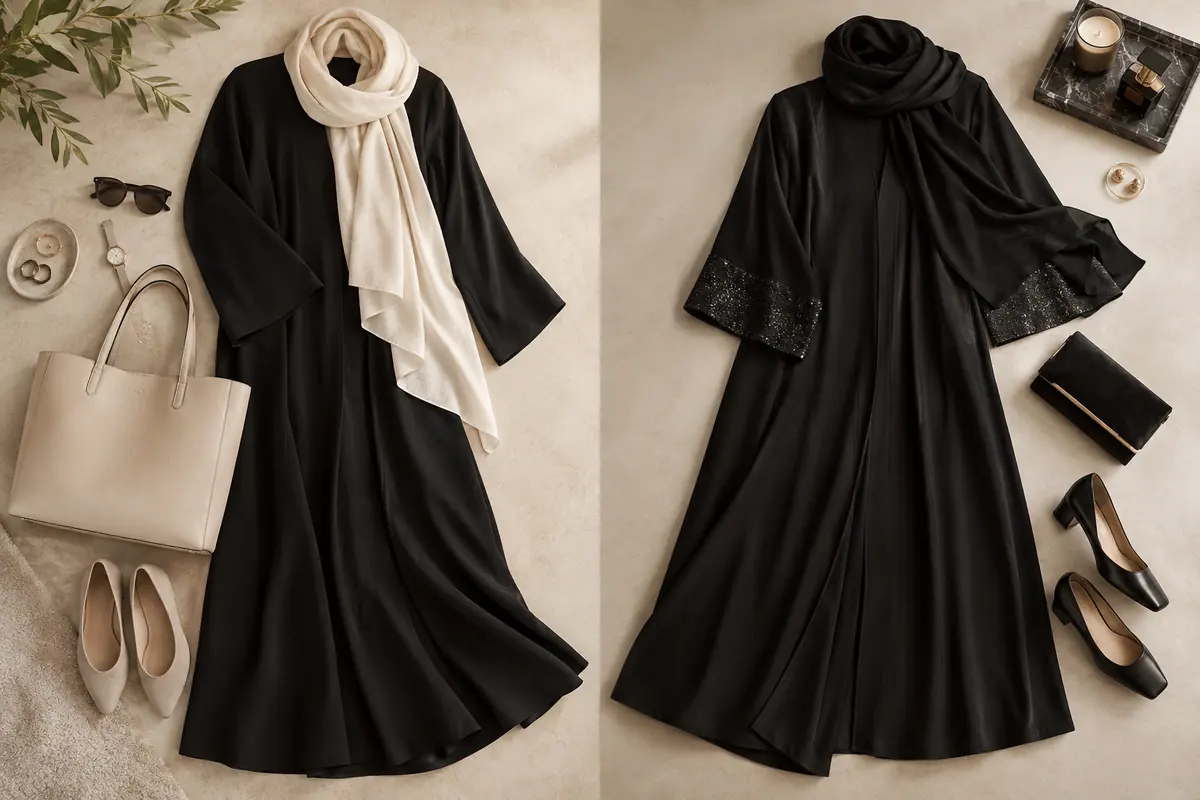
For a daytime desk outfit, try a matte black abaya, a comfortable underlayer, controlled sleeves, everyday shoes and a bag containing the actual work kit. A textured scarf can be the main visual detail. Check whether the hem works with those shoes before calling the flatlay complete.
For an evening gathering, keep the same base and compare one lustrous scarf or one accent accessory. Choose the planned shoes and test them against the existing hem. The photograph can suggest a combination; the fitted garment determines whether it works in motion.
Write down exactly what changes between the two: “swap scarf and small bag,” for example. If your plan needs a new underlayer, shoes, jewelry and another abaya, it is a separate outfit rather than a small transition. Both are valid, but the preparation is different.
Compare black pieces under more than one light
Put the abaya and scarf next to each other near a window, then under the lamp where you dress. Some apparent color matches change with the light; X-Rite explains metamerism. Your home comparison does not diagnose the exact reason for every mismatch.
If the pieces look different, choose whether that difference bothers you. You can make it deliberate by separating the surfaces with an obvious texture or a contrasting scarf. Exact matching is a preference, not a requirement for a coherent outfit.
Phone exposure, filters and a retailer's lighting can hide differences. Use an unfiltered photo as a memory aid, then make the decision while looking at the actual clothes. An app preview cannot certify a match in all lights.
Black sheila looks grey or navy: separate the observations
Before washing, dyeing or buying another black piece, compare both clean, dry garments in the same light and at a similar angle. Then change just the light or just the angle. You are locating the difference, not proving which dye or treatment caused it.
| The specific problem | Low-effort comparison | Useful next step |
|---|---|---|
| Scarf looks grey only when tilted | Rotate both surfaces without stretching | Decide whether the visible sheen contrast works for you |
| Pair matches at home but differs at work | Compare in available work-like light | Choose a pairing you like there or a clearly contrasting scarf |
| Difference remains in several lights | Compare a second existing scarf beside the same abaya | Prefer an intentional contrast if an exact match is unavailable |
| One area looks patchy or worn | Inspect the garment and its care history separately | Ask about appropriate care; do not treat a photo as a dye diagnosis |
Adding more shiny jewelry does not change a fabric mismatch. Repeated washing or improvised dye treatment is also not a styling test. If you enjoy the difference, repeat a visible texture elsewhere and keep it; matching every black is optional.
Keep the finish usable
Inspect the cuff, bag-contact area and lower hem. Loose embellishment, a snag or a strap that rubs is a practical issue worth noticing before the event. Do not pull a snag tight or aggressively brush a delicate surface to remove one mark.
Follow the garment label for care: GINETEX reference. A black dye or a shiny finish does not supply its own washing and ironing instructions. Ask a competent cleaner or tailor about an uncertain treatment rather than experimenting immediately before you need the garment.
Store accessories so rough edges do not sit against delicate fabric. Give yourself enough preparation time to check the whole outfit; last-minute steaming, perfume spraying or stain treatment should not replace label instructions.
A hypothetical edit that makes the outfit clearer
Hypothetical example: Mariam plans a family dinner in a textured black abaya, a glossy scarf, a decorated bag and a large cuff bracelet. She likes each item separately but cannot see the texture she wanted to feature. She tests a matte scarf and removes the bracelet that catches the sleeve. The bag remains her chosen accent.
Her second version is not inherently more elegant or more culturally correct. It simply serves her stated preference: visible texture with comfortable hands. Someone else may deliberately choose a richer mix after the same contact checks.
Avoid common shortcuts
Assess the garment's movement and the visual details you enjoy without rating the size of a body. Do not assume a low price means poor style or a high price means useful construction.
Do not stack new accessories because a photograph feels flat. First look at posture, lighting, surface and which part of the garment the crop shows. A subtle matte texture may disappear in a small image while remaining appealing in person.
Continue with the decision you actually need
Review abaya fit and movement, sheila draping with necklines and abaya colour palettes. Turn the base into Gulf workwear formulas, compare outfit colour combinations or start from a closet capsule. Browse the Gulf style hub for the next useful choice.
Frequently asked
Does a black abaya need bright accessories?
No. Surface contrast, a deliberate scarf arrangement or a clean silhouette can provide interest. Choose an accent if you enjoy it; it is not a compulsory correction for wearing black.
Why does my black sheila look grey or navy beside the abaya?
Compare the actual clean, dry pieces at the same angle and in the same light, then change one condition. Sheen, texture, wear and color appearance can differ; a photo cannot identify the cause. Try another existing scarf or deliberate contrast before washing or dyeing to chase a match.
Is shiny fabric always evening fabric?
No. That is a styling association, not a material rule. Test the surface, movement and dress expectations of the occasion; a small lustrous detail can work during the day.
Does satin mean silk?
A retail fabric name alone is not enough to confirm fiber content. Read the composition and care labels and examine the garment rather than treating sheen as proof of silk.
Can a black outer layer be transparent?
Yes. Black color alone does not establish opacity. Test the garment over the planned underlayer in available daylight and room light, including areas that stretch or overlap differently.