

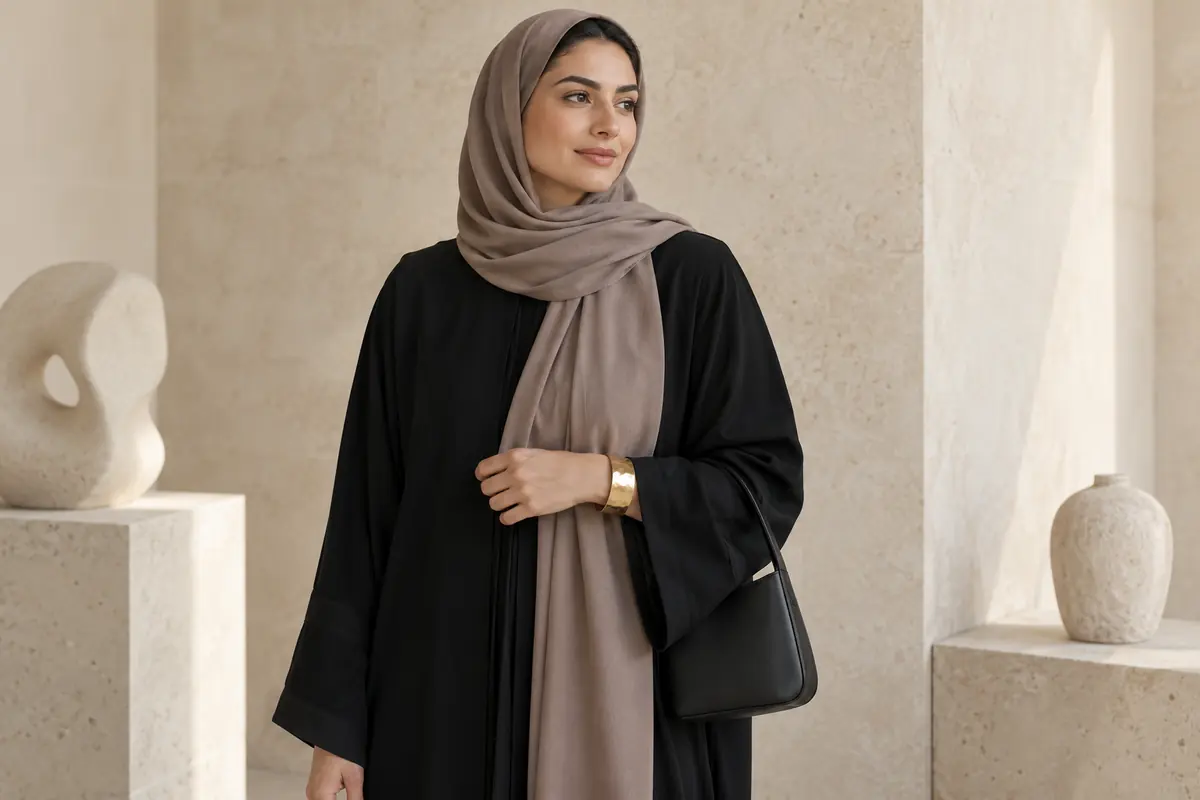
A beautiful piece can still disappear, collide with trim or catch a cuff. Start with the visible problem in the full outfit, then change one thing.
Gold jewellery has many personal and family meanings. A full set, one everyday chain and a treasured inherited piece can all be valid choices. This guide offers comparisons, not a claim about what all Gulf women wear. Start with Gulf style if several parts of your outfit need planning.
Match the fix to the actual failure
| Problem | Why the pairing may fail | Small comparison | Stop condition |
|---|---|---|---|
| Bracelet catches the cuff | Clasp or setting meets fabric during a gesture | Different piece or no bracelet with the same sleeve | Resistance, rough metal or an uncertain stone |
| Necklace vanishes when seated | Coverage or neckline overlaps its length | Another intended length or another focal area | Do not compromise chosen coverage for visibility |
| Pendant keeps striking a closure | Two details occupy the same path | Move length clearly away from the closure | Repeated contact despite adjustment |
| Outfit feels crowded | Trim, bag clasp and jewellery share attention | Remove one piece with everything else fixed | Preference settled; no need to keep adding |
A smooth-looking bangle is not automatically snag-free. Test this exact piece and garment.
Choose a visible focal area
Stand in the complete outfit with your intended sheila, scarf or other coverage. Notice what is visible while standing and seated. If the neckline is covered by a scarf, a necklace may remain visible over fabric or may be irrelevant to this look. If the ears are covered, earrings need not become the styling focus.
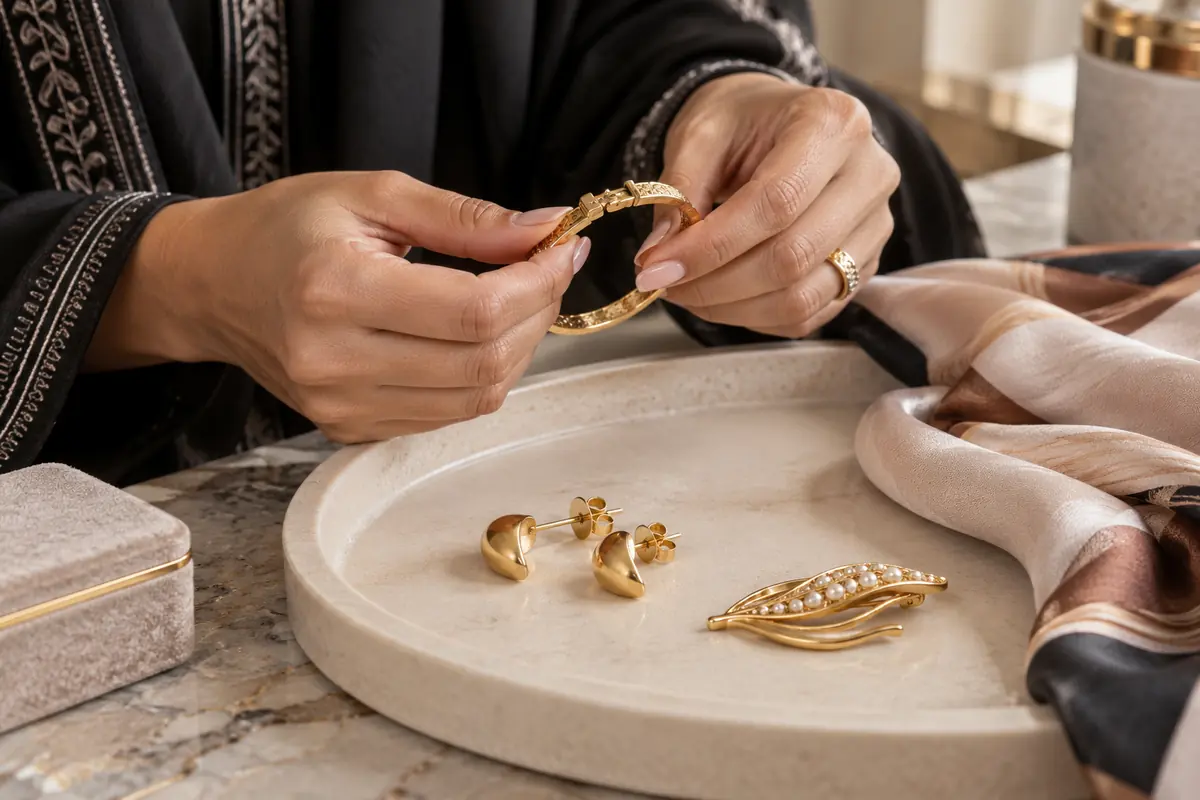
For a hands-and-cuffs look, choose a ring or bracelet that sits naturally beside the sleeve. Hold the actual clutch and phone. A cuff that looks balanced with empty hands can compete with a large bag clasp; compare them together. You are composing the visible arrangement, not filling every possible jewellery category.
Take one ordinary photograph from several steps away. Ask which detail you notice first, and whether that matches your intention. Do not use a filtered close-up as the only judge of scale.
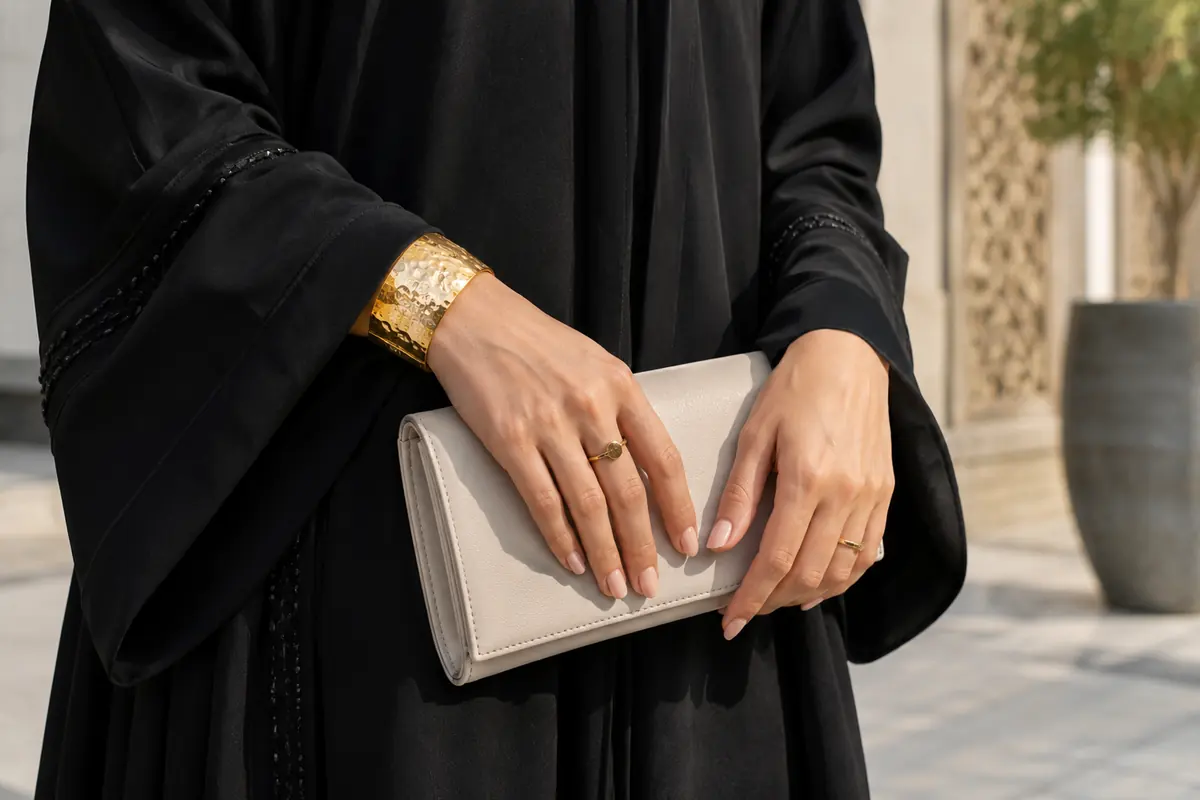
Compare jewellery scale with the trim
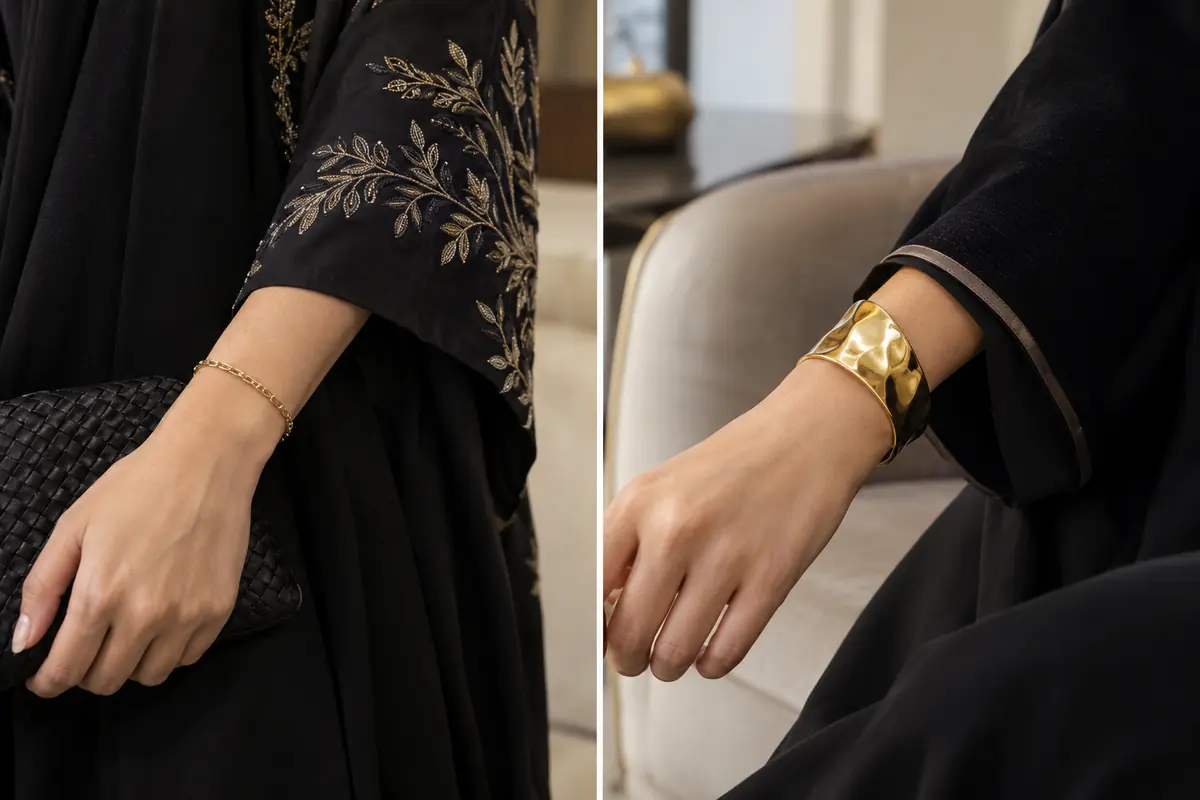
Lay the garment flat and place two candidate pieces beside its embroidery, piping or buttons. Then wear them individually. A broad cuff and a fine chain produce different balances even if their colours match.
| Abaya detail | Option to compare | What to observe |
|---|---|---|
| Broad decorated cuffs | One ring or a simpler bracelet | Does jewellery catch or hide the work? |
| Plain fabric and simple sleeves | A more visible cuff or necklace | Can you see the accent from a normal distance? |
| Metallic neckline trim | No necklace versus a different length | Are two details occupying the same line? |
| Patterned fabric | A quieter shape versus a coordinated set | Which arrangement looks intentional to you? |
You can repeat a warm gold tone without matching every surface exactly. Matte fabric and polished metal create contrast; two shiny surfaces repeat brightness. These are visual choices, not evidence that one option is more expensive or more authentically Gulf.
For the garment itself, use abaya fit and proportions. A bracelet cannot resolve an uncomfortable sleeve or an ill-fitting shoulder.
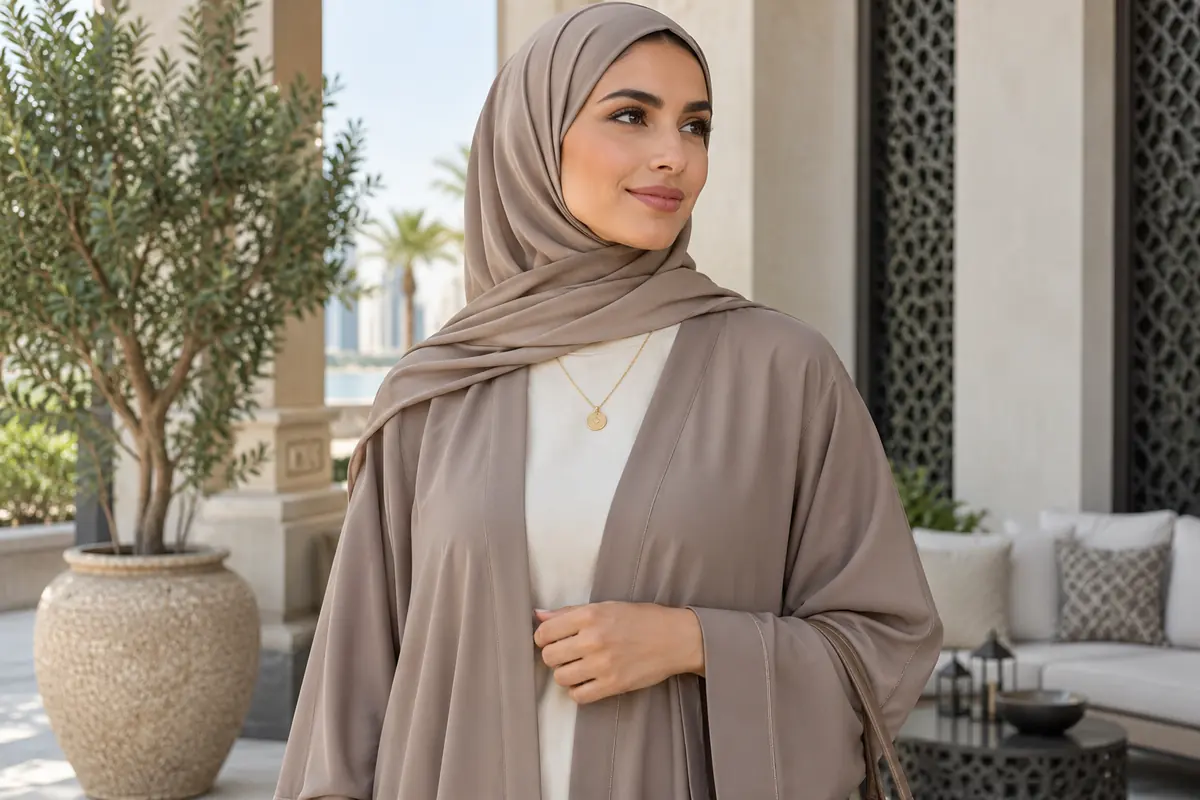
Fit the necklace to your actual neckline
Try three positions: clearly above the main trim, clearly below it, or no necklace. Avoid a pendant sitting directly on a fastening if they keep colliding. Adjust only with the necklace's intended clasp or extender; do not force a delicate chain into a makeshift knot.
For jewellery over a covered neckline, check whether the chain slides on the fabric when you turn. Check whether the scarf's edge covers the pendant as you sit. Neither outcome means the garment is wrong; it means the pairing needs another length or a different focal area.
For an open abaya, try the necklace with the inner outfit and then the outer layer. The visible opening changes its frame. Use outfit colour combinations for comparing inner and outer colours, and occasion hair and necklines if hair will share the same area.
Check fastenings and movement before leaving
Inspect clasps, earring backs and any projecting setting off the body. If a stone or fastening seems loose, ask a jeweller to check it before wearing. A styling plan should not depend on hoping an uncertain clasp holds through the event.
Put the complete set on, sit, reach forward and open your bag. Move the sleeve over the bracelet gently. If it catches, stop rather than dragging the setting through delicate fabric. Try another piece, another sleeve position that remains comfortable, or no bracelet.
Make sure rings let you use the bag and phone normally. Choose comfort over keeping a photograph's exact stack. Pack removed pieces in separate soft storage, not loose beside keys. Record where they are stored so they are not forgotten during a late departure.
If the same piece keeps catching or disappearing
Locate contact without damaging either item
A static photograph cannot show a catch during a greeting. Put clothing on before adding the piece, open the actual bag and reach forward. If something catches, stop. Release only without force; leave a persistent snag for the jeweller or garment specialist rather than tugging, cutting a thread or filing the setting.
Inspect jewellery away from fabric. A rough edge or loose-looking part is a maintenance question. Do not assume a more expensive brand, a different metal colour or a tighter bracelet removes the problem.
Compare visibility without changing your preferences
If the necklace vanishes only when seated, repeat that position. Compare its intended adjustable lengths, then a version without it. A necklace above trim, below trim and absent creates three distinct arrangements; none is compulsory.
If earrings remain covered, they can stay a personal choice without becoming the visible accent. Rings or a suitable cuff may provide the detail you want. A full set is also valid when you enjoy its result. The useful outcome is visibility and comfort you chose, not a rule that every abaya needs one formula.
Keep care decisions separate from styling advice
A gold-coloured piece may be solid gold, plated metal or another material. Appearance does not tell you composition or how it should be cleaned. Ask for the material, finish, stones and care instructions before using a cleaning method found online.
GIA's jewellery-care guide explains why chemicals and gemstone treatments matter. Follow care for the whole piece, including its stones. Do not assume a home ultrasonic cleaner or an abrasive household product suits an unknown item.
For pearls, GIA's pearl-care guidance advises avoiding harsh chemicals, wiping after wear and soft storage. Apply hair products and perfume away from the jewellery. An inherited piece with uncertain construction deserves a jeweller's assessment rather than a cleaning experiment before an event.
A practical fifteen-minute styling test
Use five minutes to put on the real outfit and identify the visible area. Use the next five to compare two arrangements. Use the final five to test clasps, sleeves, the bag and sitting. This is an organizing estimate; give yourself more time if fastenings or coverage need help.
Write the chosen combination in your notes: “Plain cuffs, broad bracelet on right wrist, simple rings, no necklace; clasp checked.” A specific description makes it easier to repeat the outfit without buying again.
For travel or a warm arrival, check heat and air-conditioning outfits. Extra layers can change which jewellery remains visible. Plan event makeup touch-ups before putting sensitive jewellery near product application.
A hypothetical example: the bracelet that was not the problem
Imagine Maryam selects a broad bracelet for a plain abaya. It looks good standing still, but catches the cuff's small fastening when she reaches for her clutch. She compares a smoother bracelet and checks the garment fastening rather than pulling the same piece through repeatedly.
She chooses the smoother option, keeps one ring and removes a necklace that disappears beneath her scarf. This illustrative example is not a real client's result. The useful change is that the jewellery works with her actual gestures, not just the still photograph.
The final question is straightforward: can you see the pieces you want to see, wear them comfortably and manage the outfit without constant repair? If yes, your styling has done its job.
Frequently asked
What should I do when a bracelet catches an embroidered cuff?
Stop pulling. Release only if it comes away without force, inspect the piece off-body and change the pairing. A persistent catch or rough setting needs appropriate professional attention, not pulling through the fabric.
Can I file a rough jewellery edge at home?
Do not make filing or reshaping an unknown precious piece your styling solution. Ask a jeweller to inspect its construction and setting. Meanwhile use another piece or leave that area without jewellery.
How do I style a necklace that disappears beneath my scarf?
Compare its intended adjustable lengths with the actual scarf while seated, then a version without it. Keep your preferred coverage. Hands or another visible area can carry the accent instead.
What if necklace and abaya embroidery compete?
Keep clothing and light fixed and compare one piece removed, or a length clearly above or below the trim. Choose the arrangement you enjoy; exact matching is optional.
Is a full gold set too much?
That is a personal styling preference. Compare the complete set with one piece removed, then check comfort, visibility and fastenings. There is no universal rule against a coordinated set.