


Powder does not answer every makeup problem. Distinguish heavy buildup, slipping coverage and friction before touching up the area.
An event in the Gulf might involve a warm outdoor arrival, a cool room, a meal, conversation and photographs. That is a planning possibility, not a claim that every venue or woman has the same routine. The Gulf style hub helps connect makeup with the outfit, jewellery and coverage you actually chose.
Name the appearance before choosing a tool
| What you see | Possible cosmetic mechanism | Small action now | Next-trial check |
|---|---|---|---|
| Thick layer or crease buildup | Product concentrated there | Redistribute a little with a clean tool; do not add coverage first | Less base or less local powder |
| Shiny islands with bare gaps | Surface slip and wear may be involved | Press unwanted shine, then a tiny local correction | Immediate onset or after travel? |
| Small rolls while blending | Layers may move under repeated rubbing | Stop rubbing and adding product | Same needed care; change one optional layer or makeup amount |
| Clear rubbed patch beside scarf, tissue or phone | Physical contact removed coverage | Repair that boundary and reduce repeat contact | Does the object meet the spot again? |
These can overlap. They do not prove a damaged skin barrier, a specific ingredient incompatibility or a need to exfoliate.
Run a wear check before the occasion
Use the makeup combination you plan to wear and take a normal daylight mirror check after application. Repeat after ordinary activities that resemble your event: a short walk, sitting indoors and a meal. You do not need a staged extreme-heat challenge to learn where lip colour wears away.
Record the location and time of change, not a verdict such as “my skin ruins makeup.” A useful note is “Lip centre faded after food; forehead shiny after travel; cheeks still comfortable.” The kit should answer those observations.
Keep one variable steady while comparing. If you change moisturizer, base, powder and spray together, you will not know which helped. Foundation shade matching addresses colour before wear; a touch-up cannot correct a fundamentally unsuitable shade by adding more of it.

Pack a small kit with an actual purpose
Lay out items and assign each a job. If you cannot name the job, it may not need to go in the bag. Use compact original containers when practical rather than an improvised pot with no product identity.
| Observed issue | Item to consider | Job |
|---|---|---|
| Forehead shine | Fresh blotting sheets | Press away surface shine before deciding on powder |
| A small worn base patch | A little familiar base and clean tool | Repair the patch without recoating the face |
| Lip centre fades | Your own lip colour and mirror | Restore the worn centre and check its edges |
| Outer edge smudges | Suitable remover and fresh small tool | Correct the outer skin area carefully |
| No significant change | Mirror, perhaps lip colour | Avoid carrying products for imaginary problems |
FDA's cosmetic-safety guidance advises following labels, washing hands, not sharing makeup and protecting containers from extreme temperatures. Use eye products only as intended. Stop a product that causes a reaction and ask for healthcare advice.
For storage and contamination questions, read FDA's microbiological guidance. Keep your kit clean and closed. Do not treat a used applicator as clean because it looks tidy.
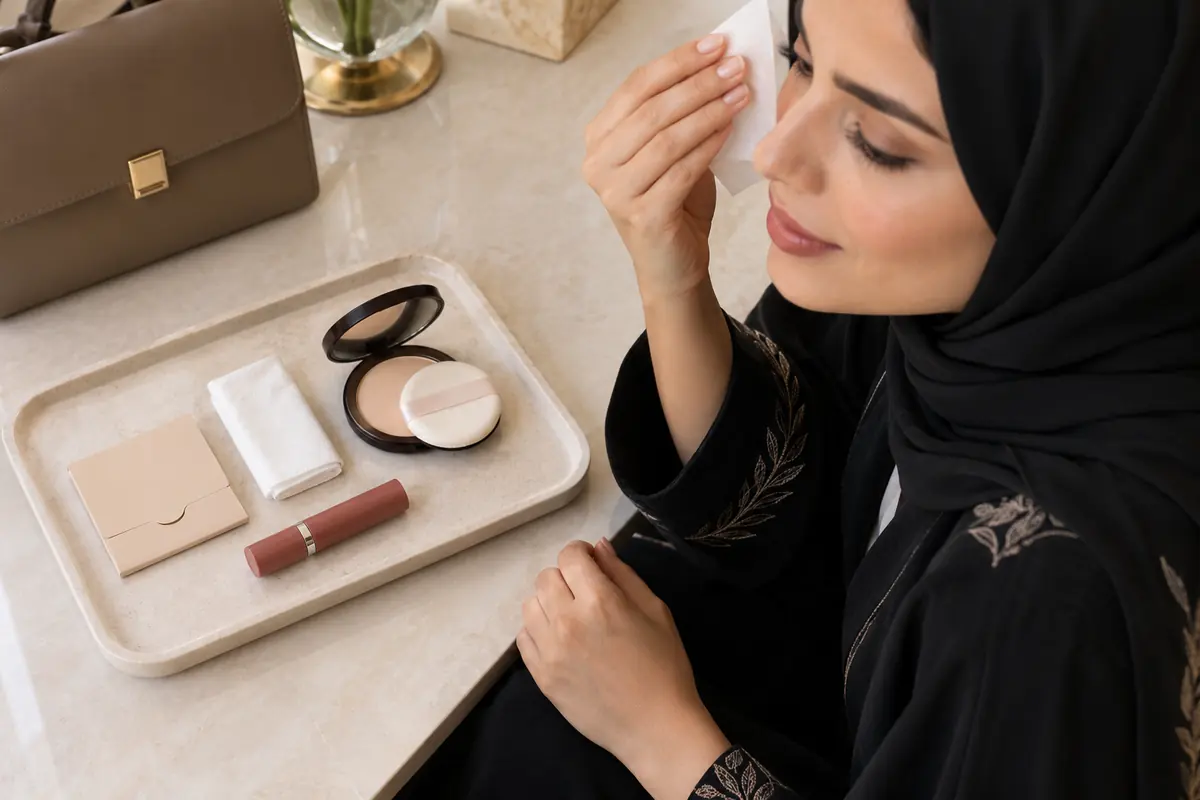
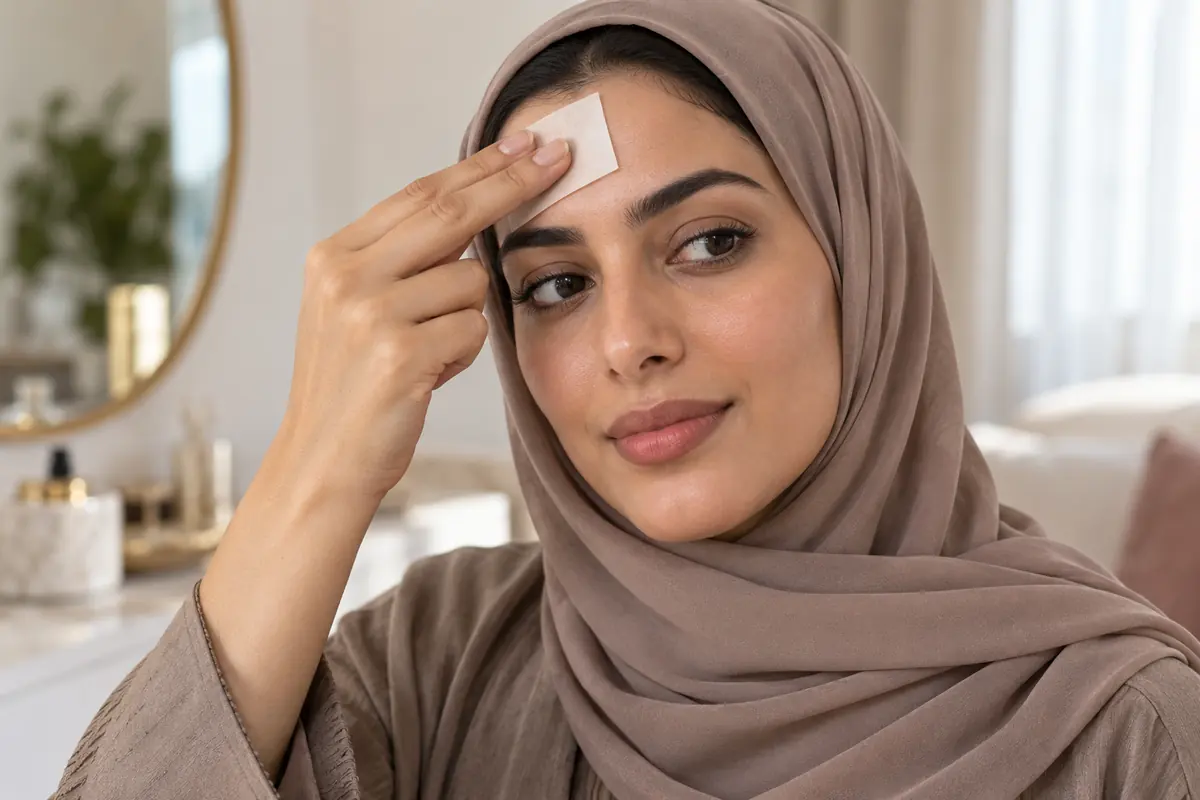
Refresh shine and creases without a full new layer
In a steady mirror, identify the exact area. Shine is a finish you may or may not want to change; it does not mean the whole face needs repair. Press a fresh blotting sheet lightly rather than rubbing it across the base. Check again before deciding on powder.
If powder is useful in your tried routine, use a small amount only on the area you want less reflective. Press, then stop. Avoid chasing every highlight: the high points of the face may be intentionally luminous.
For a small crease, use a clean tool to redistribute surface buildup gently. Inspect from conversational distance rather than magnifying until normal skin texture looks unacceptable. If another layer makes the area look heavier, leave it alone. This is a cosmetic adjustment, not a skin treatment.
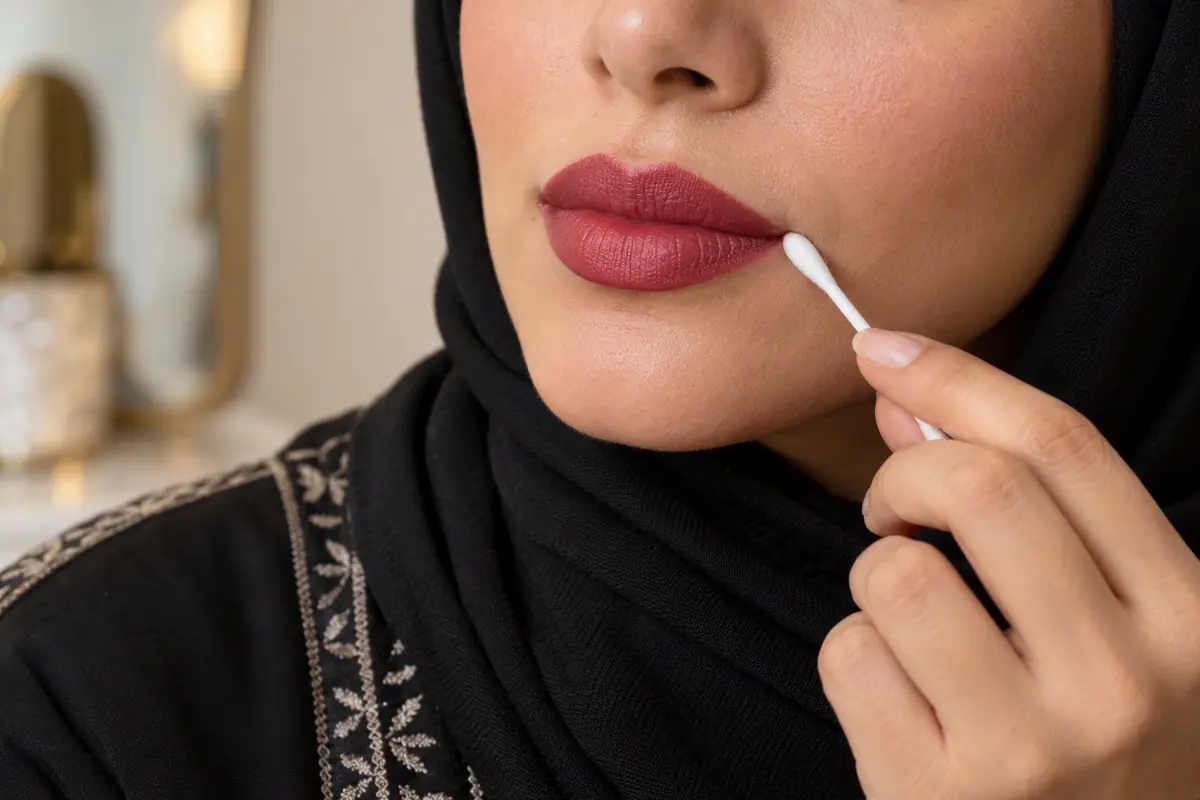
Tidy the lip edge or outer eye area selectively
After a meal, check the lip centre, corners and outline. Gently remove loose surface buildup before adding a little of the original colour. Restore the centre first if the outline is still intact. Check the teeth and corners rather than adding coat after coat with no mirror.
For a smudge on the skin outside the eye, use a fresh tool and a minimal amount of remover appropriate for that area, following directions. Keep it away from the eye itself. Let the area settle before deciding whether the edge needs your own familiar eyeliner. Do not rebuild the entire eye for one small mark.
The kohl-style eyeliner guide starts with a repeatable upper-lid shape. A planned shape is easier to tidy than a complicated one you did not test. If eyes are irritated, leave makeup out; another application is not a repair for discomfort.
If foundation separates or rolls: stop the add-more cycle
Separate the wear repair from the preparation experiment
At the event, choose the smallest affected area. For shine, press a fresh blotting sheet; for missing coverage, press little familiar base locally. If the layer is thick already, do not add more. Stop once the repair joins reasonably; ordinary skin texture need not be erased.
If product rolls while applying, further buffing can continue moving the layers. Stop, remove loose surface bits gently with a clean tool and decide whether a small area needs restarting. One useful patch beats spreading the problem across the cheek.
Trial one variable another day
Keep necessary care and sunscreen according to directions; do not reduce sun protection to make foundation behave. FDA sunscreen guidance explains why following application directions matters. Compare less makeup first. At a later trial, change one optional primer or allow a layer to settle as its directions require. Record location and timing.
A single water-based or silicone-based label does not establish how your complete routine will wear. Observe the actual combination. Avoid last-minute exfoliation, facial hairspray or a new treatment as a supposed instant fix. If skin stings or becomes irritated, stop the product and ask for appropriate advice rather than concealing it.
Coordinate the kit with the outfit
Check that the bag closes with the kit inside and that you can reach it without emptying everything. Leave jewellery away from product application, especially pieces with care requirements. Use gold jewellery and an abaya to plan the order of dressing and storage.
Coverage and neckline matter too. Take care not to press fresh lip colour or base onto fabric while adjusting it. Try the actual sequence before leaving: dress, chosen coverage, final mirror check, then jewellery where practical.
With Gulf wedding guest outfit planning, decide where a quiet touch-up is possible. You should not need to balance a kit in a crowded doorway or fix an eye edge in a moving car.
Set a realistic check-in plan
Check after arrival if travel was part of your wear issue, after a meal for lips, and when you actually notice a change. An automatic hourly full-face application is unnecessary. Allow a few quiet minutes rather than making makeup checks the main activity of the evening.
Ask a makeup artist for a specific handover: “Which area do you expect me to check, which product is suitable for it, and what should I avoid adding?” A blanket instruction to powder everything does not explain your actual repair.
Use soft glam versus full glam when choosing the original finish. A softer or more defined look can each have a modest kit; more dramatic makeup does not necessarily require carrying every product used.
A hypothetical example: three observations, three items
Imagine Noor trials her event look. The lip centre fades after dinner, the forehead becomes shinier after travel, and the cheeks stay as she likes them. She packs her lip colour, fresh blotting sheets and a mirror. She includes a little powder only after checking that it suits the finish in her trial.
At the event she presses the forehead, restores the lip centre and leaves the cheeks untouched. This is an illustrative scenario, not a measured claim about product performance or all Gulf climates.
Her useful result is not a face that never changes. It is knowing what to check, carrying what helps, and returning to the celebration after a small correction.
Frequently asked
How can I tell cakey makeup from separating foundation?
Cakey describes heavy-looking buildup; separation describes irregular islands or gaps. Both can coexist. Observe location, timing and contact before a small correction, without diagnosing skin from appearance.
How do I fix cakey makeup during an event?
Stop adding product. Gently redistribute a small surface buildup with a clean tool and check at normal distance. Leave the rest untouched. If layers make it heavier, accept a lighter correction and trial less next time.
What if foundation rolls into little bits while blending?
That differs from a bare patch after hours. Stop rubbing and adding layers. On another day keep needed care and sunscreen according to directions, then compare less makeup or one optional layer at a time.
How do I fix a patch rubbed off by a scarf or tissue?
Move the contact away during repair, press a little of the same base onto the patch and soften its edge. Keep intact areas unchanged. Adding everywhere will not remove the repeated contact.
Does setting spray fix foundation separation?
Not universally. Follow its directions and test the combination beforehand. If separation repeats, record its onset and compare amount, settling time or one optional layer separately.