

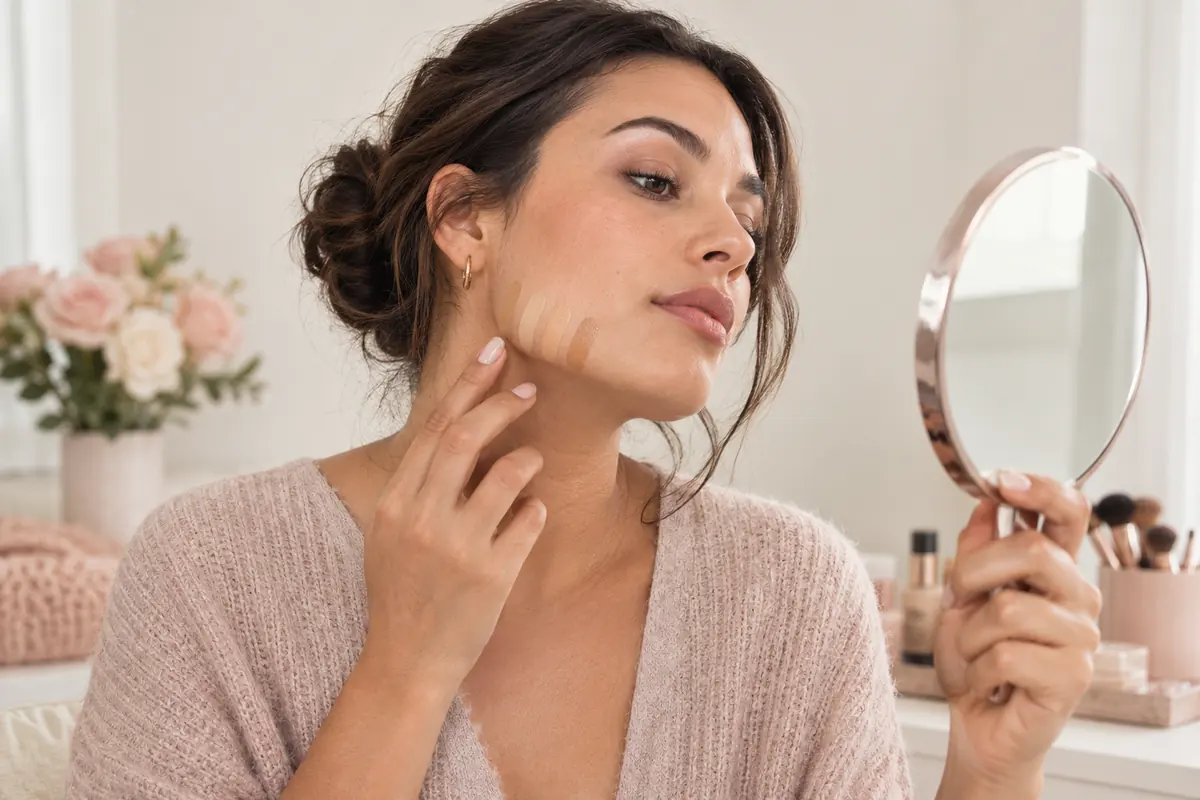
Foundation is the one piece of makeup you buy to disappear. Everything else, lipstick, liner, shadow, is supposed to be seen. Foundation succeeds only when no one can tell it's there. That's what makes it the hardest shade to get right and the most expensive to get wrong: a near-miss doesn't read as "slightly off colour," it reads as wearing makeup badly.
The good news is that matching foundation is a method, not a talent. Depth picks the row. Undertone picks the column. A daylight jaw-line test settles the cell. And one quiet villain, oxidation, explains almost every shade that betrayed you after lunch.
This guide assumes you've pinned your undertone. If you haven't, stop and run the five-minute test in find your undertone, it's half of every match, then come back.
For a match that looks orange, pink or grey even at the right depth, compare foundation options for olive skin. Change one variable at a time so you can tell a depth mismatch from an undertone or lighting problem.
The two-variable match
Every foundation shade is two decisions stacked together.
Depth is how light or deep the shade is: fair, light, medium, tan, deep. This is the easy half, you can usually eyeball your row, and a tan moves you down it seasonally.
Undertone is the colour beneath: warm, cool, neutral, olive. This is the half people skip, and it's why two foundations at the identical depth can look like glow and grime on the same face.
| Your undertone | Look for shade names like | Avoid |
|---|---|---|
| Warm | golden, honey, warm beige, caramel | rose, porcelain, "cool" anything |
| Cool | porcelain, rose, cool beige, espresso | gold, honey, "warm" anything |
| Neutral | neutral, "N" codes, true beige | strongly gold or strongly pink |
| Olive | olive, neutral-olive, golden-neutral | plain "warm golden" (oxidises orange) |
Match the row by eye; match the column by undertone. Now you have a shortlist of three, not a whole shelf.
The jaw-line daylight test
This is the test that actually decides, and it takes ten minutes.
- Start with a clean, bare, dry face, no primer, no existing makeup.
- Stripe your three candidate shades side by side along the jaw, where face meets neck. Not the back of the hand, your hand is usually a different colour and has fooled buyers for a century.
- Step into daylight. Shop lighting is engineered to sell; a window tells the truth.
- Wait ten minutes. This is the step everyone skips and the one that catches oxidation.
- The match is the stripe that disappears into your neck. The other two will show a faint edge, too light, too dark, too pink, too gold.
If all three still show an edge after ten minutes, your undertone column is wrong, not your depth row. Go back a column, most often, the answer is olive or neutral.
Oxidation: why the shop shade lied
Here's the mechanism behind nearly every "it looked perfect in the store" story. Many foundations oxidise, they react with air and your skin's natural oils and darken and warm over the first hour. A shade matched at the mirror can drift a full notch by the time you reach the car.
What to do about it:
- Wait before you judge, ten minutes minimum on a tester.
- Go a touch cooler or lighter if a formula is known to oxidise (a quick search of the exact product plus "oxidise" will tell you).
- Set with a thin veil of powder, which slows the drift.
- Olive skin, take note: you oxidise orange faster and harder than anyone. This is the whole reason olive and neutral-olive shades exist, use them.
Where virtual try-on helps (and where it doesn't)
Be honest about the tool. Overlay and AI try-on are the weakest at foundation, because they tint your skin a flat colour instead of predicting coverage, finish, and oxidation. Most tools will make every shade look like it matches, which is exactly the failure mode you're trying to avoid.
So use it for what it's good at: narrowing the family. A render on your own face, at your real depth and undertone, because a good Studio holds those constant, will quickly tell you whether you're a warm-tan or a neutral-tan, a fair-cool or a fair-olive. That alone collapses a fifty-shade wall to a shortlist of three.
Then take it offline. Save the render, take it to the counter, and run the jaw-line test on those three. Try-on gets you to the right shelf in seconds; the daylight stripe picks the bottle. The render is also a precise brief: "this depth, this undertone, in a long-wear formula" beats "something natural" every time.
A quick troubleshooting table
| The problem | The cause | The fix |
|---|---|---|
| Orange by noon | Oxidation; undertone too warm | Wait-test; go cooler or olive; set with powder |
| Grey or ashy | Undertone too cool for olive skin | Switch to neutral-olive or golden-neutral |
| Mask edge at the jaw | Matched face not neck | Match the neck; bronze the face back |
| Cakey in MENA heat | Too much product / wrong finish | Sheer it out; choose a longwear matte, set lightly |
| Looks great inside, off outside | Judged under shop light | Always confirm in daylight |
After you've matched
Foundation is the canvas; the rest of the face sits on it. Next reads, in order:
- What lipstick suits you, the same undertone logic, applied to lips.
- Makeup by face shape, where to place blush and contour now that the base is right.
- No-makeup makeup, the five-minute face that starts with the lightest base that still matches.
And the pillar: virtual makeup try-on.
A note on accuracy and authority
Foundation matching is half colour theory, half skin science. For the skin side, oils, oxidation, sun-driven depth changes, the American Academy of Dermatology at aad.org is the plain-English authority. For the colour side, the Pantone Color Institute at pantone.com is the reference behind every shade system. The jaw-line daylight test above is exactly how a senior beauty advisor matches a client, minus the fluorescent lighting that makes shops the worst possible place to judge a shade.
Frequently asked
How do I match foundation to my skin?
Two variables, in order. First depth, fair, light, medium, tan, or deep, which sets the row. Then undertone, warm, cool, neutral, or olive, which sets the column. Test three candidate shades in a stripe along your jaw, in daylight, and wait ten minutes; the one that disappears into your neck is the match. Never match to the back of your hand, which is usually a different colour from your face.
Why does my foundation turn orange or grey after a few hours?
That's oxidation: many formulas darken and warm up as they react with air and your skin's oils, so a shade that looked perfect at application drifts an hour later. The fixes are to wait ten minutes before judging a tester, to go one notch cooler or lighter if a formula is known to oxidise, and to set with a thin layer of powder. Olive skin oxidises orange most dramatically, choose olive or neutral-olive shades.
Can I match foundation online or with an app?
You can narrow the family online, depth and undertone, but you should confirm the final shade in person or in daylight. Virtual try-on and overlay tools tend to make every shade look like it matches, so use them to shortlist, not to decide. The jaw-line daylight test is still the deciding move.
Should I match foundation to my face or my neck?
Your neck, or the line where face meets neck. The goal is no visible border, foundation that matches your face but not your neck leaves a mask edge. If your face and neck are very different depths (common with sun exposure), match the neck and bring warmth back with bronzer, rather than matching the face and leaving a line.
How many shades should I test?
Three: your best guess plus one notch lighter and one notch cooler. Stripe them side by side along the jaw, in daylight, and wait. Testing one shade tells you nothing, because a single stripe almost always looks 'fine'. The match is the one that vanishes; the others will show an edge.