

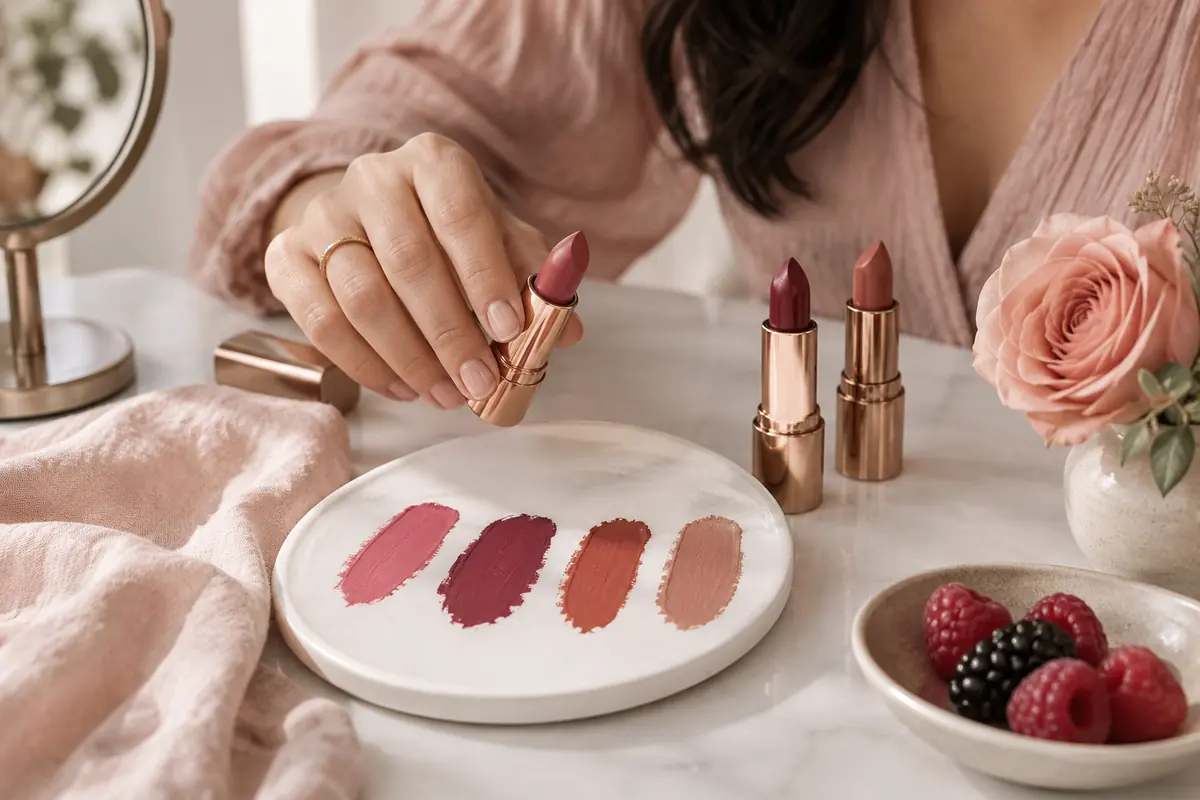
A lipstick is the fastest change in beauty, one swipe, ten seconds, a different face. It's also the one most people buy on impulse and wear once. The shade looked incredible on the influencer, or on the back of your hand, and then went strange on your actual mouth.
The fix is the same two inputs that run the whole cluster: your depth (how light or deep your skin is) and your undertone (the colour underneath). Get those right and lipstick becomes almost foolproof, the right red whitens your teeth, the right nude wakes up your whole face, and you stop buying the ones that sit in the drawer.
If you haven't pinned your undertone, do it first, five minutes in find your undertone, because half of every lipstick decision is hiding in that answer.
The rule, in one line
Undertone decides the family; depth decides how far you can push it.
- Cool undertones glow in blue-based shades: true red, raspberry, berry, rosy and pinky nudes.
- Warm undertones glow in yellow-based shades: brick, coral, terracotta, peachy and caramel nudes.
- Neutral can wear both, start with whatever the occasion wants.
- Olive is quietly lucky: brownish-rose nudes and balanced true reds both read expensive; avoid the extremes (very blue or very orange).
Depth then sets the ceiling: fair skin can be overwhelmed by very dark vamps; deep skin can swallow very pale nudes. Stay in proportion to your own contrast.
The map: nude, red, berry by depth
The three lipsticks everyone actually reaches for. Find your row, then bias the pick toward your undertone.
| Skin depth | The wearable nude | The flattering red | The evening berry |
|---|---|---|---|
| Fair | soft rosy beige / peachy nude | cherry or classic red | raspberry, soft plum |
| Light–medium | rose-beige, "MLBB" | true red or brick | mulberry, wine |
| Tan / olive | caramel-rose, warm beige | brick or balanced true red | deep berry, brick-plum |
| Deep | terracotta, warm brown, deep rose | blue-red or rich brick | plum, wine, deep fuchsia |
The single most common error sits in the nude column: choosing a nude lighter than your lips. A nude should be a touch deeper or richer than your natural lip, in your undertone, otherwise it reads grey and washes you out. "My lips but better," not "my lips erased."
Finish changes everything
Two lipsticks in the identical shade can read completely differently depending on finish:
- Matte reads the most pigmented and "done", strongest for a defined lip, driest on the lips, least forgiving in MENA heat.
- Satin / cream is the everyday sweet spot, colour-true, comfortable, flattering on almost everyone.
- Gloss / tint reads youngest and sheerest, colour drops a few shades lighter than the bullet, which is why a gloss "nude" is safer than a matte one.
Finish is the one thing a render only approximates. Get the colour from try-on; get the finish from the product description or a review.
The MENA shades that sell out
Across the Gulf and the Levant, two lip stories dominate, and both reward the undertone logic above:
- The brown-rose nude, the daytime default: a warm, slightly brown rose that flatters tan and olive skin and survives a long day. It's the "MLBB" of the region for a reason.
- The classic red, for weddings, Eid, and going out. On warm and olive skin a brick or balanced true red reads richest; on cool skin, a clean blue-red. A red lip pairs cleanly with the soft, skin-first eye that defines 2026 going-out looks, more on that in soft glam vs full glam.
See it on your own mouth first
Lipstick is the product virtual try-on does best, colour on lips renders close to true, so a render of a shade on your own face is genuinely predictive. Use it the deciding way, not the slot-machine way: put two shades side by side (the safe nude vs the bold red, or two reds an undertone apart) and pick the one you can picture wearing out, not just the prettier swatch.
Because Mademoiselle's Studio holds your real lip and skin tone constant, the comparison is honest, you're seeing the shade on your colouring, not on a brightened stand-in. Save the winner as your shopping brief: "this shade, in a satin finish, long-wear."
After you've found your shades
- Eyeshadow for your eye colour, balance the lip with the right eye.
- Soft glam vs full glam, when to let the lip lead and when to let the eye.
- Bridal makeup: plan it, trial it, see it first, the lip that survives a twelve-hour wedding.
And the pillar: virtual makeup try-on.
A note on accuracy and authority
The warm/cool logic behind shade families is colour theory, codified by the Pantone Color Institute at pantone.com. For how skin depth and undertone interact with colour, and why the same red can flatter or fight two people, the American Academy of Dermatology at aad.org is the reliable plain-English source. The map above is the same shortlist a good counter artist would build for you, minus the pressure to buy all three on the spot.
Frequently asked
How do I choose a lipstick for my skin tone?
Use depth and undertone together. Depth (fair to deep) sets how light or rich the shade can go before it overwhelms or disappears; undertone (warm, cool, neutral, olive) decides whether you lean blue-reds and rosy nudes or orange-reds and caramel nudes. As a rule: cool undertones glow in blue-based reds and pinky nudes; warm undertones glow in brick and coral; olive skin wins with brownish-rose 'MLBB' nudes and true reds.
What nude lipstick suits deeper skin?
Deep skin is flattered by nudes that are richer than your lips, not lighter, caramel, warm brown, terracotta, and deep rose. The classic mistake is a pale 'concealer nude', which reads grey and ageing on deep skin. Think one or two tones deeper than your natural lip, in your undertone.
What red lipstick goes with olive skin?
Olive skin is one of the luckiest for red, true reds and brick reds both work. Avoid very blue-toned reds (they can clash with the green cast) and very orange reds (they can muddy); aim for a balanced classic red or a warm brick, and it will read expensive on olive skin.
What is an MLBB lipstick?
MLBB means 'my lips but better', a shade a touch deeper or rosier than your natural lip colour that looks like your own lips on their best day. It is the most wearable everyday category and the easiest to match: pick your natural lip tone and go one notch richer in your undertone.
Can I try lipstick virtually before buying?
Yes, and lipstick is the product virtual try-on handles best, colour on lips renders close to true. Use it to compare two or three shades side by side on your own face; the only thing a render approximates is finish (matte vs glossy vs satin), so confirm that detail at the counter or from reviews.