

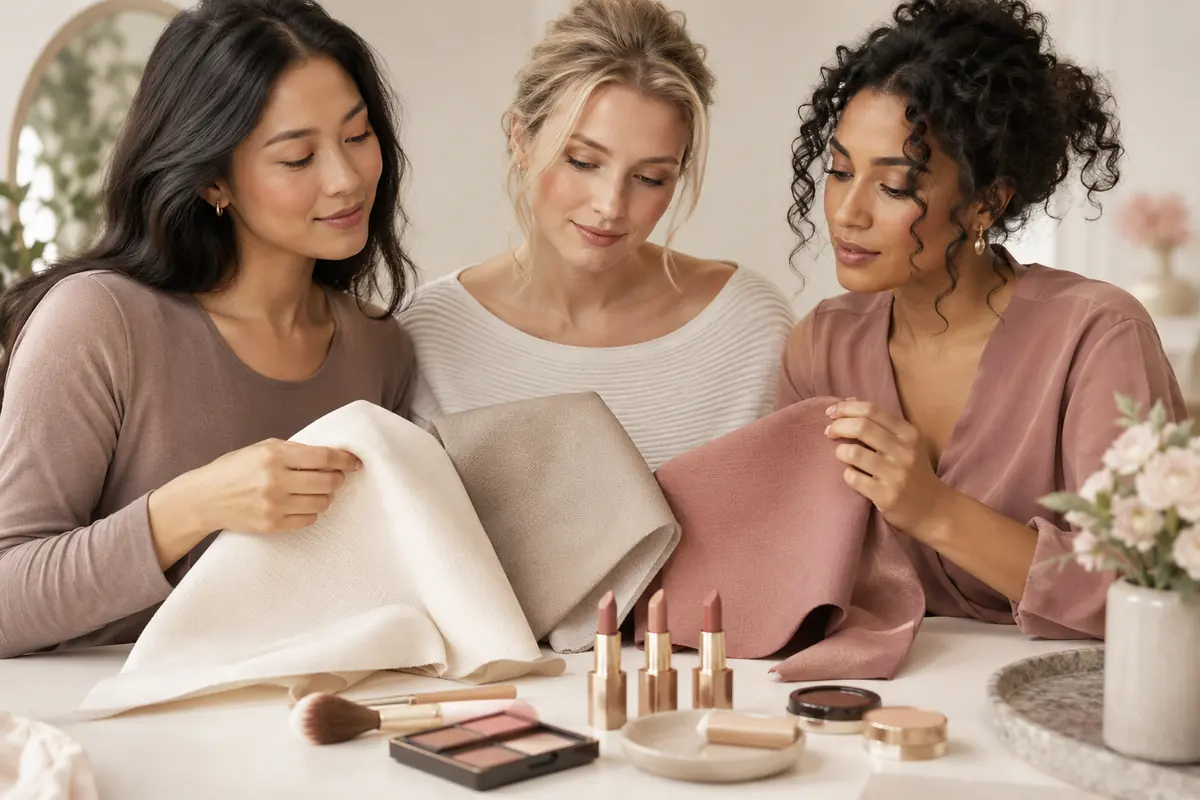
To find an undertone useful for makeup, compare foundation shades at the same depth along your jaw in consistent indirect daylight. Check their colour once the formula has settled, then repeat the strongest candidates. Warm, cool, neutral and olive are sampling descriptions; you do not need an unchangeable label before you can choose well.
A foundation can have the right depth and still look pink, peach, yellow or grey against your neck. It can also be too light, applied too thickly or different in another light. Identify the mismatch before deciding that undertone explains it.
Use this as the starting method for foundation matching. For lipstick and eyeshadow, undertone vocabulary can help organise trials, but your preferred result remains a separate decision.
If warm and cool foundations both look wrong, use the focused olive-undertone comparison guide. It separates skin depth, surface redness and a muted olive-looking cast without treating one test as a diagnosis.
Four common makeup descriptions
These families describe colour choices, not four medical skin types. Brands may combine or interpret them differently, and olive does not mean a particular depth or ancestry.
| Description | Colour nuance commonly meant | Useful sample comparison |
|---|---|---|
| Warm | Golden, yellow or peach | Compare a more yellow option with a less peach one |
| Cool | Pink or rosy | Compare a rosy option with a less pink neighbour |
| Neutral | A less obvious warm or cool lean | Check whether the specific formula still looks peach or pink |
| Olive | A greenish or greyish cast | Compare olive and neutral shades at similar depths |
Find the depth first. If a light cool shade seems chalky beside a much deeper warm one, you have not isolated undertone. Look for close neighbours so the colour difference is easier to read.
A useful note can be “medium depth, needs less peach.” That observation can guide the next sample even if you are unsure whether neutral or olive is the better label.
Three steps for a repeatable comparison
1. Keep light and preparation consistent
Stand beside a window in indirect daylight. Avoid mixed lamps, a sunbeam across one cheek and a strongly coloured background. Keep the same skincare and allow temporary redness from cleansing to settle before judging.
Look at lower cheek, jaw and neck together. They may differ. Your wrist or hand can show texture, but does not automatically represent the colour where you will wear foundation.
2. Compare close depths on the jaw
Choose three plausible samples, varying colour nuance rather than making large changes in depth. Apply small separated stripes and blend one edge of each.
Notice which is too light or deep first. Among the closer candidates, look for a visible pink, orange, yellow or grey edge. Leave some bare skin between stripes so you are comparing each with skin, not only with another product.
3. Check settled colour, then test again
Follow the formula's settling instructions and look again in the same light. Compare a thin patch of the strongest candidate with the amount you would normally wear.
If available, take samples home and repeat the best two on another day. Note the formula and shade name. Your result is a practical shortlist, not a laboratory measurement or a guarantee that the same code works in another range.
Veins, white paper and jewellery: optional observations
Wrist veins
Veins may appear different across lighting and body areas. A green or blue appearance does not reliably tell you which facial foundation to buy. If you have already used this shortcut, keep it as a question to investigate with samples rather than a verdict.
White paper
A pale backdrop can make you notice a colour contrast, but the result depends on light, the backdrop and the area examined. Pink cheeks beside paper might reflect a surface difference from the neck. Do not turn that one comparison into “I must buy pink.”
Jewellery
Try gold and silver to discover which finish you enjoy with a particular outfit. Size, shine and neighbouring colours matter too. Liking both does not establish neutral or olive skin; liking one does not exclude the other makeup families.
There is no dependable “two out of three” scoring rule. Agreement between these observations does not override a sample that visibly fails on your face.
If olive seems worth exploring
Olive is a colour description used at different depths. It is not a synonym for tan, and it cannot be assigned from family background.
Try an olive and a neutral-olive sample alongside a similarly deep neutral. If the olive blends more discreetly on repeated comparisons, keep it on the shortlist. The foundation guide for olive skin explains how to troubleshoot candidates.
One product looking orange does not prove olive skin or oxidation. It may be too peach or too deep from the start; drying, finish and lighting can also change the appearance. Record what happened before assigning a cause.
What a virtual preview can tell you
A makeup preview can help you explore a visible colour direction. It cannot establish an undertone or verify a physical foundation match: camera white balance, image processing and your screen influence the result.
Use the virtual makeup try-on guide to understand those limits. Keep product swatches as the deciding comparison for buying foundation. A generated image is not evidence that a shade will wear, settle or cover as shown.
Common mistakes to correct
- Changing depth and undertone together. Choose nearby depths before comparing colour nuance.
- Matching the hand instead of the face. Check the lower face, jaw and visible neck; body areas can differ.
- Calling every later change oxidation. Compare the starting and settled result in the same light before replacing the shade.
- Using tanning or burning as a test. Neither is a cosmetic undertone test. Compare your current complexion without seeking sun exposure.
- Treating labels as universal. Read each range's descriptions and test the actual formula.
If no sample works, compare another range, an intermediate depth or a coverage closer to your needs. An uncertain label is not a failure.
Use the result for your next choice
Keep a short record: current depth, the unwanted hue in rejected samples, and the strongest match after settling. For example: “light to medium; peach is visible; neutral blends better in a thin layer.”
- Foundation shade matching, turn the shortlist into a wear trial.
- Lipstick for your skin tone, compare colours you want to remain visible.
- Eyeshadow for your eye colour, organise a different part of the look.
- Colours for olive skin, compare clothing and lip combinations by preference.
For salon colour, use hair colour for olive skin; a base-makeup match does not decide every colour you should wear.
What this method claims
This is practical cosmetics comparison, not a skin diagnosis. MAC's matching guidance recommends a shade that blends at the jawline without looking too light or dark. Repeated trials help you choose samples; they do not make informal undertone categories exact or universal.
Frequently asked
What are the four undertones used in makeup?
Common descriptions are warm, cool, neutral and olive. Warm usually refers to golden, yellow or peach nuances; cool to pink or rosy nuances; neutral to a less obvious lean; and olive to a greenish or greyish cast. Brands use these labels differently, and an olive shade can also be described as warmer or cooler.
What is the difference between skin tone and undertone?
For makeup matching, depth describes how light or deep a shade is, while undertone describes its colour nuance at that depth. Both matter: two foundations can be equally light but differ in pink, peach, yellow or olive colour. Surface redness and differences between face and neck also affect the comparison.
Do I need to keep the same undertone label forever?
No. Treat it as a working description for choosing samples. Lighting, the area examined and the shade range can change which label seems useful. Recheck your current match when your complexion or formula changes rather than assuming an old code must still fit.
How do I know whether an olive shade is worth trying?
Try it when similarly deep pink, peach or strongly yellow samples repeatedly look separate from your skin. Compare olive and neutral options along the jaw after the formula has settled. One orange foundation or a disagreement between informal tests does not prove an olive undertone.
Do veins, white paper or jewellery reliably identify undertone?
No. They can prompt observations or help you explore a styling preference, but they do not provide a dependable classification. Gold and silver can both appeal for many reasons. For choosing foundation, prioritise repeatable swatches at a similar depth on the lower face and jaw.