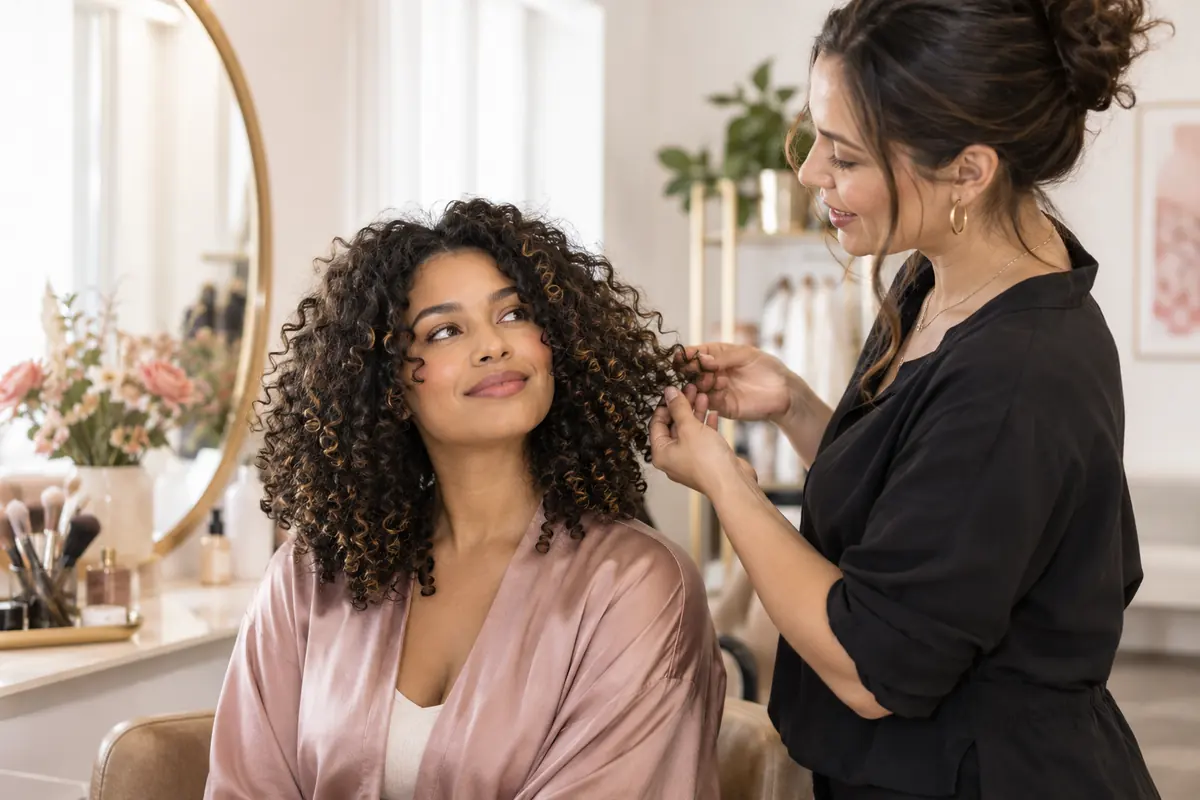
A curly cut is won before the cape goes on. The stylist needs to see the pattern you live with, not the pattern your wash day can temporarily fake and not the stretched version that appears after three days in a bun.
Curly hair is shape, spring, density, shrinkage, and weather. It cannot be briefed like straight hair. The appointment works best when you arrive with your normal curl pattern visible and your desired dry shape already thought through.
This is the prep.
If loose strands or short pieces are the reason you booked, use breakage versus shedding to describe what you notice without guessing the cause. The split-end guide separates trimming damaged tips from reducing the next round of friction.
Arrive as your hair actually lives
For most curly clients, the best appointment state is:
- washed within the last 24 hours
- detangled
- styled with your normal light product
- fully dry
- worn down
- not stretched, braided, slicked, or heavily oiled
The stylist is reading your curl families: tighter pieces, looser pieces, flat crown, dense nape, face-framing shrinkage, uneven sides. If you arrive in a bun, the stylist has to guess. Guessing is where curly cuts go wrong.
If your daily hair is usually diffused, arrive diffused. If your daily hair is usually air-dried, arrive air-dried. The cut should serve your real routine.
Know your shrinkage in real measurements
Shrinkage is not a vibe. It is a measurement.
Before the appointment, pick one curl near the front and one near the back. Pull each gently to its full wet-looking length, then let it spring back. Estimate the difference.
Write it down:
- front curl: stretches to chin, sits at cheekbone
- side curl: stretches to collarbone, sits at jaw
- back curl: stretches to shoulder, sits above shoulder
Bring that note. It tells the stylist where the dry shape will land.
The Type 3 and Type 4 guides go deeper here:
Decide the silhouette, not only the length
Curly haircut language should be silhouette-first.
Do you want:
- round shape
- long layers
- triangle control
- volume at the crown
- less width at the sides
- more face-framing movement
- a fringe
- a tapered nape
"Take two centimetres off" does not describe a curly cut. Two centimetres can disappear into shrinkage. Shape language is safer.
Studio prompt:
"Curly haircut on my face, rounded layered shape, keep dry length below the shoulders, defined natural curls, soft face-framing pieces, realistic shrinkage, no stretched hair."
Bring three images
The curly version of three photos and a phrase is very specific.
Your AI render. This shows the desired silhouette on your face.
A real curl-pattern reference. Choose someone with hair that behaves like yours, not just hair you admire. Density and curl size matter.
Your own good hair day. This is the grounding image. It shows the stylist what your hair can do without fantasy.
If the render and the real reference disagree, the real reference wins on texture. AI often makes curls too uniform.
Questions to ask before the cut
Ask these before the first snip:
- "Will you judge the final shape dry?"
- "Where will the shortest face-framing curl sit when dry?"
- "How much shrinkage are you assuming?"
- "Are you removing bulk internally or changing the perimeter?"
- "Should this cut be styled air-dried or diffused?"
A stylist who works well with curls will not mind these questions. They are the appointment.
Dry cut, wet cut, or both?
The internet argues about dry versus wet cuts as if one answer fits every curl. In practice, good stylists use different methods for different heads.
Dry cut: excellent for visible shape, shrinkage control, curl-by-curl adjustments, and clients with mixed curl patterns.
Wet cut: useful for structure, clean sectioning, and some looser curl patterns, but risky if the final dry shape is not checked carefully.
Wet structure plus dry finish: common and often sensible. The stylist builds the cut, dries it, then refines the lived shape.
The non-negotiable part is not the first cut. It is the final check. Curly hair must be judged dry before you leave.
What not to do before the appointment
Do not arrive with heavy oil. It makes the curl clump and hang differently.
Do not straighten the hair "to make it easier." That gives the stylist the wrong map.
Do not wear a tight bun all day before the appointment. It stretches the front and flattens the crown.
Do not try a new product for the appointment. Your stylist needs your normal pattern, not a product experiment.
Do not brush dry curls right before you walk in. That creates a halo the stylist may cut into.
The mirror check before leaving
Before the cape comes off, stand up. Curly shape changes when your shoulders, neck, and posture return.
Check:
- Where does the shortest curl sit dry?
- Is one side springing higher than the other?
- Does the crown have enough lift?
- Does the nape feel too heavy?
- Can you style this at home with your real routine?
Ask for small dry adjustments now. This is the moment they are easiest.
The quiet rule
Curly hair does not need a brave appointment. It needs an honest one. Arrive with the pattern visible, name the shrinkage, choose the silhouette, and make the final decision dry.
The cut should look like your curls decided to cooperate, not like someone forced them into a shape they will abandon tomorrow.
Frequently asked
Should curly hair be cut wet or dry?
Many curly cuts are best refined dry because curl shrinkage changes the final length and shape. Some stylists cut a structure wet and finish dry; others cut entirely curl-by-curl. The key is that the final shape must be judged in the hair's natural dry pattern.
Should I wash my curly hair before a haircut?
Usually yes, within 24 hours, styled in your normal wash-day routine with light product. Do not arrive with heavy oils, stretched styles, or a slick bun unless that is the state you want the stylist to cut for.
What photos should I bring for a curly cut?
Bring three: an AI render of the shape on you, a real-photo reference with a similar curl pattern, and a photo of your own hair on a good normal day. The third photo matters because it shows your actual density and shrinkage.
How do I avoid losing too much length on curly hair?
Discuss dry length, not wet length. Show exactly where you want the curl to sit when dry, and ask the stylist to cut conservatively first. Curly hair can shrink several centimetres, so the finishing length must be confirmed dry.