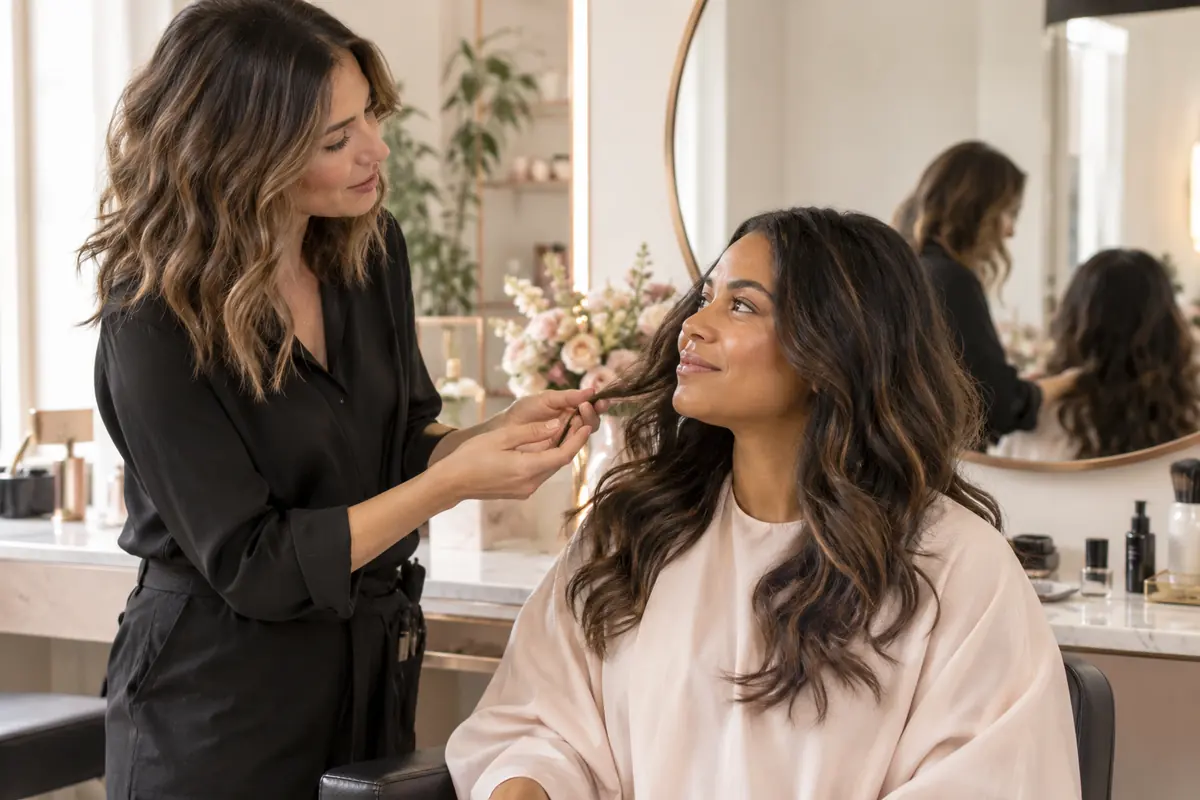
The first rule after a bad haircut is boring and difficult: do not make the second decision while still angry at the first one.
Bad haircut energy is powerful. You want to cut more, colour something, book another chair, buy a hat, text everyone, and investigate bangs as if bangs have been patiently waiting to save you. Pause. A correction cut is still a cut. It can help, but it can also remove the last bit of length that would have made the fix easier.
This is the calm sequence.
Step 1: wait through one wash
Unless the cut is visibly uneven or technically wrong, wait 48 hours.
The salon finish is not your real hair. It may be smoother, rounder, straighter, bigger, or more polished than your daily version. The cut also needs to settle after the first wash. Some layers look too sharp on day one and soften by day three.
During the wait:
- Wash and style it the way you normally do.
- Take photos in daylight from the front, side, and back.
- Note exactly what feels wrong.
- Do not trim at home.
- Do not book a dramatic new service.
If the problem is still there after your normal routine, you have data instead of panic.
Step 2: name the problem precisely
"I hate it" is emotionally true but technically useless. A stylist can fix specific problems.
Use this translation table:
| Feeling | Useful salon language |
|---|---|
| It looks bulky | "There is too much weight through this section." |
| It looks thin | "The perimeter lost more density than I wanted." |
| It looks old-fashioned | "The shape feels too uniform; I wanted softer movement." |
| It is too short | "The final length dried shorter than expected." |
| The front is wrong | "The face-framing pieces start higher than we discussed." |
| One side is off | "The balance between the left and right sides is uneven." |
Good correction language points to the part of the haircut that needs attention. It does not ask the stylist to guess.
Step 3: call the salon, not the group chat
If the cut is technically wrong, call the salon within a week. Most good salons would rather correct the problem than have you disappear unhappy.
Say:
"I had a haircut on Tuesday. After washing and styling it at home, I noticed the face-framing layers are much shorter than we discussed. Could I come in for a correction consultation?"
If it is uneven:
"The right side is visibly longer than the left after washing. Could someone check the balance?"
If you felt dismissed:
"I would prefer a senior stylist to look at the correction."
This is not rude. It is normal salon communication. The stylist brief guide has the same principle: observation beats blame.
Step 4: decide whether the same stylist should fix it
Go back to the same stylist if:
- the consultation was respectful
- the issue is small or technical
- the cut mostly works except one area
- the stylist understands your hair history
Ask for a senior stylist or a different salon if:
- the stylist ignored your brief
- the cut is structurally wrong
- your texture was handled incorrectly
- you do not trust the chair anymore
Trust matters because correction cuts involve restraint. A nervous stylist can over-correct. A good stylist knows when not to cut.
Step 5: run correction renders
AI try-on helps most when it narrows the fix.
Take a fresh selfie with the haircut as it currently is. Then render three options:
- the smallest correction that could make it wearable
- a slightly shorter shape that fixes the balance
- the shortest acceptable rescue cut
Do not render a fantasy haircut unrelated to the current length. The question is not "what would I have chosen in a better universe?" The question is "what can this haircut become now?"
Studio prompt:
"Correction haircut based on my current cut, keep as much length as possible, soften the face-framing layers, balance both sides, natural air-dried texture, no dramatic transformation."
If your hair is curly or coily, add:
"Respect natural curl shrinkage, dry-cut shape, no wet-straight length assumption."
The common fixes
Too bulky. The stylist can remove internal weight without changing the outer length much. This is one of the easier corrections.
Too blunt. Softening the perimeter or adding very subtle internal movement can help.
Too layered. Harder. You cannot add length back. The fix is usually blending, reshaping, and waiting.
Too short around the face. The correction may be to make the rest of the cut relate to those pieces, not to cut the front more.
Uneven length. Usually fixable quickly, but only if you do not start trimming it yourself.
Wrong shape for texture. This needs a stylist who understands your texture. A Type 2 triangle, a Type 3 shelf, or a Type 4 shrinkage mistake is not solved by random thinning.
What not to do
Do not cut bangs as an emotional correction. Bangs are their own decision; use the bangs maintenance guide before adding a new front problem to an old cut problem.
Do not bleach or colour immediately to distract from shape. Colour can make a bad shape more visible by adding contrast.
Do not ask for "just more layers" unless you know where and why. More layers are not a universal fix.
Do not let the correction become a second dramatic haircut unless you have accepted the new length calmly.
A bad cut weeks before a wedding has its own emergency lane: the wedding hair planner countdown shows what is still fixable at each week.
The growing-out plan
Sometimes the honest fix is not a cut. It is a plan.
Ask the stylist:
- What should we leave alone?
- What can be softened today?
- What length are we growing toward?
- When should I come back?
- How should I style it during the awkward phase?
The answer may be six weeks, not six minutes. That is annoying, but it is better than cutting away the recovery.
The quiet rule
A bad haircut is a problem to diagnose, not a verdict on your face. Wait through one wash. Name the issue. Call with specifics. Render correction options. Cut only what improves the path from here.
The goal is not revenge on the haircut. The goal is a next version you can live with.
Frequently asked
How long should I wait after a bad haircut before fixing it?
Wait 48 hours unless there is a clear technical error, such as uneven length or a missed section. Hair often looks different after the first wash and your normal styling routine. If it is still wrong after two days, document it in natural light and call the salon.
Should I go back to the same stylist after a bad cut?
If the issue is technical and the stylist was professional, yes. They know what was done and can often correct it quickly. If the consultation felt dismissive or the cut ignored your brief, ask for a senior stylist or choose another salon.
What should I say when asking for a correction?
Use observations, not blame. Say, 'The layers are falling shorter around my face than we discussed' or 'The right side is visibly longer than the left.' Clear, specific feedback gets a better correction than emotional language.
Can AI try-on help fix a bad haircut?
Yes, if you use it to compare realistic correction options. Render the current cut, a small adjustment, and the shortest acceptable fix. Do not use it to chase a totally different haircut while you are upset.