

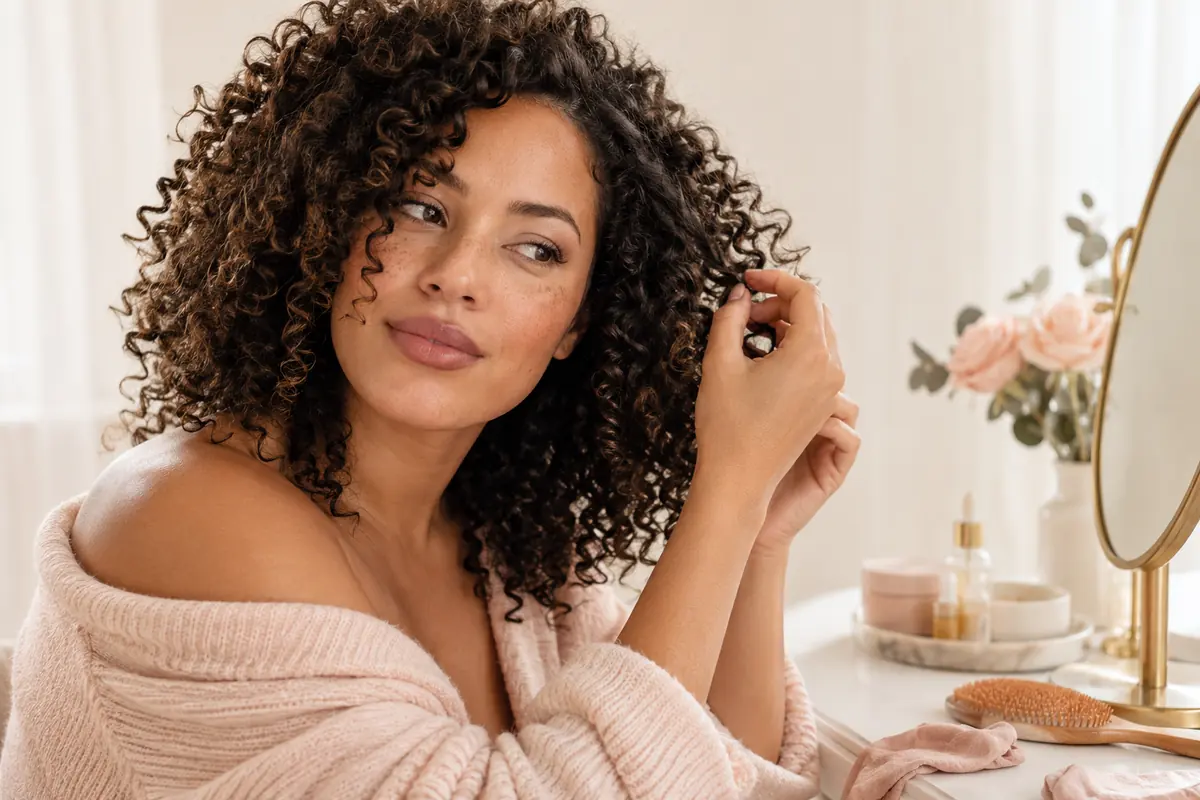
Type 3 hair is the most common texture across the Maghreb, the Levant, and large parts of the Gulf, and the most consistently mistreated by mainstream beauty press trained on straight hair. The product aisle assumes you are smoothing something. The salon, until recently, assumed you wanted blow-out hair. The result is decades of women told to fight a curl pattern that, with the right cut and the right routine, is the easiest hair to wear well in this climate.
This is the editorial guide we wished existed when we started building Mademoiselle. It is long, on purpose. Type 3 hair rewards specifics, the difference between 3A and 3C is not cosmetic, it is structural, and the cut, the wash routine, and the styling choices all change with the subtype. The general curly-hair article most beauty sites publish glosses over that. This one does not.
If you don't yet know your overall hair type, the 1/2/3/4 family, read find your hair type first; it's the front-door read. If you already know you are in type 3 and want to drill down, the next sections are for you.
The three Type 3 subtypes
Type 3 hair forms a spiral that holds itself without being styled into the spiral. The three subtypes are distinguished mainly by the diameter of one curl, the wider the circumference, the looser the curl, and the more the cut and routine bend toward the type 2 side of the spectrum. The narrower, the tighter, and the closer the routine sits to type 4. A single head of hair can carry two subtypes in different zones; treat the descriptions below as the dominant note for each section of your head.
3A, loose ringlets
The widest of the three. A single 3A curl has a circumference roughly equivalent to a piece of sidewalk chalk or a wine cork, wide enough that the curl reads as a defined ringlet, not a tight spiral. The S-pattern is clear; the curl holds with a light product but loses definition quickly under heavy weight.
How to identify 3A on yourself
- Air-dried, the curl forms a clear S that bounces when you pull and release.
- Shrinkage from wet to dry length is around 30 percent, a curl that hangs to the bra strap when wet will settle around the collarbone when dry.
- The hair feels fine to medium in density; the scalp tends to show through in the part line.
- Frizz appears mainly at the crown and around the hairline, less at the ends.
Daily life and MENA climate notes. In Beirut, Casablanca, Tunis, and the Maghreb coast generally, 3A is the texture most pulled around by humidity, the loose curl reads as wavy in dry air and as a tighter ringlet in damp air. In Gulf cities where indoor air-conditioning runs cold and dry, the curl can flatten and stretch by the end of a working day. The fix is a lighter product layer than 3B or 3C would need, applied more often, rather than a heavy product applied once.
Cuts that work. Long layers with face-framing pieces starting at the cheekbone; a long bob with internal layering; a midi length with subtle weight removed underneath so the curls fall in a clear cascade. 3A reads best at lengths that give the curl room to elongate.
Cuts that don't. Severe blunt cuts at a single length, the weight of a one-length 3A cut flattens the curl pattern from the mid-shaft down. Aggressive thinning shears at the ends turn the ringlets stringy.
Studio prompt template:
"Loose 3A ringlets on this face, mid-length cut with face-framing layers starting at the cheekbone, soft curls falling to the collarbone, defined curl pattern, no frizz, natural soft daylight."
3B, defined ringlets
The middle of the three. A single 3B curl has a circumference roughly equivalent to a marker pen or an ordinary Sharpie, tighter than 3A, looser than 3C. The spiral is springy, dense, and holds shape under heavier product. The ends often run drier than the roots because the natural scalp oils struggle to travel down the tighter coil.
How to identify 3B on yourself
- The curl is a clear spiral, not an S, the bend wraps around itself rather than waving.
- Shrinkage from wet to dry is around 40 percent, a curl that reaches mid-back wet settles around the shoulder blades dry.
- Density is medium to high; the part line is less visible than on 3A.
- Frizz appears throughout, but is most pronounced at the crown and on the underside layers if not styled at the right product weight.
Daily life and MENA climate notes. 3B is the texture that benefits most from the regional split between Maghreb humidity and Gulf air-conditioning. In Casablanca, Algiers, or coastal Tunisia, the humidity gives 3B its clearest definition and the curl reads as it does in product photography, provided salt-haze frizz is managed. In Riyadh, Doha, or Kuwait City, the dry indoor air pulls moisture out of the curl all day; a richer leave-in and a refresh spray for the middle of the day are the small daily inputs that keep the spiral defined.
Cuts that work. A round curly cut with internal layering and a deliberate external silhouette, wider at the cheekbone, narrower at the temple, longer through the ends. A collarbone-length curly cut with bulk removed from the underside through finger-shaping rather than thinning shears. A long shape with face-framing curls released at the eye line.
Cuts that don't. A flat one-length cut at any length, 3B will triangulate, fanning out at the bottom and shrinking at the top. Heavy razor cuts on the ends create frayed-looking spirals.
Studio prompt template:
"Defined 3B spirals on this face, curly cut with internal layering and round silhouette, curls released at the eye line, no triangulation at the ends, natural soft daylight."
3C, tight corkscrews
The tightest of the three, and the most often misclassified as 4A. A single 3C curl has a circumference roughly equivalent to a pencil or a drinking straw. The corkscrew is dense, the volume is significant, and the shrinkage is dramatic, many 3C women are surprised by their own length the first time they see it stretched.
How to identify 3C on yourself
- The curl is a tight corkscrew, not a wave or a soft spiral.
- Shrinkage from wet to dry is around 50 percent, a curl that hangs to the waist wet sits at the bra strap dry.
- Density is high; the scalp is rarely visible through the curls.
- The texture often contains two patterns in the same head, slightly looser at the front and at the very ends, tighter through the bulk.
Daily life and MENA climate notes. 3C is the texture most often described in regional salons as "shaaer afriqui" or "shaaer karli", and most often the one mismanaged by stylists trained only on straight hair. In humidity, the curl drinks moisture and reads at its most defined; in air-conditioning, the corkscrew loses elasticity by mid-afternoon. 3C in Gulf summer is the texture that benefits most from heavier creams, satin headwraps in transit, and accepting the curl rather than trying to elongate it.
Cuts that work. A round shape with intentional volume, the cut is designed around the corkscrew, not against it. Internal shaping that releases the curls from each other so they don't bunch. A square or rounded silhouette with weight balanced through the lengths. A curl-by-curl dry cut is non-negotiable for 3C at any meaningful length.
Cuts that don't. A wet cut at one length will dry as a triangle and you will not recognise it. Heat-straightened cuts assessed in the straightened state, the same cut on natural 3C texture will look completely different.
Studio prompt template:
"Tight 3C corkscrews on this face, round curly cut with intentional volume, curls released through the lengths, no triangulation, defined corkscrew pattern, natural soft daylight."
Cuts that work for Type 3 hair
A curly cut is not a regular cut. The method is dry-cutting, curl by curl, with the hair in its natural pattern, not wet-combed and cut to a hypothetical length. Most stylists are trained to cut wet because it is easier to see geometry; a curl-trained stylist works in the curl's actual state, which is the only state that lives outside the salon. The four major methods worth knowing by name:
- The DevaCut (the most globally recognised method), sectioning the hair dry, cutting each curl individually at the angle it naturally falls.
- The Rezo cut, a refinement of DevaCut, with attention to the underside layers for more even shape.
- The Ouidad carve-and-slice, a method developed specifically for tighter Type 3 and Type 4 textures, with internal carving to relieve weight.
- Dry-cutting in general, even without a branded method, a stylist who simply cuts dry, curl by curl, will produce a better Type 3 cut than the best wet-cutter in the city.
In MENA salons, ask explicitly: "Do you cut curls dry?" The answer is the single most important screening question. A stylist who says yes is worth trying. A stylist who insists on cutting wet, regardless of texture, is the wrong stylist for Type 3 hair.
The comparison below shows which named cuts hold up across the three subtypes:
| Cut | 3A | 3B | 3C |
|---|---|---|---|
| Long layers with face-framing | excellent | very good | good |
| Curly long bob (collarbone) | very good | excellent | good |
| Round curly cut with internal layering | good | excellent | excellent |
| Long shag with curl-cut layers | very good | good | acceptable |
| Curly pixie (DevaCut short) | acceptable | very good | excellent |
| One-length blunt cut | acceptable | poor | poor |
| Heavy thinning-shear cut | poor | poor | poor |
| Wet-cut at any length | poor | poor | poor |
The cut you want from the chair is the cut that respects the curl. Everything else is decoration.
The wash-and-style decision
For Type 3 hair, the routine decision is bigger than the cut decision. A good cut on a bad routine still frizzes. A modest cut on a respectful routine still reads well. The four levers below are where most of the result actually comes from.
Wash frequency
The wash schedule is calibrated to the subtype, not to the day of the week. The general rhythm:
- 3A, every 3 to 4 days. Looser curls hold less product weight, scalp oils travel down the shaft faster, the hair benefits from a more frequent gentle wash. Co-washes between full washes.
- 3B, every 5 to 7 days. The middle case. A sulfate-free shampoo at the scalp, conditioner through the lengths, a deeper conditioning treatment once every two weeks. Refresh between washes with water and a leave-in.
- 3C, every 7 to 10 days. Tighter curls retain product longer and the scalp oils struggle to coat the lengths. The wash itself becomes a longer ritual, pre-poo with an oil, sulfate-free shampoo at the scalp, deep conditioner with heat, then style.
Co-wash, sulfate-free, low-poo, water-only
Four wash approaches, in order from most cleansing to least:
- Sulfate-free shampoo, the standard recommendation for almost all Type 3 hair. Cleans the scalp without stripping the natural oils that define the curl. Use on the scalp only.
- Low-poo, a shampoo with very mild surfactants, designed for daily-to-frequent use without stripping. Useful for 3A in summer when scalp oil builds faster.
- Co-wash, conditioner only, no shampoo. Cleans gently through emulsification rather than stripping. Most useful for 3B and 3C between full washes, and for 3C as the primary cleanse method.
- Water-only, rinsing without product. Useful as a refresh between washes for all three subtypes; works as a primary method only for very low-product routines on 3C.
The pattern most curl specialists recommend: full sulfate-free wash once, co-wash or water-rinse between, deep conditioner once every two weeks, clarifying wash (a stronger shampoo to remove build-up) once a month at most.
The styling glossary
The styling terms a Type 3 woman runs into online, translated into plain instructions:
- Plopping. After washing, gather the wet curls onto the top of the head and wrap them in a soft cotton T-shirt for fifteen to twenty minutes. The curls dry partially in their natural pattern without falling under their own weight. Best for 3B and 3C; less necessary for 3A.
- Squish-to-condish. While the conditioner is in the hair, scoop water from the shower into the lengths and squish upward, encouraging the conditioner to penetrate while the curls form. The hair drinks; the curls clump.
- Praying hands. Apply curl cream or gel between flat palms and press the product onto the lengths from above and below, without raking. Prevents frizz and keeps the curl clumps intact.
- Micro-plopping. A short version of plopping, five minutes only, used after the leave-in step to remove excess water before the styling product goes on. Gentler on the curl pattern than rough towel-drying.
- Pineappling. Gathering the curls into a loose pile at the very top of the head before sleeping, secured with a soft tie. Preserves the curl pattern overnight.
- The diffuser. A wide-mouthed attachment for a hairdryer that distributes airflow evenly through the curl. Used on the lowest heat setting only. Speeds up drying without breaking the curl clumps.
A simple full Type 3 wash day, end to end: pre-poo if 3C, sulfate-free shampoo at the scalp only, conditioner with squish-to-condish through the lengths, leave-in conditioner on wet hair, curl cream or light gel with praying hands, micro-plop for five minutes, air-dry or diffuse on low heat. Touch as little as possible until fully dry.
MENA climate considerations
The single most important section of this guide, and the one no other publication writes. The MENA region is not a uniform climate, and Type 3 hair behaves measurably differently from city to city.
The Gulf, Riyadh, Doha, Kuwait City, Abu Dhabi. Outdoor heat is intense, indoor air-conditioning is dry and cold, and the two cycle multiple times a day. The combination is the most dehydrating climate for curls in the region. Adjustments worth making:
- A richer leave-in conditioner, slightly heavier than the same routine in a Maghrebi climate would require.
- A refresh spray for the middle of the day, water-and-leave-in in a small bottle, misted lightly through the curls when they start to lose elasticity.
- A satin head wrap or scarf for car commutes, the long drives in air-conditioning are where Gulf curls flatten fastest.
- Hydration for the scalp itself, not only the lengths, oily-scalp Type 3 women in Gulf summer still need scalp hydration because the AC pulls moisture from the skin too.
The Maghreb, Casablanca, Algiers, Tunis, Rabat. Coastal humidity gives Type 3 hair its clearest definition; the curl reads at its best in this climate. The trade-off is salt-haze frizz from coastal air and the daily expansion of the curl in humid conditions. Adjustments:
- A lighter product layer than the Gulf would call for, the air does some of the moisturising work.
- An anti-humectant on humid days (a small amount of a curl cream that resists, rather than draws, atmospheric moisture), useful only when humidity is high enough that the curl is expanding past its definition.
- A clarifying wash every two to three weeks rather than monthly, salt and air pollution build up faster on coastal hair than on inland hair.
The Levant, Beirut, Amman, Damascus, Aleppo. A mixed climate, humid coast, dry interior, distinct seasons. Type 3 hair in Beirut behaves differently in winter (richer products, less wash) than in summer (lighter products, more wash). The Levantine curl is often the one that benefits most from a seasonal product wardrobe, two complete routines, one warm-weather and one cool-weather, rather than fighting one routine through the year.
Coastal cities specifically, Beirut, Alexandria, Casablanca, Latakia, Sousse. Salt-haze frizz is real. The fix is structural, not cosmetic, the salt particles in coastal air settle on the cuticle and disrupt the moisture barrier. A weekly rinse-out clarifying treatment, an occasional apple cider vinegar rinse (1:5 with water, through the lengths only, never the scalp), and a microfibre towel for travel days do more than any product label promises.
AI try-on accuracy for curly hair
A section worth being honest about. Diffusion models, the technology behind almost all AI try-on tools, are trained on image datasets that historically over-represent straight and lightly wavy hair. The consequence is that many AI try-on tools render Type 3 curls as Type 2 waves, smoothing the corkscrew into an S-bend that doesn't match how your hair actually falls.
The Mademoiselle Studio pipeline is specifically tuned for identity preservation including curl pattern. The same technical detail that holds your skin tone and face shape, see the 2026 try-on guide, extends to the texture of your hair. A render of a new haircut on 3B hair should still read as 3B in the output, not as a smoothed version of it.
A few practical notes for the most honest result:
- Upload your photo in the curl-defined state, not the brushed-out state. A reference photo where your curls are well-defined (after a fresh wash and gel) renders better than a reference photo where the curls have been brushed and lifted. The model needs to see the pattern to preserve it.
- For a cut decision, render with the curl in its natural fall, not pinned up. A render of a long cut on hair that is currently pinned up will guess at where the curls would land.
- For a length decision, account for shrinkage. A render that shows a cut "to the collarbone" on Type 3 hair means to the collarbone in the curled state, when stretched, the actual cut length is 30 to 50 percent longer.
If a render smooths your curls into waves, the model behind it is not curl-aware. Switch products, or in the Studio, use a more specific prompt, naming the subtype ("3B defined spirals", "3C tight corkscrews") tightens the result.
Common mistakes
Six errors specific to Type 3 hair, in order of how often they undo good cuts.
Heat-straightening 3B or 3C regularly and complaining the curls "don't bounce back." Heat damage is cumulative; cuticles cracked at 220 degrees in a flat-iron do not repair themselves. A daily flat-iron habit on 3C will, over twelve months, produce a head of hair that reads as 2C, and the original pattern often does not return without a trim through the damaged section.
Cutting wet at a non-curl-trained stylist. A wet cut on Type 3 hair is a guess at where the curl will land. The curl dries differently than the stylist sees it during the cut, and the geometry of the finished shape is wrong by 30 to 50 percent depending on subtype. Always cut dry; always cut curl by curl; always with a stylist who works in the curl's natural state.
Brushing dry curls. A brush through dry Type 3 hair separates the curl clumps that the styling routine just built. The result is volume without definition, frizz. Detangle wet, with conditioner in, fingers first then a wide-tooth comb. Never a brush on dry curls.
Sulfate shampoos. Sodium lauryl sulfate strips natural oils that define the curl. Type 3 hair washed with sulfates reads as drier and frizzier within weeks of starting the routine, and reads better within weeks of stopping. The label to look for: sulfate-free, paraben-free, ideally silicone-free as well, though silicones are a separate debate the next section briefly touches.
Towel-drying with cotton. Cotton fibres lift the cuticle and break the curl clumps. The fix is a microfibre towel or, simpler still, an old soft cotton T-shirt, the woven structure is gentler. The difference is visible within a single wash day.
Bleach without a bond builder. Lightening Type 3 hair without a bond builder (Olaplex, Wella WellaPlex, K18, or one of the regional equivalents) is the single most damaging cosmetic decision available. The chemical break of the disulfide bonds in the hair shaft does not repair; the curl pattern loosens permanently in the bleached zones. If you are colouring lighter, the bond builder is non-negotiable. See the AI hair colour try-on guide for the decision around lightening at all.
What to read next
The internal cluster around this guide:
- Find your hair type, the front-door read on the 1/2/3/4 classification, useful if you are not sure whether you are in type 3 at all.
- Hairstyles by face shape, the cut-by-shape decision tool, useful for matching the curl-cut to the face shape it will frame.
- AI hairstyle try-on: the 2026 guide, the pillar on what a render is, what to look for, and how identity preservation works.
- AI hair colour try-on guide, the sister pillar for colour, especially relevant for Type 3 women considering balayage or lightening (the cut and colour decisions are not independent).
- Hairstyles under hijab, the intersection of curly hair and daily covering is its own discipline; the cut criteria differ in meaningful ways from the uncovered case.
A typical reading order: face shape first, hair type (here) second, AI try-on pillar third, then the cluster posts for the specific decisions you are weighing.
A note on accuracy
The named hair-typing system used throughout this guide, the 1/2/3/4 family with A/B/C subtypes, originates with the Andre Walker classification, first published in his book Andre Talks Hair (Simon & Schuster, 1997). It is the most widely adopted curl-typing framework in modern hairdressing, used by stylists, product brands, and dermatologists worldwide. It is a useful descriptive system, not a deterministic one, many heads of hair carry two adjacent subtypes in different zones.
For deeper grounding, the American Academy of Dermatology keeps an educational hub on hair and scalp health at aad.org, and L'Oréal Professionnel's stylist library at lorealprofessionnel.com is a useful reference on cutting methods and treatments for curl-pattern-aware care. Neither writes for the MENA climate specifically; that gap is what this guide tries to close.
If a stylist who knows your hair tells you something different from what the internet tells you, trust the stylist. They have hands on the texture; the model is reading pixels.
Frequently asked
What is type 3 hair?
Type 3 hair is curly, defined, spiralling, with a clear S- or corkscrew-pattern that holds its shape without needing to be styled into a curl. It sits between type 2 (wavy, looser S-bend) and type 4 (coily, tight zig-zag). Within type 3 there are three subtypes, 3A, 3B, and 3C, distinguished mainly by the diameter of one curl. The wider the circumference, the looser the curl. The narrower, the tighter. Most adults across the Maghreb, the Levant, and large parts of the Gulf carry hair somewhere in this band, even when years of straightening have made the pattern less visible than it would be untreated.
How do I know if I have 3A, 3B, or 3C?
Wash your hair, apply a light curl cream, and let one curl air-dry without touching it. Then look at the diameter of that single spiral. If it is roughly the width of a piece of sidewalk chalk or a wine cork, that is 3A. If it is closer to the diameter of a marker pen or an ordinary Sharpie, that is 3B. If it is as narrow as a pencil or a drinking straw, that is 3C. A second tell is shrinkage: 3A loses about 30 percent of length when curled, 3B about 40 percent, 3C about 50 percent. The same head of hair can carry two subtypes in different zones, crown often looser than nape, front often looser than the back.
What is the best haircut for curly hair?
There isn't one best cut, there is a best cutting method, and a best cut for your specific subtype. The method is a dry cut, curl by curl, by a stylist trained in curl-specific cutting (Rezo, Ouidad, DevaCut, or one of the regional variants in MENA salons). The cut itself should add weight where you want the curl to fall and remove weight where it bunches. For 3A, long layers with face-framing pieces work best. For 3B, a shape with internal layering and a clean external line keeps the curls from triangulating. For 3C, a shape that respects the volume, round, with intentional length, beats a flat one-length cut every time.
How often should curly hair be washed?
Less often than straight hair, and very rarely with a stripping shampoo. For 3A, every 3 to 4 days is a reasonable rhythm. For 3B, every 5 to 7 days. For 3C, every 7 to 10 days. Between full washes, most type 3 women run a co-wash (a conditioner-only rinse that cleans gently without stripping curl-defining oils) or simply refresh the curls with water and a small amount of leave-in product. The detail that matters more than frequency: when you do wash, use a sulfate-free shampoo, work it only into the scalp, and let the suds rinse through the lengths on the way out, never scrub the lengths themselves.
Why is my curly hair frizzy?
Frizz on type 3 hair is almost always one of four things, in this order of frequency, dryness (the hair shaft has lost cuticle moisture and is reaching for water from the air), friction (cotton pillowcases, rough towels, brushing dry curls), broken curl pattern from heat damage, or wrong product weight for the climate. The single fastest improvement most women see is replacing the cotton towel with a microfibre or a soft T-shirt and the cotton pillowcase with satin or silk. The second is a leave-in conditioner applied to wet hair, sealed with a curl cream or light gel, and not touched until fully dry.