This is the cluster companion to the upcoming pillar find your hair type. Read that first if you are not yet sure which of the four types you sit in; this guide is for the Type 2 reader who already knows she is wavy and wants to know which kind.
Type 2 is the most-misclassified hair type in the world. Half the people who think they have straight hair that "gets weird in humidity" are actually wavy and have spent years fighting their own pattern with brushes, irons, and disappointment. The other half think they are curly, run curly-girl products, and end up over-conditioned and weighed down. The middle ground, wavy hair, treated as wavy, is where Type 2 hair actually behaves.
This is the field guide to the three Type 2 subtypes. By the end, you will know which subtype you are, which cuts flatter your specific wave, why the styling decision matters more than the cut decision, and how to render yourself honestly in the Studio before you book.
The three subtypes, read your own first
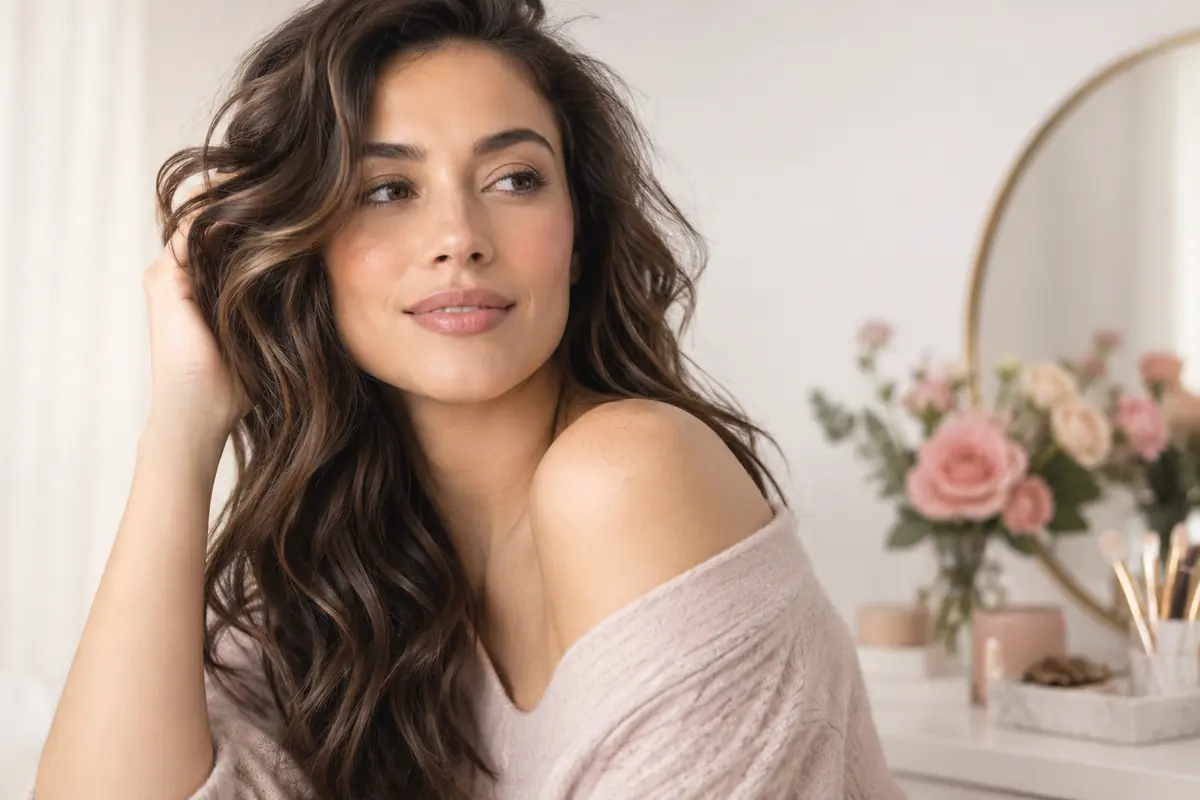
The Type 2 family runs from a barely-perceptible bend to a near-curl. The strand structure changes across the three subtypes (fine to medium to coarse), the wave begins higher up the shaft as you move down the alphabet, and the frizz behaviour follows the cuticle.
| Subtype | Strand | Wave begins | Wet-to-dry shrinkage | Tendency |
|---|---|---|---|---|
| 2A | fine | mid-shaft to ends | minimal (1–2 cm) | soft, beachy, easily flattens |
| 2B | medium | from the cheekbone | moderate (3–5 cm) | clear S, frizz-prone in humidity |
| 2C | coarse | from the root | significant (5–10 cm) | defined, often misread as 3A |
The most common error: a 2C reader runs Type 3 products on her hair, finds them too heavy, swears off them, and concludes she has "weird hair that does nothing." She has 2C hair. It needs 2C products.
2A, the loose S
You have hair that looks straight when wet, and a soft beachy bend by late afternoon. The strand is fine. Volume disappears the moment any weight goes in. Hairdressers in unfamiliar salons will look at your hair and tell you it is straight; you will go home, sleep on it, and wake up with the wave back where it always lives.
Identification cues
- Hair looks straight or barely bent immediately after washing.
- A loose S develops as the hair air-dries past the cheekbone.
- One side often waves more than the other (the side you sleep on flattens).
- Heavy conditioners, butters, and oils weigh the wave out completely. You can lose your texture entirely on a single product mistake.
Daily life
You can blow-dry it straight in fifteen minutes. You can sleep on it badly and recover with a quick mist of water. You probably style on the third day, not the first. The risk for 2A is flatness, not frizz, your cut and your product set should be choosing volume over weight at almost every step.
Cuts that work
A long, mid-back-length shag with face-framing layers starting at the cheekbone. A collarbone lob with internal layering for movement. A long bob with subtle layering, never blunt, never one-length, that lets the wave breathe.
Cuts that do not work
Very heavy bottom-blunt cuts. Long one-length hair that drags the wave straight. Tight cropped pixies that lose the texture entirely.
Studio prompt template: "Long shoulder-length 2A wavy hair, fine strand, soft beachy S-wave starting at the cheekbone, face-framing layers, side part, air-dried texture not blowout, even soft daylight."
2B, the defined S
You have a clear wave from the cheekbone down. The strand is medium, neither fine nor coarse. In dry climate, the wave is well-behaved and easy. In humidity, the same hair triples in volume by 11am and frizzes around the hairline.
Identification cues
- A clear S-shape develops as the hair dries, beginning roughly at the cheekbone.
- The top of the head reads flatter than the rest, wavy hair does not bend much under its own weight at the root.
- Humidity is your single biggest variable. The same head looks like two different heads in winter and summer.
- The wave holds without product, but reads ten times better with the right amount.
Daily life
You probably plop in a microfibre towel or a cotton tee after washing. You have negotiated a peace with the wave, some days you let it air-dry, others you diffuse, others you take an iron to it for the meeting. Layering products is your real skill set: leave-in, then cream, then gel, then nothing for forty minutes.
Cuts that work
A wolf cut, the modern shag with mullet energy, is 2B's signature cut. A long layered lob with internal weight removed. A midi-length cut with curtain bangs that sit on the cheekbone (the bangs become part of the wave rather than fighting it).
Cuts that do not work
Heavy razor work at the ends (razors lift the cuticle and cause permanent frizz on the lower third of the cut). Tight uniform layers all the way up, they make the head read as a pyramid. Centre parts on chin-length cuts (echoes round-face issues for those readers; see hairstyles by face shape).
Studio prompt template: "Long layered 2B wavy hair, medium strand, clear S-wave from the cheekbone, mid-back length, soft curtain bangs, side part, air-dried with diffuser, no salon blowout sheen, neutral daylight."
2C, the wave-curl crossover
You have a coarse strand, a prominent wave that begins from the root, and on a humid morning your hair reads almost like a loose curl. You may have been misclassified as 3A by a hairdresser who saw your hair on its best day and assumed coil structure. You are not 3A. You are 2C, and 2C has its own product rules.
Identification cues
- The wave begins from the root, not the mid-shaft.
- The strand is coarse, thicker between thumb and forefinger than a 2A or 2B strand.
- Significant wet-to-dry shrinkage (5–10 cm), but the shrinkage is along the length, not into a coil.
- A single pulled-straight strand springs back into an S, not a spiral. This is the cleanest 2C-vs-3A test.
Daily life
You probably style wet and refuse to touch the hair again until it is dry. You own a microfibre cloth, possibly a diffuser, possibly silk pillowcases. Your hair has a clear opinion about every product you put in it, too heavy and it goes flat, too light and it frizzes by lunchtime. The window of correct application is narrower than 2A or 2B.
Cuts that work
A long layered cut, cut dry, with a deep side part. Weight kept in the lower third. Internal layering that removes bulk without disturbing the wave pattern. A long shag works beautifully if your stylist understands wavy hair. Mediterranean and Levantine readers, this is your subtype, statistically; the same head that looks impossibly thick on a humid Beirut morning is a textbook 2C.
Cuts that do not work
Anything cut wet on a junior stylist. Aggressive razor work. Short uniform layers above the cheekbone (you will balloon). Centre parts on cuts that already broaden the face, see the round-face note in the face shape guide.
Studio prompt template: "Long layered 2C wavy hair, coarse strand, defined wave starting from the root, deep side part, mid-back length, air-dried with a diffuser, no salon blowout, Mediterranean light, no over-coiling."
Cuts that work for Type 2 hair, the comparison
Most articles give one cut for "wavy hair" and stop there. Wavy hair is three different textures. The cut that flatters 2A flattens 2C, and the cut that disciplines 2C disappears on 2A. The table below is the version we wish more salons used.
| Cut | 2A | 2B | 2C |
|---|---|---|---|
| Long shag, face-framing layers from cheekbone | yes, adds movement to fine wave | yes, signature cut for 2B | yes, needs internal weight removed |
| Wolf cut (modern shag with mullet energy) | maybe, can flatten fine strand | yes, best in class for 2B | yes, needs the lower layers heavier |
| Long layered cut, deep side part | yes, adds volume at the crown | yes, neutral choice | yes, the 2C signature |
| Collarbone lob with subtle layering | yes, keeps weight light | yes, needs internal layering | maybe, too short for 2C density |
| Curtain bangs that hit the cheekbone | yes, becomes part of the wave | yes, works with the S | yes, needs to be cut dry |
| Chin-length blunt bob | no, kills the wave | no, reads as a triangle | no, pyramid effect |
| Razored ends, aggressive thinning | no, causes frizz | no, lifts the cuticle | no, destroys the wave |
| Tight uniform short layers | no, ballooning | no, pyramid | no, disaster |
The pattern is consistent. Type 2 hair wants long layers, weight in the lower third, work done dry rather than wet, no blunt lines, no razor.
The styling decision (bigger than the cut)
For wavy hair, how you style it is the bigger decision than what you cut. The same Type 2 head can be made to read as straight, wavy, or curl-adjacent depending on the styling method. Choose the method first, and choose the cut to support it.
Air-dry. The honest reading of your hair. You see the wave as it actually is. The downside: it takes hours, the result depends entirely on how you slept and what climate you woke up in, and frizz around the hairline is the rule, not the exception. The upside: it is the truest version of your texture, and any cut decision should be made for this state.
Diffuser. The middle ground. A diffuser dries the hair without disturbing the wave pattern, and tightens the wave by roughly one full rung (a 2A reads as a 2B, a 2B reads as a 2C, a 2C reads as a 3A-adjacent). The downside: ten to twenty minutes of careful work, and the result depends on technique (pixie-diffusing, cupping each section into the diffuser bowl, is the move). The upside: enhanced wave, controlled frizz, and a result that lasts past noon.
Heat-style. The performance version. A round brush and a blow-dryer can make 2A read as straight, 2B read as a soft blow-out, and 2C read as a glossy salon set. The downside: it is a performance, not your hair. Forty minutes minimum. Heat protection is mandatory. The wave returns the moment moisture finds its way back in. The upside: control over the result for a specific occasion.
The cut should be chosen for the state you live in most days, which, for most readers, is air-dry or diffuser. Stylists who cut wavy hair as if you will heat-style it every day produce cuts that look great in the salon and bad in your bathroom.
Why Type 2 hair frizzes
Frizz on wavy hair is a cuticle behaviour, not a personality defect. The hair shaft is wrapped in a cuticle layer, overlapping scales like fish scales, that lie flat on healthy straight hair and lie progressively less flat across Types 2, 3, and 4. When moisture enters or leaves the shaft, the cuticle lifts, and the lifted cuticle is what your eye reads as frizz.
Three factors lift the cuticle on Type 2 hair:
- Humidity. Ambient water vapour finds its way under the lifted scale and swells the shaft. The wave bulks out around the hairline and the cuticle stays open until you re-close it with cold water or a smoothing product. The cuticle is sensitive to relative humidity above roughly 60%, which describes most of the Mediterranean from May to October.
- Mechanical friction. Cotton towels, dry brushing, sleeping on cotton pillowcases, touching the hair while it dries. Every motion against the grain of the cuticle lifts it further. The fix is structural, microfibre or cotton-tee drying, silk or satin on the pillow, finger-styling instead of brushing.
- Product weight. Heavy butters and oils sit on top of the cuticle without sealing it. A 2A or 2B head ends up coated rather than closed. The right products are lightweight, layered (leave-in, then cream, then gel), and applied to wet hair so the cuticle seals shut as it dries.
For the dermatology background, the American Academy of Dermatology's educational resources on hair and scalp at aad.org cover the cuticle, the cortex, and the relationship between humidity and protein structure in more depth than this article will. L'Oréal Professionnel's stylist library at lorealprofessionnel.com covers the styling-product side from the bench-science angle.
AI try-on accuracy for wavy hair
Diffusion models, the technology underneath modern AI hair try-on, explained in the pillar, were trained predominantly on straight hair and on salon blow-out renders. For Type 2 readers this means two predictable failure modes.
Too straight. The model defaults toward straighter hair than yours actually is, and shows you a glossy salon-blowout result. You book the cut. You wake up the next morning, air-dry your hair, and the wave you actually own is back, but the cut was chosen for the straight version. The cut now looks wrong.
Too curly. The model overshoots in the other direction, especially on 2C prompts, and renders your hair as a 3A coil. You decide the cut looks "too curly for you" and reject it, when in fact the cut would have flattered your real 2C texture beautifully, just less dramatically than the render suggests.
The fix is in the prompt. Always render your wave in its air-dried state, not its blow-out state, when making a cut decision. Words like "air-dried texture, not blowout", "no salon sheen", "natural wave pattern", "diffuser-dried" are doing real work here. If the render shows you a salon-night result, run it again with the air-dry words explicit.
A second test: render the same cut on a 2A prompt and a 2C prompt back-to-back, and see how the model varies. If both renders look the same, the model is not actually conditioning on your wave type, you are looking at a generic wavy-hair render with your face pasted on. Try a different product.
Common mistakes Type 2 readers make
Five errors we see repeatedly. Each costs you months of growing out.
Over-layering. A stylist who layers wavy hair the way they layer straight hair removes weight uniformly across the head, and a Type 2 head ends up looking like a pyramid, wide at the bottom, narrow at the top. The right way is to remove weight internally (inside the cut) rather than externally (off the perimeter). Ask for internal layering by name, and ask the stylist to keep the perimeter weight intact.
Razor cuts. A razor blade lifts the cuticle as it cuts. On straight hair, this lifts a few scales and creates a soft edge. On wavy hair, this lifts a substantial portion of the cuticle along the entire end of every razored strand, and that hair will frizz, permanently, until the razored portion grows out. Type 2 hair should be cut with sharp shears, dry or damp, never razored.
Sulfate shampoos. Strong sulfates strip the cuticle of its protective lipid layer. On Type 2 hair the lipid layer is one of the few things keeping the cuticle closed; strip it, and the wave loses definition and frizzes. Switch to a sulfate-free shampoo or a low-poo cleanser; you will see the wave return within two or three washes.
Centre parts on 2C. A centre part on a 2C head with a round-leaning face widens what is already a horizontal-volume texture. The combination reads softer with a deep side part and the wave allowed to bias to one side. See the round-face cuts in the face shape guide for the underlying principle.
Brushing dry hair. A wide-tooth comb on wet hair, conditioner in hand, is correct. A bristle brush on dry hair turns the wave into a halo. If you must brush dry, use a wet brush or a paddle with widely spaced bristles, and only on the lower third of the hair.
What to read next
The cluster lives in this order:
- Find your hair type, the pillar, one tier up.
- You are here, Type 2.
- Hairstyles by face shape, cross-cluster; choose a cut for your wave and your bones.
- AI hairstyle try-on guide, the technical underneath.
- AI hair colour try-on guide, the colour-side companion; some shades read very differently on wavy hair.
- Should you get bangs?, the fringe-on-wavy-hair decision, condensed.
For context-specific reads: hairstyles under hijab covers wavy hair under daily covering (the hair flattens at the crown but the lower wave keeps its shape), and the Eid hair appointment brief is the seasonal version of the salon brief when an event date is fixed. For one-night occasions, wedding guest hair covers texture-respecting styles that survive the sahra.
A note on accuracy
The cuticle, cortex, and medulla structure of the hair shaft, the relationship between Type 2 wave pattern and humidity response, and the published taxonomy that identifies 2A, 2B, and 2C as the three subtypes of wavy hair are documented in the educational library of the American Academy of Dermatology at aad.org and in L'Oréal Professionnel's stylist-education library at lorealprofessionnel.com. Both are primary references for trichology and clinical haircare; both publish more depth than a single article can carry.
Individual variation is real. Hair type can shift across a single head (you may run 2B at the front and 2A at the crown), and shifts further still over a lifetime with hormones, age, and scalp health. The subtype categories are a useful starting tool, not a deterministic system. If a render or a stylist tells you something that contradicts what your hair actually does in your own bathroom mirror, trust the bathroom mirror. Your hair is the primary reference.
Frequently asked
Is 2C hair curly or wavy?
2C is wavy, the last and most pronounced rung of Type 2 before Type 3 begins. The wave forms from close to the root, the strand is coarser than 2A or 2B, and on a humid morning a 2C reads almost like a loose curl. The structural cue is the cross-section: 2C strands are wavy along their length, not coiled around an axis. If you pull a single strand straight and let go, 2C springs into an S-curve; 3A springs into a spiral.
How do I know if I have 2A, 2B, or 2C?
Wash your hair with a gentle shampoo, condition lightly, comb through, and let it air-dry untouched. Look at the wave at the mid-shaft. A barely-there bend that flattens by lunchtime is 2A. A clear S-shape that holds from the cheekbone down is 2B. A defined, almost-spiral wave that starts from the root and resists straightening is 2C. The cleanest signal is the air-dried state, not the blow-dried state, which can fake any texture upward or downward by a full rung.
What is the best haircut for wavy hair?
Long layers cut dry, with weight kept in the lower third of the cut. Wavy hair carries volume horizontally, it widens, so the cut needs to put length and weight where you want the eye to travel. Avoid heavy bottom-blunt cuts (they read as a triangle), aggressive razored ends (they frizz), and short uniform layers above the cheekbone (they balloon). 2A reads beautifully on a midi shag, 2B on a wolf cut, 2C on a long layered cut with a deep side part.
Why does my wavy hair frizz?
Two reasons, both about the cuticle. First, wavy strands have a more open cuticle than straight strands by structure, humidity finds its way in and the wave swells. Second, mechanical friction (towel-drying, sleeping on cotton, brushing dry hair) lifts the cuticle further. The fix is a closed cuticle: cold rinse on the last wash step, a microfibre or cotton-tee plop, silk on the pillow, and product applied to wet, not damp, hair so the cuticle seals shut as it dries.
Can wavy hair be made curly?
Briefly, with technique. Permanently, no, your hair grows in the pattern your follicle dictates. A 2B or 2C head can be coaxed into looking 3A for the day with a diffuser, a curl-defining cream, and a finger-coil per section. The trick is to never disturb the wet pattern between application and dry. If you scrunch with a cotton tee and refrain from touching for forty minutes, the wave reads two rungs tighter than it would air-dried. By tomorrow morning it is back.