

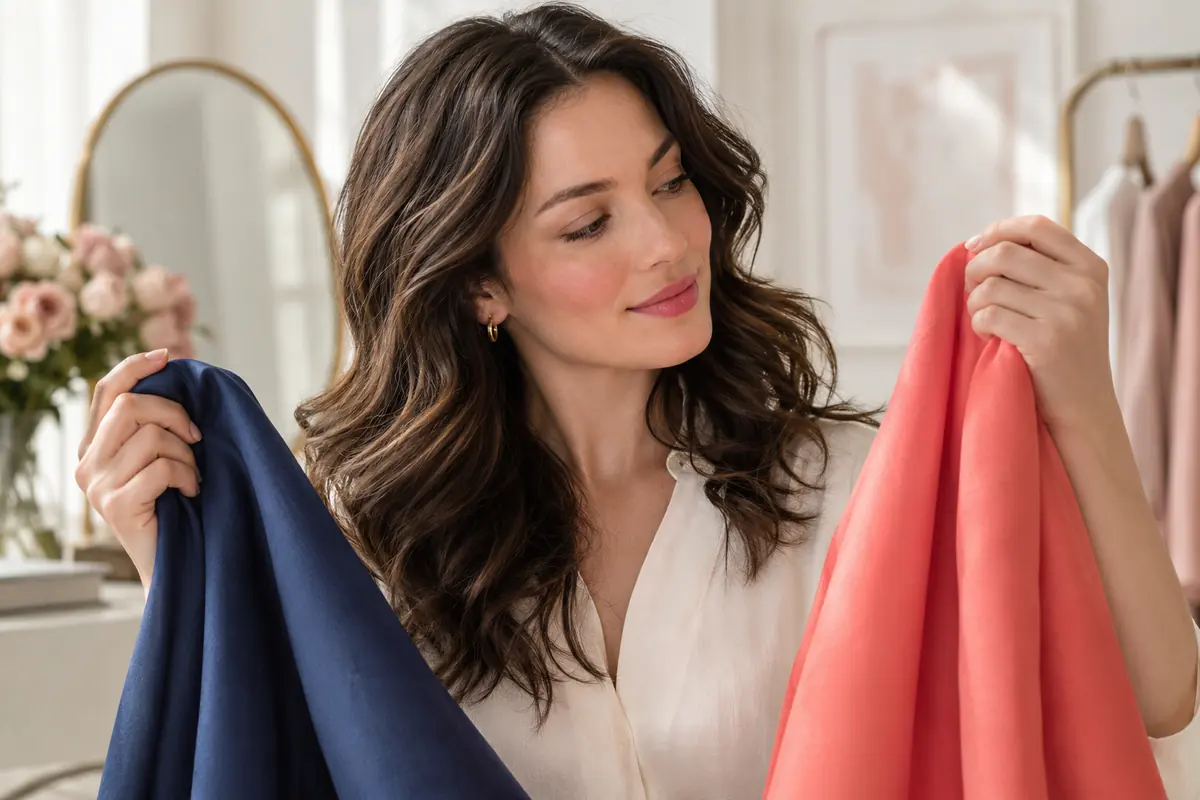
You have felt this even if you've never named it: two tops, same style, same price, and in one you look rested and lit, in the other you look like you didn't sleep. The clothes are identical. The difference is colour, and how it behaves against your colouring.
Colour analysis is the method behind that difference. Strip away the mystique and the season-name marketing, and it's three simple readings of your own colouring that, together, hand you a wardrobe palette you can actually shop from. Get it right and getting dressed gets cheaper and easier, you stop buying the colours that sit in the wardrobe with the tags on.
If you've already found your makeup undertone, you're halfway here, it's the same undertone, now applied to clothes. Start with find your undertone if you haven't, then come back for the other two axes.
If you see a muted olive cast, the olive-skin clothing and lip-colour guide gives you fabric pairs to compare at your face, with room for personal preference instead of a fixed seasonal verdict.
The three axes
Forget the season names for a moment. Every palette comes down to three readings.
| Axis | The question | The effect on your palette |
|---|---|---|
| Undertone | Warm, cool, neutral, or olive? | Warm → golden, earthy, warm colours. Cool → blue-based, jewel colours. |
| Depth | Overall, are your hair/skin/eyes light or deep? | Light colouring → softer, lighter colours. Deep colouring → can carry rich, dark, saturated colours. |
| Contrast | How different are your features from each other? | High contrast (e.g. dark hair, light skin) → bold pairings. Low contrast → soft, blended, tonal palettes. |
Read all three and you have your direction: e.g. warm + deep + medium contrast points to rich, earthy colours (rust, olive, gold, deep teal); cool + light + low contrast points to soft, muted blues, roses, and greys.
How to test on yourself
The reliable test is the same one a colour analyst runs, and you can do it with fabrics from your own wardrobe.
- Daylight, bare face, hair back. Same rule as foundation matching, shop and bulb light both lie.
- Hold colours under your chin, one at a time. Watch your face, not the fabric.
- A flattering colour brightens your skin, evens the tone, lifts the eyes, and makes you look rested.
- An unflattering colour casts shadows under the eyes, brings out redness or sallowness, and ages you.
- Photograph each in the same light to compare side by side, the camera is more objective than the mirror.
Test the obvious decisions first: pure white vs cream (cool vs warm), silver-grey vs camel, true red vs tomato vs berry. Your face will tell you which side you're on.
Turning it into a palette you can shop
Knowing "warm and deep" is useless until it's a shopping rule. Build three tiers:
- Your anchors (5–6 colours): the flattering neutrals you'll buy in trousers, coats, and bags, for warm-deep that might be camel, chocolate, olive, cream; for cool-light, soft navy, grey, dove, off-white.
- Your faces (4–5 colours): the flattering colours you'll wear near your face, knits, tops, scarves, the inside of a collar. These are the ones that do the lifting.
- Your accents (2–3 colours): your best brights, for when you want the outfit to carry colour.
Everything in the palette goes with everything else, which is the quiet superpower, a small, on-palette wardrobe produces more outfits than a large random one. That's the engine behind a capsule wardrobe, and it's why colour comes before shopping, not after.
Colours outside your palette
Your palette is a guide, not a cage. Two ways to wear a colour that isn't ideal near your face:
- Wear it below the waist, as trousers, a skirt, or shoes, where it's far from your face and can't cast shadow on it.
- Break it at the neckline, a flattering scarf, collar, or layer between the colour and your skin.
The colours that truly matter are the ones touching your face in photos and across a table. Everything else is free.
See the colour on you, not on a hanger
A colour on a shop hanger, or on a model with different colouring, tells you almost nothing about how it behaves on you. This is where previewing on your own face earns its keep: render a top in a candidate colour on yourself and watch whether your skin lifts or dulls. Because Mademoiselle holds your real colouring constant, the comparison is honest, you're judging the colour against your skin, hair, and eyes, not against a stranger's.
The same logic carries to hair: the warmth or coolness that suits your clothes usually suits your hair colour too, which is why hair colour and wardrobe colour are one decision. And the makeup version is in what lipstick suits you.
After you have your palette
- How to find your body shape, colour decides which colours; shape decides which lines. Together they're most of getting dressed well.
- What to wear to work, build the office capsule in your anchors.
- Find your undertone, the makeup half of the same colouring.
A note on accuracy and authority
The warm/cool, light/deep relationships behind colour analysis are standard colour theory, codified by the Pantone Color Institute at pantone.com, whose seasonal and harmony work is the reference the whole design industry uses. The season-name systems layered on top are a styling convention, not science, useful as shorthand, but the three axes above are what actually decide your palette, and you can read them yourself in daylight in ten minutes.
Frequently asked
How do I know which colours suit me?
Read three things about your own colouring: undertone (warm, cool, neutral, or olive), depth (how light or deep your hair, skin, and eyes are overall), and contrast (how different your features are from each other). Warm undertones glow in golden, earthy, and warm colours; cool undertones in jewel and blue-based colours; high-contrast colouring carries bold combinations; low-contrast colouring is flattered by softer, blended palettes. Test by holding colours to your face in daylight: the right ones lift your face, the wrong ones cast shadows or sallowness.
What is colour analysis / the 'colour seasons'?
Colour analysis sorts your natural colouring into a palette that flatters you, often labelled by season, spring and autumn are warm, summer and winter are cool, then split further by depth and clarity (e.g. deep autumn, soft summer, bright winter). The season name matters less than the three underlying axes: warm/cool, light/deep, soft/clear. Nail those and you have your palette without needing the label.
Can I wear colours outside my palette?
Yes, your palette is guidance, not a cage. The trick for a colour that isn't ideal near your face is to wear it away from your face (as trousers, a skirt, shoes) or to break it from your skin with a flattering layer or scarf at the neckline. The colours that matter most are the ones touching your face in photos and conversation.
Does colour analysis relate to my makeup undertone?
Directly, it's the same undertone, applied to clothes instead of foundation. If you've already found your makeup undertone, you've done half of colour analysis. Warm-undertone people suit warm clothing colours and warm-leaning makeup; cool suits cool. Doing both at once means your foundation, lipstick, and wardrobe all agree.
How do I test colours on myself accurately?
In daylight, with a bare face and hair pushed back, hold different coloured fabrics up under your chin and watch your face, not the fabric. Flattering colours brighten your skin, even out tone, and make your eyes pop; unflattering ones add shadows under the eyes, emphasise redness, or drain you. Photograph each in the same light to compare, or preview a top in that colour on yourself with a virtual try-on.